

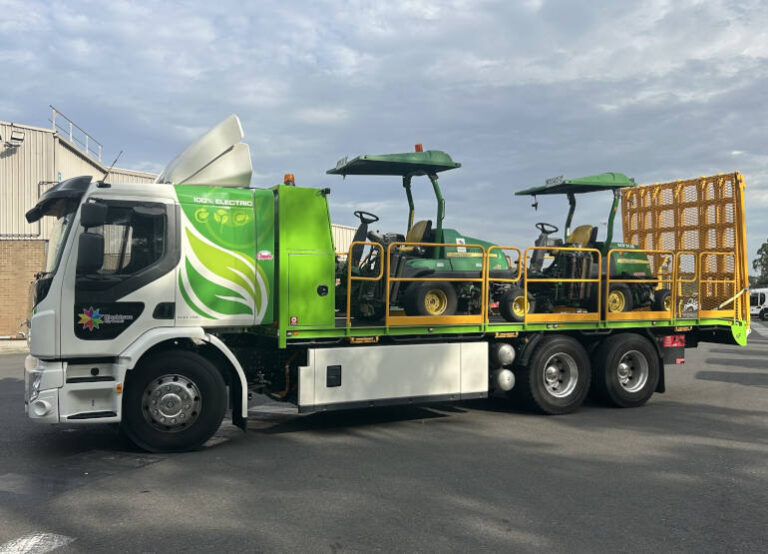
Blacktown City Council has introduced what is believed to be Australia’s first fully electric beavertail truck, delivering a practical example of how electrification can be applied to specialised heavy fleet operations. The vehicle, nicknamed “Cleopatra”, has been developed to improve the transport of heavy mowing and agricultural equipment across the council’s extensive network of parks, sporting fields and community spaces.
Built on a fully electric Volvo FE Electric chassis, the truck features a purpose-designed loading platform engineered specifically for the equipment used by council maintenance teams. The project forms part of Blacktown City Council’s broader pathway towards a Net Zero fleet while also improving operational efficiency and safety for frontline staff.
Designing a truck to solve a real operational problem
Blacktown City Council manages almost 250 square kilometres of urban and open space. Maintaining these areas requires the frequent movement of large mowing equipment and tractors between sites.
Historically this work relied on diesel transport trucks. These vehicles created noise and emissions in parks and residential areas and often required multiple trips to move equipment between locations. The geometry of many mowers and tractors also made them difficult to load using standard ramp designs, increasing the risk of underbody damage and creating safety challenges for operators.
To address these issues, council engineers developed a custom transport solution built around an electric truck platform and a purpose-designed beavertail body. The design was developed using digital engineering tools including 3D spatial modelling, kinematic load-path simulation and finite element analysis to optimise ramp geometry and load distribution.
Engineering innovation inside the fleet team
Rather than purchasing an off-the-shelf truck body, Blacktown City Council led the design process internally to ensure the vehicle matched its operational requirements.
The ramp design specifically addresses shallow approach angles common with large mowing equipment. By redesigning the deck and ramp configuration, engineers were able to eliminate underbody strike risks and create safer loading conditions for operators. Additional features include anti-slip surfaces, improved ramp controls and a solar-assisted auxiliary energy system that powers the hydraulic tail mechanism without relying solely on the vehicle’s traction battery.
The solar system uses photovoltaic panels to charge a separate battery that operates the hydraulic equipment, improving overall energy efficiency during daily operations.
Operational and environmental benefits
Since entering service in late 2024, the electric beavertail truck has delivered measurable operational improvements.
The vehicle allows multiple pieces of equipment to be transported in a single trip, reducing the need for multiple diesel vehicles and improving the productivity of maintenance crews. Fleet data shows the truck has replaced diesel vehicles that previously travelled more than 74,000 kilometres each year.
The change is also delivering financial and environmental benefits. Annual diesel savings are estimated at around $13,000, while the electric drivetrain reduces maintenance requirements compared with conventional diesel engines.
Importantly for council operations in community areas, the truck operates with zero tailpipe emissions and significantly lower noise levels when moving equipment through parks and residential streets.
A blueprint for future heavy fleet electrification
The Cleopatra project highlights how local governments can combine engineering capability with fleet electrification to solve operational challenges.
By leading the design process internally and using digital modelling tools to validate the concept before construction, Blacktown City Council was able to create a specialised vehicle tailored to its operational environment. Early engagement with operators also ensured the final design addressed real-world loading and safety requirements.
For other fleet managers considering the transition to zero-emission heavy vehicles, the project demonstrates that electrification is not limited to passenger vehicles or light commercials. With the right engineering approach, electric platforms can also support specialised operational tasks while improving safety, productivity and environmental outcomes.
Cleopatra now provides a scalable model for future zero-emission heavy fleet projects and shows how innovation within a council fleet team can deliver practical benefits for operations, staff and the community.
The case study was shared at the 2026 IPWEA Fleet Conference in Melbourne.
- Volkswagen ID. Buzz Cargo wins 2026 Fleet EV of the Year
 The Volkswagen ID. Buzz Cargo has been named the 2026 Fleet EV of the Year in the Fleet News Group Awards, finishing ahead of two very different electric fleet propositions after assessment by fleet industry judges using Best Value Analysis. The Volkswagen ID. Buzz Cargo BEV 550 competed against the Toyota HiLux SR BEV 4×4 Double Cab Pickup and Kia EV5 Air
 - Kia PV5 wins 2026 Fleet LCV of the YearThe Kia PV5 Cargo has been named the 2026 Fleet LCV of the Year in the Fleet News Group Awards, giving Kia an important win as electric commercial vehicles move further into mainstream fleet consideration. The Kia PV5 Cargo S 4D LR finished ahead of the Hyundai STARIA Load Hybrid and Isuzu D-MAX SX 2WD Single Cab, giving judges three very different
- Parramatta found a simple way to tackle EV resistanceRange anxiety isn’t always solved with another spreadsheet. Sometimes you need to hand someone the keys. That’s one of the lessons from City of Parramatta’s fleet electrification program, where an EV drive week has become an important tool for building employee support for the transition. Speaking at Everything Electric Sydney during a panel featuring finalists
- Can an electric van really be better to drive all day? Kia thinks soFor Fleet Managers considering electric vans, range, payload and charging usually dominate the discussion. But there is another factor that can have just as much influence on whether a new vehicle succeeds in a fleet: what drivers think of it after spending an entire working day behind the wheel. That was one of Kia’s priorities
- Ausgrid’s charging strategy goes well beyond the depotInstalling chargers at the depot might be the obvious starting point for fleet electrification. For Ausgrid, it wasn’t going to be enough. As the electricity network continues electrifying passenger vehicles, vans and trucks, it has developed a charging strategy designed around how employees actually use fleet vehicles. Speaking during the Fleet News Group Awards finalists