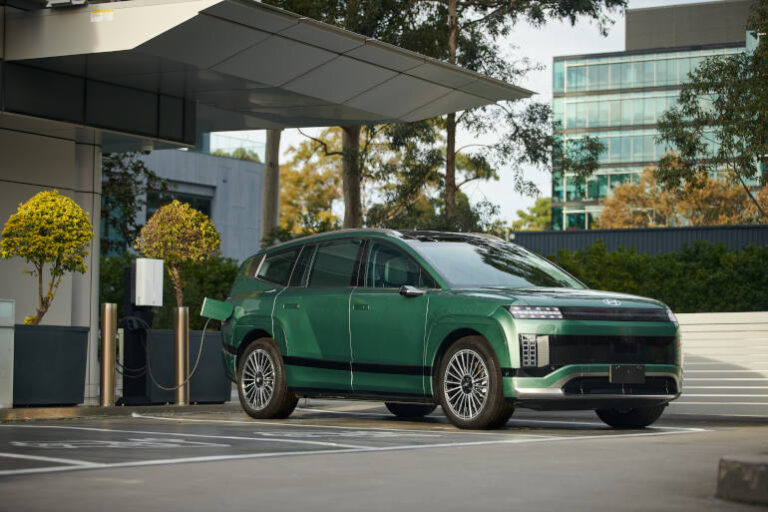
Hyundai Motor Company Australia says it has completed Australia’s first Vehicle-to-Grid (V2G) discharge using the ISO 15118-20 communication protocol.
The demonstration paired a Hyundai IONIQ 9 with a StarCharge Halo 7.4kW bidirectional DC charger, with Hyundai positioning the achievement as an important step towards standards-compliant V2G deployment in Australia.
ISO 15118-20 is the newer international standard designed to support secure, interoperable bidirectional energy transfer between electric vehicles and charging equipment. It is intended to underpin Vehicle-to-Grid, Vehicle-to-Home and broader Vehicle-to-Everything applications.

The StarCharge Halo charger received Clean Energy Council listing in March 2026 and is compliant with AS/NZS 4777.2, according to Hyundai.
Hyundai said the IONIQ 9’s 800-volt Electric-Global Modular Platform architecture supports both high-power DC charging and bidirectional energy flows. The company believes the local test demonstrates that V2G software enablement and certification are progressing for the Australian market.
“This is the result of sustained technical work by Hyundai’s R&D teams in Korea and Australia,” Hyundai Motor Company Australia CEO Don Romano said.
“Getting this right is essential, because V2G will only scale in Australia if consumers, energy providers and governments can trust the technology.”
V2G allows an electric vehicle battery to export electricity back to a home, building, energy network or virtual power plant when connected to suitable bidirectional charging infrastructure.
For fleets, the technology could eventually create another consideration in the business case for electric vehicles, particularly for assets parked for long periods at depots or employee homes. However, practical deployment will depend on vehicle compatibility, approved charging equipment, electricity network requirements, energy tariffs and operational policies that protect vehicle availability.
StarCharge Energy Oceania director of eMobility Austin Luo said the trial showed the importance of manufacturer-backed, standards-compliant systems.
“This is an important milestone for Australia’s V2G market and a strong demonstration of Hyundai’s leadership in bringing ISO 15118-20-enabled vehicle technology to Australia through the IONIQ 9,” Luo said.
Hyundai said the IONIQ 9, IONIQ 5, IONIQ 6 and future IONIQ platforms are under evaluation or development for V2G applications in Australia.
The company is also pointing to its wider V2X activity globally, including a customer-focused V2G pilot in South Korea, commercial V2G services in Europe and Vehicle-to-Home activity in the United States.
Australia adopted national V2G and V2H standards in 2024. Hyundai said it will continue to advocate for manufacturer-approved technology that complies with ISO 15118-20 as V2G trials and commercial programs develop locally.