


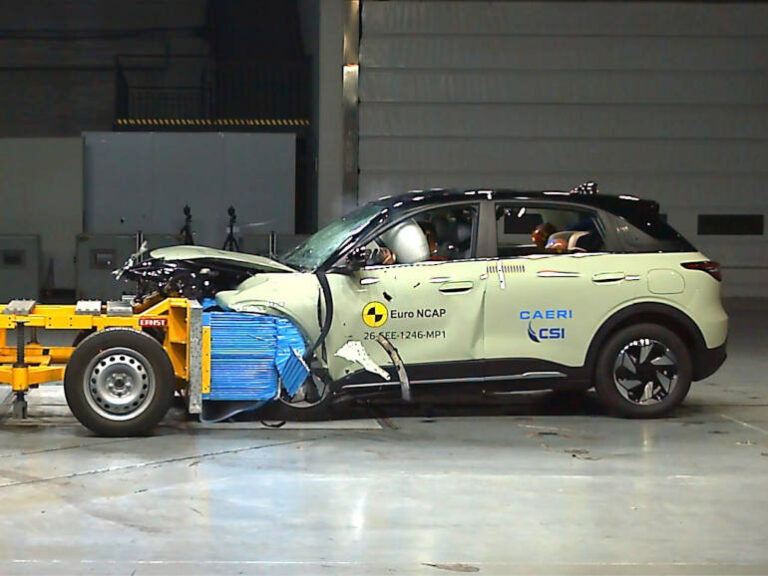
Two new electric vehicles priced below $40,000 have secured five-star ANCAP safety ratings, adding further competition to the rapidly expanding affordable EV market in Australia and New Zealand.
The Leapmotor B05 and Geely EX2 are among the first vehicles assessed under ANCAP’s tougher 2026 Stages of Safetycriteria, which place greater emphasis on crash avoidance, occupant protection, safe driving technologies and post-crash performance.
For fleet operators considering lower-cost EVs, the results provide another indication that moving into more affordable segments does not necessarily require compromising on vehicle safety.
Leapmotor B05 scores strongly for crash protection
The Leapmotor B05 achieved particularly strong results for crash protection, scoring 92 per cent under the new ANCAP assessment.
ANCAP said the vehicle performed well in tests covering occupants of different sizes and statures, with its vehicle structure and restraint systems helping minimise injury across a range of crash speeds.
The rating card published with the announcement shows the B05 scoring:
- Safe Driving: 66%
- Crash Avoidance: 77%
- Crash Protection: 92%
- Post Crash: 89%
Its lane departure collision prevention system scored close to full points, while autonomous emergency braking performed well across a broad range of scenarios.
There is still room for improvement. ANCAP identified some of its new low-speed “start-from-stop” scenarios, including tests designed around pedal misapplication and driveway runover risks, as areas requiring further development.
The B05 is also fitted with eCall hardware. Leapmotor is expected to activate the emergency calling functionality in coming months, with existing vehicles also set to receive access once it becomes operational.
Geely EX2 punches above its size
The smaller Geely EX2 also achieved a five-star result, with its strongest performance coming in Safe Driving and Post Crash.
Its ANCAP rating card shows:
- Safe Driving: 79%
- Crash Avoidance: 72%
- Crash Protection: 86%
- Post Crash: 95%
ANCAP highlighted the EX2’s occupant monitoring system, which can recognise incorrect seatbelt use and adjust restraints according to the stature of front-seat occupants. Its driver monitoring technology also performed strongly in detecting common forms of distraction.
The EX2’s autonomous emergency braking and lane support systems performed well in most assessed scenarios, including helping prevent collisions with oncoming and overtaking vehicles and motorcycles.
However, some newer low-speed tests were more challenging, including turning across the path of another vehicle, reversing towards a pedestrian and pedal misapplication scenarios.
Crash protection was generally good, although ANCAP recorded an elevated risk of driver leg injury in the frontal offset test.
Interestingly, ANCAP also noted the EX2’s strong crash compatibility with other road users, suggesting its compact size and available frontal crush space — helped by the absence of a conventional internal combustion engine — contributed to the result.
Post-crash testing found effective battery voltage isolation and fire-risk management, while the doors, seatbelt buckles and tailgate remained operable after impact.
Like the B05, the EX2 arrives with eCall hardware installed, with Geely expected to activate the feature for existing and new vehicles within 12 months.
Safety becomes another battleground for affordable EVs
ANCAP CEO Carla Hoorweg said the results demonstrate that lower-priced EVs can still deliver strong safety performance.
“These results show that choosing a more affordable electric vehicle doesn’t have to mean compromising on safety,” Hoorweg said.
She said the two vehicles had delivered the fundamentals in crash protection, crash avoidance and standard safety equipment, while their performance under the new assessment criteria set an early benchmark for other manufacturers entering the market.
For fleet buyers, that competition could become increasingly important. As more EVs enter the sub-$40,000 segment, purchase price will be only one part of the procurement decision.
Five-star safety ratings, crash avoidance performance, driver monitoring, post-crash battery management and the availability of emergency functions such as eCall will increasingly provide useful points of differentiation when fleets compare the growing number of electric vehicles entering the Australian market.