


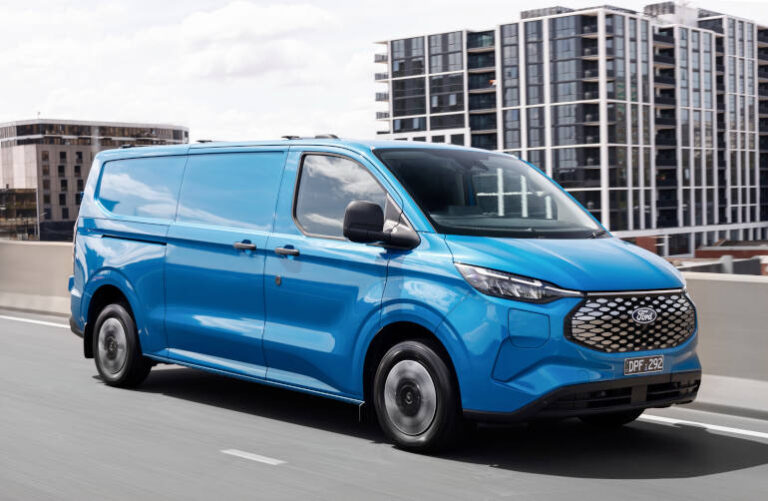
Ford Australia is strengthening the fleet proposition for its electrified Transit Custom range, adding Pro Power Onboard as standard while repositioning the models within its expanding electric commercial vehicle line-up.
Transit Custom PHEV and E-Transit Custom vehicles arriving in the second quarter of 2027 will feature a 2.3kW Pro Power Onboard system as standard, giving trade, service and mobile-work fleets another practical reason to consider electrification.
The change comes as Ford builds a broader electrified van range in Australia, with the Transit City now providing an entry point for urban applications and Transit Custom offering greater capability for fleets that need more from their vehicles.
Onboard power adds another fleet capability
Ford Australia General Manager, Product Marketing Karen Larkin said the changes were designed to make the electrified Transit Custom range more accessible while increasing its usefulness.
“I’m pleased to say that we’ll be realigning our pricing on both products arriving in Q2 next year, and that both will come standard with a 2.3 kilowatt Pro Power on board system fitted as standard,” Larkin said.
For fleet operators, the onboard power system may be more significant than another comfort or convenience feature.
Pro Power Onboard allows equipment and tools to be powered directly from the vehicle, potentially reducing the need for a separate generator or portable power supply on some jobs.
That gives fleets another factor to include when assessing vehicle productivity and whole-of-life costs, particularly for trades, maintenance teams and field service operations.
Competition is changing the electric van market
Ford Australia and New Zealand President and CEO Fadi Mawal acknowledged that competitive pressure across the vehicle market is increasing.
“The market has become much more competitive,” Mawal said.
That competition is giving fleets more choice and making previous assumptions about electric commercial vehicles less reliable.
New models, changing specifications and additional manufacturers entering the market mean a fleet electrification business case can change considerably between initial planning and the actual replacement date.
For Fleet Managers and procurement teams, it reinforces the importance of reviewing available vehicles close to purchase rather than relying on comparisons prepared several years earlier.
A clearer fit-for-purpose Transit range
The introduction of Transit City also changes how fleets can approach Ford’s electrified commercial vehicle range.
Transit City provides an option for urban applications where operators do not require the capability of a larger van, while Transit Custom adds features such as towing capability and onboard power. The larger E-Transit covers another operating class again.
That structure supports a fit-for-purpose approach to fleet electrification.
Instead of selecting one electric van specification for every role, fleets can assess range, payload, towing, charging and operating requirements for individual applications before choosing the most appropriate vehicle.
For some operations, a smaller electric van may be enough. Other roles may justify the additional capability available from Transit Custom or E-Transit.
It is also a reminder that electrification does not necessarily mean replacing every existing commercial vehicle with an equivalent electric model.
The stronger fleet strategy may be to examine what each vehicle actually does and select the least complex vehicle capable of completing that task.
As competition grows and manufacturers expand their electric commercial vehicle ranges, that fit-for-purpose approach should give fleets more opportunities to electrify without compromising operational requirements.