


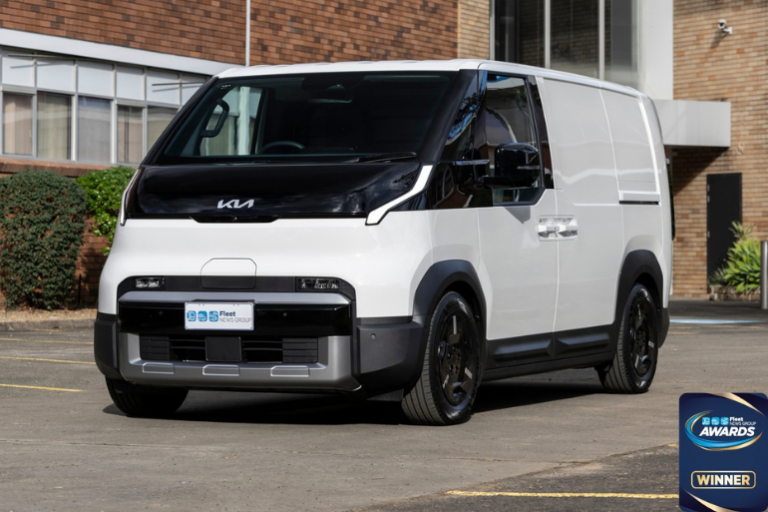
The Kia PV5 Cargo has been named the 2026 Fleet LCV of the Year in the Fleet News Group Awards, giving Kia an important win as electric commercial vehicles move further into mainstream fleet consideration.
The Kia PV5 Cargo S 4D LR finished ahead of the Hyundai STARIA Load Hybrid and Isuzu D-MAX SX 2WD Single Cab, giving judges three very different approaches to the light commercial vehicle task.
The result is significant for fleet electrification because the PV5 was not assessed simply as an electric vehicle.
It was judged against the same fleet fundamentals as its hybrid and diesel competitors, including whole-of-life cost, ergonomics, sustainability and safety, vehicle appeal and manufacturer support.

PV5 tops the Best Value Analysis
Fleet News Group’s Best Value Analysis (BVA) is designed to assess vehicles from the perspective of fleet buyers rather than relying on purchase price or specification alone.
The Kia PV5 achieved an overall BVA score of 7.8142 out of 10, the highest result of the three Fleet LCV of the Year finalists.
Its final scores were:
| Best Value Analysis section | Kia PV5 score | Maximum |
|---|---|---|
| Whole-of-life cost (WOLC) | 3.2000 | 4.0 |
| Ergonomics | 0.9840 | 1.5 |
| Car park/driveway appeal | 1.0902 | 1.5 |
| Sustainability & safety | 1.5400 | 2.0 |
| Manufacturer commitment | 1.0000 | 1.0 |
| Overall BVA score | 7.8142 | 10.0 |
The result shows that the PV5’s fleet proposition extends beyond its zero-tailpipe-emission powertrain.
Whole-of-life cost strengthens the EV case
One of the most important results for fleet buyers was the PV5’s 3.2 out of 4.0 score for whole-of-life cost.
Commercial vehicle purchasing decisions are rarely based on purchase price alone.
Fuel or electricity costs, servicing, maintenance, utilisation, downtime and expected lifecycle all influence whether a vehicle makes financial sense.
For electric commercial vehicles, whole-of-life cost is particularly important because the initial purchase price can be only one part of the equation.
The PV5’s strong BVA result shows why fleet managers need to evaluate electric LCVs across their entire operating life rather than comparing sticker prices.
Strong result for sustainability and safety
The PV5 scored 1.54 out of 2.0 for sustainability and safety, another important contributor to its winning result.
For organisations with emissions reduction targets, replacing commercial vehicles can represent a significant opportunity to reduce fleet emissions.
But sustainability alone is not enough.
A vehicle still needs to meet the operational, safety and financial requirements of the organisation.
The PV5’s result demonstrates that an electric LCV can compete across those broader requirements while also offering the benefits of zero-tailpipe-emission operation.
Manufacturer commitment earns full marks
Kia received the maximum 1.0 out of 1.0 for manufacturer commitment.
That becomes particularly important as fleets introduce new vehicle technology.
Electric commercial vehicles can require organisations to rethink charging, driver education, utilisation planning and sometimes even operational processes.
Manufacturer engagement and aftersales support can therefore play a major role in giving fleet buyers confidence to make the transition.
For organisations adopting their first electric commercial vehicles, the support surrounding the vehicle may be almost as important as the vehicle itself.
Electric, hybrid and diesel face off
The three finalists reflected the changing shape of the light commercial vehicle market.
The Kia PV5 Cargo represented the battery-electric option.
The Hyundai STARIA Load Hybrid offered fleets an electrified solution without the need for external charging.
The Isuzu D-MAX SX 2WD Single Cab represented the familiar diesel workhorse approach.
The STARIA Load Hybrid recorded an overall BVA score of 7.52 out of 10, while the D-MAX finished with 7.33 out of 10.
The relatively close scores demonstrate that fleet buyers now have credible options across multiple powertrains.
It also reinforces that there is unlikely to be one answer for every fleet application.
The task still comes first
Fleet electrification works best when vehicle selection starts with the operational task.
Payload, daily kilometres, route predictability, charging access, downtime, driver requirements and replacement cycles all need to be considered before a powertrain decision is made.
For some applications, diesel may remain the most practical option.
For others, hybrid can reduce fuel use without requiring charging infrastructure.
And where the operating profile suits an EV, vehicles such as the PV5 increasingly give fleet managers another credible option.
That is why the diversity of the 2026 finalists matters.
The decision is no longer simply between conventional vehicles and EVs. Fleet managers can increasingly select the powertrain that best matches the application.
Electric LCVs move into the mainstream
The PV5’s win is another indication of how quickly the electric commercial vehicle market is developing.
Electric vans are increasingly being considered for metropolitan delivery, service and operational fleets where vehicles follow predictable routes and can return to a depot or home base for charging.
That allows organisations to match charging infrastructure with known vehicle utilisation while reducing fuel consumption and tailpipe emissions.
The Fleet LCV of the Year result suggests these vehicles are also becoming competitive when assessed on broader fleet criteria.
With an overall Best Value Analysis score of 7.8142 out of 10, the Kia PV5 Cargo is the 2026 Fleet LCV of the Year.