

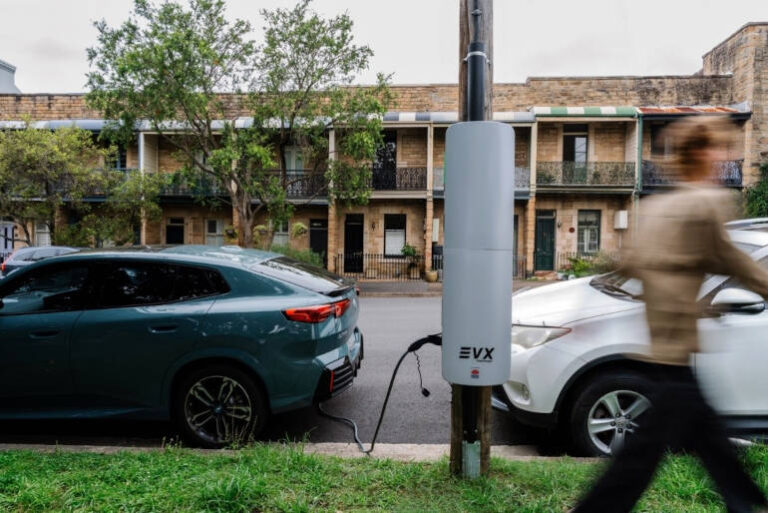
Australian EV charging manufacturer EVX is developing a pole-mounted DC fast charger, aiming to give councils and infrastructure partners more options to expand public charging without adding conventional freestanding equipment to streets.
The new Polecharger Rapid will deliver 40–50kW and is being designed and manufactured locally, with initial deployments targeted for early 2027.
EVX plans to introduce the chargers at selected locations across urban activity centres and regional and rural communities. The product extends its existing kerbside AC charging technology into the DC market.
For fleets, the development could broaden access to public charging where vehicles already park during the working day. Its usefulness will depend on deployment locations, parking access and how charging sessions fit operational schedules.
EVX CEO Andrew Forster said the project demonstrated the potential for Australian manufacturing to support the energy transition.
“Australia should be capable of designing and manufacturing the infrastructure required for its own energy transition.”
“We have already demonstrated that public EV charging infrastructure can be designed and manufactured locally and deployed at meaningful scale. Polecharger Rapid is the next step, taking that capability into DC charging and creating a product specifically for the places and conditions in which Australian councils, networks and communities need it to operate,” Forster said.
Matching charging speed to parking time
Polecharger Rapid is intended to complement EVX’s existing AC kerbside chargers, allowing councils and infrastructure partners to select charging speeds according to local demand and parking behaviour.
AC charging remains suitable for locations where vehicles stay parked for longer periods. However, charging speed is constrained by the vehicle’s onboard AC charger, commonly to 7–11kW, with some vehicles accepting 22kW.
DC charging bypasses the onboard AC charger, enabling compatible vehicles to receive power at higher rates.
At 40–50kW, Polecharger Rapid is intended to support shorter charging stops. The energy delivered and time required will depend on the vehicle’s charging capability, battery temperature, starting charge level and other operating conditions.
For fleet managers, the practical measure will be whether a charging stop adds enough range within the time a vehicle is available.
Using existing street infrastructure
EVX says Polecharger Rapid is being developed from the outset as pole-mounted infrastructure, with a compact format intended to reduce the physical footprint and visual impact of public charging installations.
The design aims to make greater use of existing roadside power poles while addressing Australian electricity network and local government requirements.
This approach could give councils another option when planning charging in public spaces where footpath access, parking arrangements and competing infrastructure needs influence installation decisions.
The company is also emphasising modular design, serviceability and ongoing technical support as part of its Australian manufacturing program.
“Local manufacturing is not simply about where the hardware gets made. It is about retaining the engineering knowledge, intellectual property, supply-chain capability and technical support required to keep critical infrastructure operating over its full life,” Forster said.
“We want Australian customers to have an Australian manufacturer standing behind the product.”
Early 2027 deployments targeted
The announcement follows EVX’s collaboration with Australian smart-pole manufacturer Goldspar on a light-column integrated EV charger, showcased at Everything Electric.
Both products form part of EVX’s strategy to develop locally manufactured charging solutions that integrate with existing streetscape infrastructure.
Polecharger Rapid remains in development, with detailed engineering, certification, manufacturing and deployment planning underway. Further technical specifications, manufacturing partnerships and initial locations are expected ahead of commercial release.
For councils and fleets considering the technology, those details will help determine how the chargers can support vehicle operations and broader community charging needs.