The transition from diesel to electric vehicles is no longer just about technology—it’s about learning a new language: electricity pricing.
For years, Fleet Managers have based total cost of ownership calculations on a simple comparison of fuel prices—cents per litre versus cents per kilowatt-hour. But as Neil Glozier, Executive General Manager at MTA Energy, explained in a recent conversation with Fleet News Group, that approach no longer reflects reality.
“The ongoing charging costs ultimately are what makes the business case drive internally,” said Glozier. “We find often that fleets focus on CapEx and operational challenges—how to get chargers in, how much money they have—but OPEX is one of the biggest drivers for the business case.”
Electricity pricing: predictable, but complex
Electricity isn’t static. Prices move every five minutes in Australia’s wholesale market, and understanding that pattern can unlock significant value.
“There’s a fairly predictable price curve every day,” Glozier said. “Daytime electricity is extremely cheap. The price rises from about 4pm to 8pm when the sun goes down and usage goes up. If you can be smart and manage around that profile, you can save a significant amount of money.”
For operators running electric fleets, this means charging strategies need to evolve. Fleet Managers must understand not just when vehicles are available to charge—but when electricity is cheapest and cleanest.
“It’s one of the most controllable loads we actually have out there,” Glozier added. “If operations can avoid charging during that four-to-eight window, there are significant savings. Even public AC chargers can save 60–70% on the cost of energy when they’re priced correctly into the market.”
Turning energy into a revenue stream
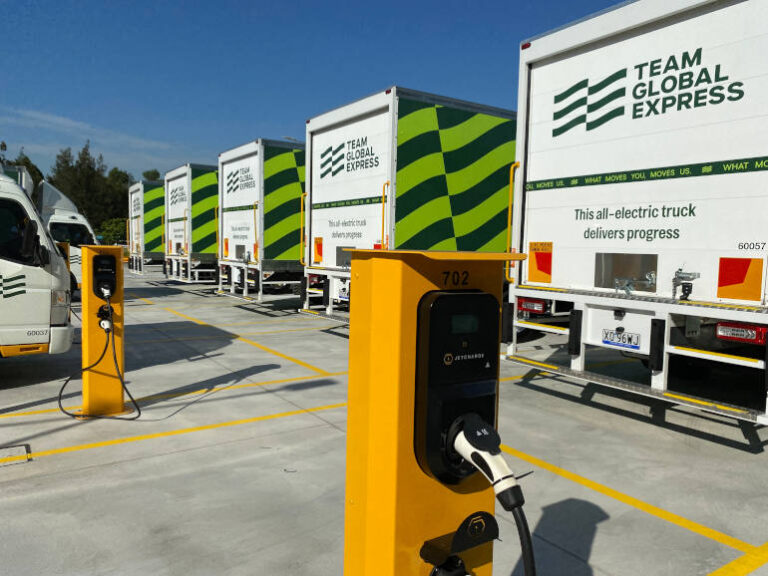
At Team Global Express (TGE), MTA Energy has demonstrated how smart energy management turns electrification into a financial advantage.
Glozier explained that TGE’s energy strategy began as a practical response to power constraints. “Rather than doing a big, expensive upgrade at the site, they put in a battery—it was cheaper than upgrading the connection,” he said. “Then, from an OPEX saving perspective, that was just upside. There’s also a revenue stream out of that.”
In essence, the same battery system that solved a grid limitation also became an asset that earns money by buying cheap and selling power back to the grid at peak times.
“Vehicle-to-grid will be fantastic only if you can access the high pricing and low pricing moments,” Glozier noted. “If you’re paying someone 20 cents a kilowatt-hour all day, every day, it’s not really going to do a lot of good.”
The new skillset for Fleet Managers
This changing landscape creates an opportunity for Fleet Managers to acquire a new skill that goes beyond procurement and utilisation.
As Glozier put it, “There needs to be more of an internal connection between what they’re trying to do and what they’re trying to achieve in energy. These organisations don’t necessarily see energy and fleet as points of collaboration, but they should. It’s just taken as a given—‘we’ll spend this much’—when in reality, there’s a lot more potential value.”
Fleet Managers who understand how to integrate fleet operations with energy management can make their departments cost-neutral—or even revenue-generating.
The key is to think beyond the vehicle itself and consider energy as part of the fleet ecosystem: when to charge, how to store, and how to optimise for both cost and carbon intensity.
Embracing technology and automation
At MTA Energy, technology underpins this transformation. “We facilitate it for clients on a daily basis,” Glozier explained. “We’ve got tech that manages battery automation and charging, all linked together to look at local demand charges and wholesale market prices. It’s rules-based, automated, and constantly optimised.”
For some fleets, such as large depots, the systems operate autonomously; for others, MTA provides high-touch support and regular savings reports. The concept is similar to retail energy management platforms like Amber Electric—but adapted for commercial and industrial clients.
“It’s about embracing the tech,” said Glozier. “If you can charge vehicles when electricity has been negative for the last few weeks, you actually get paid for using it. There’s also a carbon benefit—midday charging has a much lower carbon intensity compared to when coal-fired plants come online.”
A new mindset for the road ahead
For Fleet Managers, this is more than an operational shift—it’s a mindset change. Electrification now touches finance, property, and sustainability teams, creating a need for cross-department collaboration.
Glozier believes that as organisations mature in their EV transition, the line between fleet and energy management will continue to blur. “It’s an education piece,” he said. “We talk about energy transition and renewables driving up prices, but if you can be smart, EVs become one of the most controllable loads out there. That’s where the opportunity is.”
The lesson for Fleet Managers is clear: success in the electric era won’t just come from choosing the right vehicles—it will come from mastering when, where, and how to power them.
Key takeaway
Electricity is no longer a fixed cost—it’s a variable opportunity. By learning to navigate the wholesale energy market and adopting smart charging strategies, Fleet Managers can transform their fleets from cost centres into energy-smart assets that save—and even earn—money.