
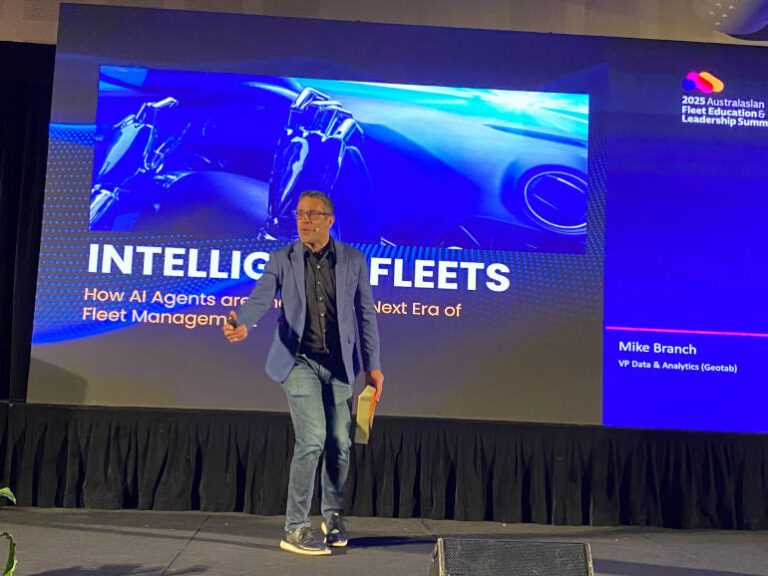
At AfMA 2025, Mike Branch—Vice President of Data & Analytics at Geotab—challenged fleet managers to rethink their role in the age of AI. In a one-on-one interview with Fleet News Group, Branch explored how artificial intelligence is shifting the nature of decision-making in fleet management—not just by generating answers, but by helping ask better questions.
“We found that people didn’t always know what to ask,” said Branch, referring to early use of Geotab’s ACE platform. “Now we’ve built up a library of common questions—mostly around safety—and we’re seeing how the role of the fleet manager is evolving from analyst to strategist.”
That evolution is being accelerated by tools like ACE, which allow managers to ask natural language questions like, “Where are my vehicles coming from before arriving at this depot?” and receive sophisticated geospatial analysis in seconds. “That kind of analysis used to take days. Now it’s immediate,” Branch explained.
From Technician to Translator
The real shift, Branch argued, is about mindset. Fleet managers no longer need to be data scientists or spreadsheet masters—they need to understand how to frame problems clearly and interpret insights effectively.
“If the pivot table is used to come up with an answer to a question, then yes—go to ACE and ask the question instead,” he said. The platform even includes “trusted insights” with a green tick, ensuring that the results are drawn from validated data, not generative guesses.
Branch believes the future belongs to fleet leaders who can move beyond reactive management to proactive planning—using AI not just for reporting, but for optimisation. “You’ll be able to say, ‘Help me optimise my fleet,’ and it will figure out where to start—whether that’s safety, maintenance, or downtime.”
The Human Role Remains Critical
Despite the increasing automation, Branch emphasised that AI won’t replace human judgement. “Anything that connects to a system can be automated,” he said. “But interpreting goals, aligning them with organisational strategy, that still requires people.”
This is especially true in areas like utilisation, where broad goals can quickly become too vague for AI to interpret. “You can’t just say, ‘I want better utilisation.’ You have to be specific—define what active means, how it’s measured, and what outcome you’re chasing.”
According to Branch, this is where many fleets are struggling—not because of lack of technology, but because of unclear strategy. “If you can’t measure every single piece, you’re going to have these agents go bananas,” he warned.
A New Role for Fleet Managers
Rather than being the person who finds the answer, the modern fleet manager becomes the person who knows which question matters most. That’s a fundamental shift—one that requires confidence, curiosity, and a willingness to let go of legacy tools.
“In the next three to five years, we’ll see far more automation,” said Branch. “But we’ll still need people who can guide the systems, trust the insights, and define what success looks like.”
In other words, the most valuable skill in the AI-enabled fleet team may soon be asking the right question at the right time.
- Australia’s First Off-Site Electric Truck Charging Hub Opens in Sydney
 A new shared charging model for electric trucks has launched in Sydney, offering fleets access to high-capacity infrastructure without the need to build their own depot facilities. The collaboration between Foton Mobility Distribution (FMD) and Zenobē has delivered Australia’s first off-site electric truck charging hub in Mascot, designed to support the growing number of light-duty
 - Electric trucks reach cost parity in more freight segmentsA new industry analysis suggests electric trucks are becoming financially viable across a wider range of freight tasks, with falling vehicle prices, more model availability and government incentives reshaping the economics of fleet transitions. The latest Electric Truck Report from fleet sustainability advisory group MOV3MENT indicates that electric trucks are now cost-competitive with diesel in
- EV Finance Hits $7.37B as Policy Uncertainty Threatens Fleet MomentumElectric and hybrid vehicle adoption across Australia’s financed vehicle market accelerated in 2025, but new data suggests policy uncertainty could slow progress just as fleets begin moving from planning to implementation. According to the Australian Finance Industry Association (AFIA), financing for electric and hybrid vehicles reached $7.37 billion in 2025, representing a 20 per cent
- Toyota HiLux Goes Electric: A Defining Moment for Australia’s Most Trusted WorkhorseThe arrival of the battery-electric Toyota HiLux BEV marks one of the most significant milestones in the history of Australia’s best-selling ute. For fleet operators, this is more than just a new model—it represents a practical pathway to reduce emissions while maintaining the productivity and durability that has made the HiLux a staple across construction, utilities, mining
- V2G for Fleets – The Next Big Opportunity, But Are Fleet Managers Ready?Vehicle-to-Grid technology could transform fleet economics. Here’s what you need to know. Electric vehicles are no longer just about replacing the fuel bowser with a charging cable. The next phase of fleet electrification is about turning those vehicles into energy assets, and Vehicle-to-Grid (V2G) technology is the key. With ARENA’s (Australian Renewable Energy Agency) recently