


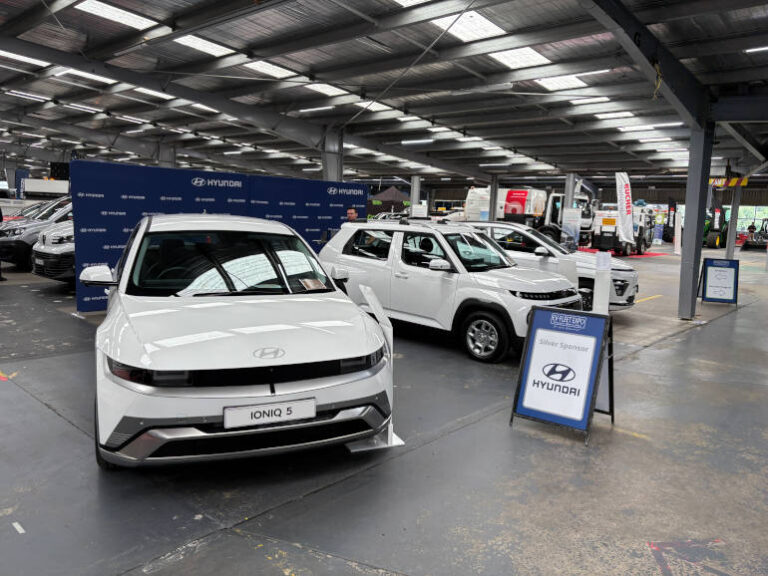
At a vehicle launch in late 2025, Hyundai Australia’s senior leadership offered an unusually candid assessment of where the brand sits in the electric vehicle market — and what fleets should expect next. The discussion revealed a reset in strategy that puts dealers, hybrids and powertrain choice at the centre of Hyundai’s plans heading into 2026.
Speaking openly about recent missteps, Don Romano, Chief Executive Officer of Hyundai Australia, acknowledged the brand’s early approach to EVs had created challenges.
“Last time we were together, I told you we were doing a terrible job of selling EVs. I would say today we’re a little less terrible, but we’ve got a long way to go.”
For fleet buyers, that admission matters. It frames Hyundai’s next phase not as a quiet course correction, but as a deliberate shift in how EVs are sold, supported and positioned in Australia.
Dealers back in the EV conversation
A recurring theme from the launch was the importance of re-engaging Hyundai’s dealer network after a period where EVs were sold directly.
Romano explained the unintended consequences of that approach:
“Imagine dealers, their goal is to sell. They have an inventory. So when a customer walks into a showroom and they’re interested in an EV, what does the dealer kind of database going to try to move them into? What they have to sell, and not into an EV.”
Hyundai’s response has been to bring dealers back into the EV journey, supported by national alignment on marketing, training and volume planning. Rather than pushing EVs as a standalone channel, the brand is repositioning them as part of a broader powertrain mix that dealers can confidently sell and service.
For fleets, that signals greater consistency in availability, aftersales support and technical capability — all critical factors in EV adoption.
Choice over prescription
Another clear message from the conversation was Hyundai’s commitment to powertrain choice rather than forcing a single pathway. While EV expansion continues, hybrids are playing an increasingly important role.
Romano was explicit:
“We are going heavy both in EV… at the same time, we’re growing fastest in HEV. So right now, we’re number two in HEV, next to Toyota, and we plan to continue to grow.”
This balanced approach reflects the reality many fleets face in 2026 — managing emissions targets while operating across diverse duty cycles, regions and infrastructure readiness.
Hyundai’s position is that flexibility, rather than absolutism, will underpin sustainable fleet transitions.
China-sourced EVs, locally tuned
Hyundai also confirmed that future EVs, including new models sourced from China, will play a role in its Australian lineup. However, executives were keen to stress that local engineering input remains non-negotiable.
Tim Rodgers, Product Development Manager at Hyundai Australia, addressed concerns around ride and handling:
“Ride and handling is completed on that car. We had engineers here, and actually the setting that we developed in Australia is now a general market setting on the right-hand-drive markets.”
For fleets wary of offshore-developed vehicles lacking local calibration, this point was made deliberately. Hyundai’s message is that manufacturing location does not remove Australian validation and tuning from the process.
EV growth supported by service capability
Beyond products, Hyundai spent significant time talking about service capability, technician training and responsiveness — areas that can determine whether EV fleets succeed or stall.
Gavin Donaldson, Chief Operating Officer, highlighted early signs of progress:
“We’re up eight per cent year on year. Our NPS scores for service are starting to improve. Our fix-it-right-the-first-time is starting to improve.”
Donaldson was careful to temper expectations, noting that six to twelve months does not define long-term performance, but framed these improvements as the foundation for rebuilding confidence with customers and fleet buyers alike.
What fleets should take from this
For Fleet EV News readers, the late-2025 discussion offered a preview of Hyundai’s 2026 direction:
- EV growth will continue, but not in isolation
- Hybrids remain central to fleet emissions strategies
- Dealers are being repositioned as enablers, not obstacles
- Local engineering and service capability are being reinforced
- Brand strength and customer support are seen as long-term differentiators
Hyundai’s leadership was clear that competition from new entrants — particularly Chinese brands — is intensifying. But rather than racing purely on price or speed to market, the company is betting on process, people and choice.
As Romano put it:
“We’re not running away from the Chinese threat. We’re actually taking it on a different way.”
For fleets planning their EV and hybrid strategies into 2026, that difference may prove just as important as the vehicles themselves.