


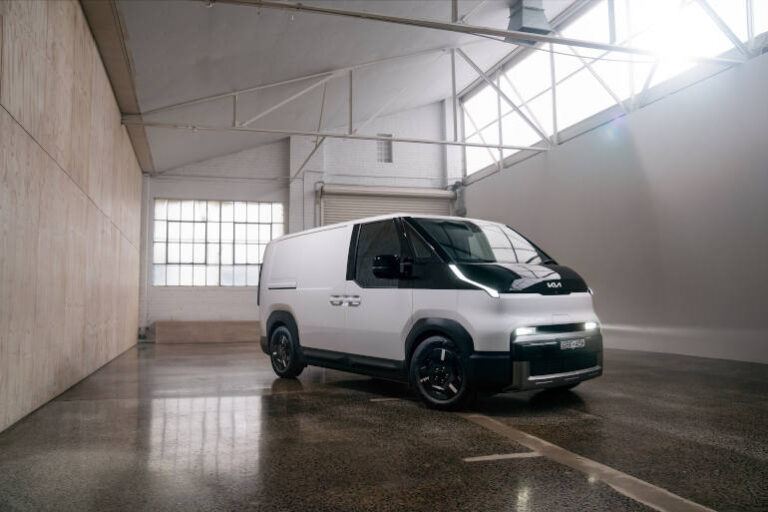
Kia Australia is positioning the recently launched PV5 Cargo as more than a single electric van, with additional versions planned and work underway to address one of the practical concerns raised by Australian fleet operators.
Speaking with Fleet News Group, Roland Rivero, General Manager, Product Planning & Training at Kia Australia at the time of the interview, said the PV5 had already attracted interest from corporate and government fleets looking for practical ways to reduce emissions without giving up commercial capability.

Pricing brings EVs closer to mainstream vans
Rivero said the PV5 Cargo entered the Australian market at $55,990 before on-road costs, putting it closer to established internal combustion vans than many fleet buyers might expect.
The vehicle offers 4.4 cubic metres of cargo volume, dual sliding doors and both exterior and interior vehicle-to-load capability, allowing operators to use energy stored in the battery to power equipment such as tools.
Kia has also modelled whole-of-life costs across three, four and five-year ownership periods.
“The modeling that we’ve done is even more a stronger, more compelling case when diesel prices go up, and we’re talking thousands of dollars in savings over a three, four, or five-year operating cycle or ownership period,” Rivero said.
For fleet operators, that means the purchasing decision is likely to depend on more than the initial price comparison between an EV and an equivalent diesel van.
Corporate and government fleets showing interest
Rivero said early fleet interest had been particularly strong among organisations with emissions reduction targets.
“There’s definitely been some corporate and government interest. It’s been pretty high, heavily driven by, as you can understand, you’ve got organisations that are that are targeting, you know, net zero mandates,” he said.
He added that the PV5 was intended to provide the commercial utility fleet operators expect while giving them another pathway towards those targets.
More PV5 variants are coming
Importantly for fleets, Kia does not intend the Cargo version to be the only PV5 available in Australia.
“We don’t want to just have the just the one variant. We’re creating an eco cycle for fleets out there to to consider,” Rivero said.
A seven-seat People Mover is planned for later in 2026, followed by a High Roof version in the early part of 2027.
The High Roof should broaden the number of commercial applications available to Fleet Managers by increasing cargo volume and moving the PV5 closer to larger established vans.
Kia studying an Australian pallet solution
One practical issue with the current Cargo model is that its load area accommodates a Euro pallet rather than the more commonly used Australian pallet. Kia is aware of the concern and is investigating a potential solution.
“We do recognise that at the moment it does cater to a a Euro pallet, but obviously the more common the more common in our market is is an Aussie pallet size,” Rivero said.
“What we are studying is is a platform, a platform that can actually elevate it past a particular wheel arch molding point that allows the ability to fit an Aussie palette. So watch this space. We hope to have some positive news on that in the near future.”
For fleet buyers, that response is significant. EV adoption in commercial fleets ultimately depends on whether a vehicle can perform the job required of it. Addressing local load requirements while expanding the number of PV5 configurations could make the platform relevant to a much broader range of Australian fleet applications.