


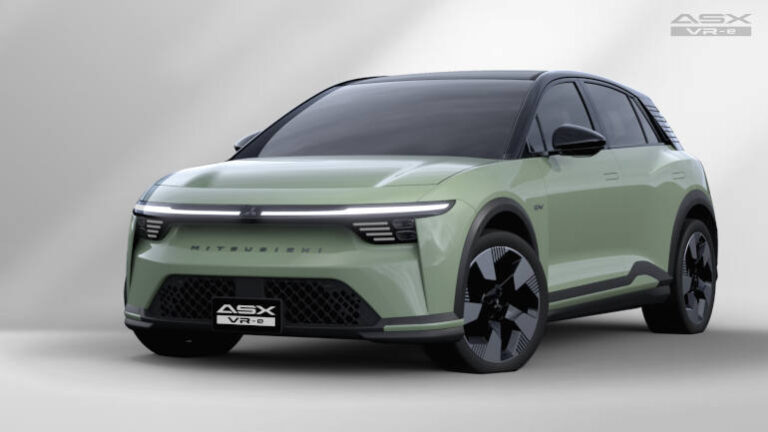
Mitsubishi Motors Australia will return to the battery electric vehicle market in late 2026 with the launch of the all-new ASX VR-e, marking a significant step in the company’s electrification strategy.
Scheduled to join the Australian Mitsubishi range in the fourth quarter of 2026, the ASX VR-e will be the brand’s first battery electric vehicle sold locally since the pioneering i-MiEV.
For Mitsubishi, the new model represents more than another powertrain option. It signals the beginning of a new phase in the company’s Australian electrification plans as it builds a broader multi-powertrain range under its Momentum 2030 strategy.
“ASX VR-e marks a significant milestone in our refreshed Mitsubishi range as the first BEV since the i-MiEV – Australia’s first mass-produced electric vehicle,” said Mitsubishi Motors Australia CEO Shunichi Kihara.
The ASX VR-e has been developed through Mitsubishi’s partnership with Foxtron Vehicle Technologies and will use a Pininfarina-designed vehicle platform, with Mitsubishi applying its own styling elements to the front and rear fascia, wheels and interior.
Importantly for Australian buyers, Mitsubishi says the vehicle has undergone extensive local testing and tuning by its global and regional engineering teams, with a focus on delivering sporty performance and responsive handling.
The new model also brings the familiar ASX name into the electric era. Mitsubishi says the ASX – Active Sports Crossover – badge reflects the compact SUV nameplate’s long history in Australia, while the VR-e designation pays tribute to the Galant VR-4 performance sedan.
Aerodynamics will play an important part in the EV’s design, with features including an S-Duct that directs airflow from the centre of the front bumper across the bonnet, along with active grille shutters that can reduce drag depending on driving conditions.
Four variants are planned for Australia – LS, ASPIRE, EXCEED and GSR – giving Mitsubishi a broad line-up from launch and allowing the electric ASX to slot into a familiar model structure for Australian buyers.
“The new Mitsubishi ASX VR-e continues this path of innovation with an immersive infotainment system, bold design and excellent electric driving performance,” Kihara said.
“It joins an evolving multi-powertrain vehicle lineup designed and tuned with Australian lifestyles in mind as part of our Momentum 2030 plan – which will see the electrification of new models in the years to come.”
For fleet buyers, the ASX VR-e will give Mitsubishi an entry into a rapidly expanding electric compact SUV segment while allowing existing Mitsubishi customers to consider a BEV without moving away from the brand.
Pricing, battery capacity, driving range, charging performance and detailed specifications have not yet been announced, meaning those figures will be important when assessing how competitive the ASX VR-e will be on whole-of-life cost and fleet suitability.
But its arrival represents an important change for Mitsubishi Australia. After years of focusing primarily on plug-in hybrid technology, the ASX VR-e puts a fully electric vehicle back into Mitsubishi showrooms and provides the first indication of what the next phase of the company’s electrification strategy will look like.