

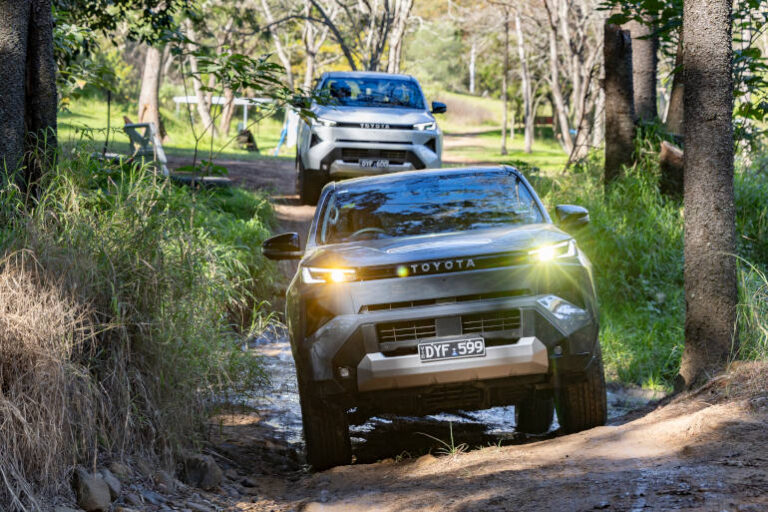
Toyota has secured more than 300 customer orders for the battery-electric HiLux since sales opened in late May, with mining, construction and energy companies among the first fleet buyers.
The early orders include BHP, Newcastle Coal, Acciona and Essential Energy, according to Toyota Australia.
John Pappas, Vice President of National Sales, Marketing & Franchise Operations at Toyota Australia, said the initial demand supported Toyota’s decision to develop the HiLux BEV around defined commercial applications rather than try to replace every diesel ute.
“Following start of sales in late May, we have already secured over 300 customer orders,” Pappas said. “We have secured orders from industry leaders across mining, construction, and the energy sectors.”

Toyota has positioned the HiLux BEV for organisations with accessible back-to-base charging, predictable operating cycles and an objective to reduce vehicle emissions while retaining four-wheel-drive utility.
The 59.2kWh battery-electric ute has a claimed range of 315km for pick-up variants and 245km for cab-chassis models. Toyota says payload is up to 855kg, while braked towing capacity is 2,000kg.
Ray Munday, Senior Manager Product Planning and Pricing at Toyota Motor Corporation Australia, said the vehicle was developed specifically for mining, government and fleet applications.
“For companies and fleets that have easily accessible back-to-base charging facilities and want to reduce their carbon emissions, but still require the flexibility and functionality of a four-wheel-drive pick-up, our double-cab four-wheel-drive HiLux BEV is a strong contender,” Munday said.
Toyota has made compromises to preserve work capability. Rather than installing the largest possible battery, the company says it optimised battery size, location and protection to retain payload, durability and off-road performance.
The battery is mounted within the chassis rails in a waterproof housing, allowing the HiLux BEV to retain 700mm water-wading depth and 218mm ground clearance. It uses a body-on-frame chassis, an automatic four-wheel-drive system and six terrain modes.
“Core to its development was to maintain as much of the turbo-diesel HiLux’s payload, off-road capability and durability,” Munday said.
“While the driving range is relatively low compared to other BEVs, the HiLux BEV was developed for specific applications.”
Toyota says pre-production vehicles completed more than two vehicle-years of testing at Australian mine sites, operating in heat, dust and humidity without major vehicle issues.
Pappas said the early customers operate in conditions where vehicle reliability remains critical.
“These are organisations that depend on their vehicles in some of the most demanding conditions Australia has to offer,” he said.
“Their confidence in HiLux BEV demonstrates that our multi-pathway approach is delivering real solutions for commercial customers who are serious about reducing emissions without compromising on quality, durability, and reliability.”
Toyota is not suggesting the HiLux BEV will replace diesel across every fleet task. The company continues to position turbo-diesel as the better fit for heavy towing, long-distance travel and remote operations where charging access is limited.
Instead, the HiLux BEV gives fleets a new option for roles where vehicles return to base, can be charged overnight and operate within a known duty cycle.
For mining, energy and construction fleets under pressure to reduce emissions, the first orders suggest some buyers are ready to make that change where the application is right.