

The energy transition may be powered by technology, but its long-term success will depend on people — and critically, on who gets a seat at the table. That was the clear message at the Women+ of Zero Emission Vehicles (WoZEV+) breakfast held at All Energy Australia 2025, where industry leaders, innovators, and emerging professionals gathered before the exhibition floor opened for a conversation centred on representation, leadership, and the future of clean transport across Australia and New Zealand.
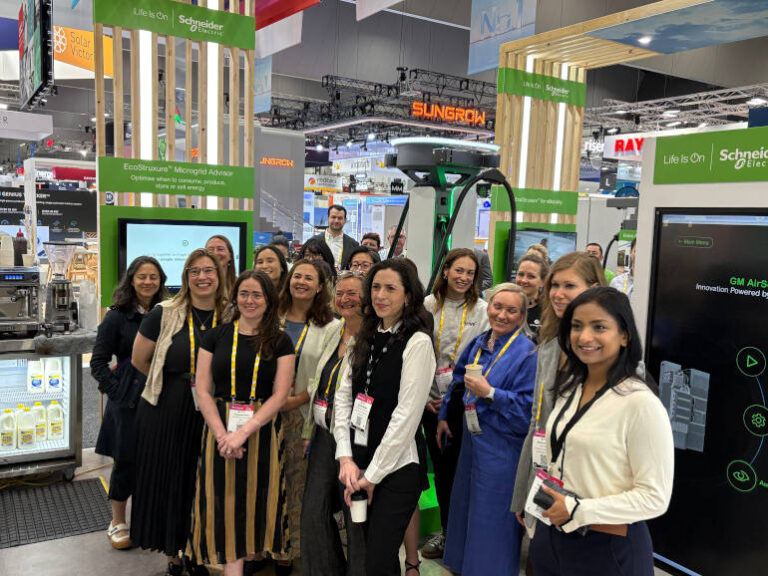
Hosted on the Schneider Electric stand, the breakfast brought together one of the largest cross-sector groups of women and gender-diverse professionals at the event. Attendees represented everything from passenger EVs and charging infrastructure to heavy-vehicle electrification, marine applications, policy, investment, fleets, and academic research. True to the spirit of All Energy, it was a room buzzing with connection, practical insight, and shared purpose.
A Network Built for the Transition — and for Equity
Women+ of Zero Emission Vehicles (WoZEV+) is now the leading network advancing gender equity across the clean-transport ecosystem in Australia and New Zealand. What began as an informal series of coffee catch-ups between industry colleagues has grown into a fully fledged non-profit organisation driving visibility, opportunity, and systemic change.
Co-founder and leadership team member Alina Dini shared the organisation’s journey during the breakfast, explaining how the community emerged from a simple but powerful idea.
“It started really organically,” Dini recalled. “We had a number of women working in the EV sector who just wanted opportunities to connect. Those conversations made it clear that we needed something more formal — something that could help build gender diversity in what has historically been a very non-diverse sector.”
WoZEV+ was originally founded as an Australian chapter of a US-based organisation, but soon evolved into a standalone entity uniquely tailored to the needs of the Australian and New Zealand EV landscape.
“After a couple of years, it became clear that working with an overseas body was challenging,” she said. “So we took the time to establish our own not-for-profit. Women+ of Zero Emission Vehicles now brings together women and gender-diverse professionals across Australia and New Zealand who work in every part of vehicle electrification — from passenger cars and charging to heavy vehicles and even marine.”
Today, WoZEV+’s mission is clear: empower women+, increase visibility, shape policy, and help create an inclusive clean-transport future.
Showcasing Local Expertise: The Speakers Guide
One of WoZEV+’s most visible contributions is the WoZEV+ Speakers Guide, a curated platform designed to help conferences, media outlets, and organisations find expert women+ across the zero-emission mobility sector.
Dini highlighted the importance of this tool during the breakfast.
“The intention is to promote women in the sector by showcasing the talent we have locally,” she said. “Our Speakers Guide is already being used by major conferences, and we’re about to open expressions of interest to include even more participants. It’s there to make gender-balanced events the norm — not the exception.”
For an industry that often struggles to present diverse panels and spokespeople, the Speakers Guide is already shifting practice. It’s an initiative that reflects WoZEV+’s broader mission to amplify voices and build pathways for leadership across the sector.
A Growing Community Across Australia and New Zealand
One of the strengths of WoZEV+ is its trans-Tasman reach. New Zealand, Dini noted, has been there “from day one.”
“Some of our very first events were hosted in Auckland and Wellington,” she said. “New Zealand has really helped shape our early direction, and we now have leaders driving the network there while our committee supports the virtual presence. It truly feels like a shared effort across the region.”
The organisation’s calendar for 2026 will include state-based meet-ups, virtual sessions, and events aligned with major conferences — ensuring that members can stay connected and supported regardless of location or industry segment.
WoZEV+ has also recently been granted charity status, enabling it to begin building more structured workforce-development and mentoring programs.
“We want to create pathways for women+ at every stage of their career,” Dini said. “Mentorship, visibility, professional development — all of it matters as our sector grows.”
Why Schneider Electric Stepped Up to Host
Schneider Electric, a long-time supporter of gender equity and clean-energy leadership, hosted the breakfast on its All Energy stand — a space split equally between EV charging technology and energy-management solutions.
For Akanksha Sharma, General Manager – Marketing & New Energy Landscape Lead at Schneider Electric, the decision was simple.
“Diversity and inclusion are a strong pillar of what we stand for,” Sharma said. “Diversity comes in all shapes and sizes, but gender diversity is one of the most visible. It’s also easier for people to relate to — especially young people who need role models. I’m a strong believer that the more you see, the easier it is to emulate.”
Sharma emphasised the importance of creating environments where women can see themselves represented in leadership, technical roles, and public forums.
“That’s why WoZEV+ is such an important initiative for us and for the industry. It provides visibility. And as the community evolves, we want to see strong coaching frameworks and support networks for members as they join and progress.”
Schneider Electric has been a catalyst for practical change in the clean-transport and energy sectors — and hosting the breakfast was a natural extension of that leadership.
“All Energy is a highlight of the year for us,” Sharma said. “This is our industry. The people here are decision-makers, influencers, innovators. And over the last few years, the conversation has evolved. It’s no longer just about utilities and the grid — so much of the transition is happening behind the meter. That’s why you see home-energy management, EV infrastructure, and depot electrification alongside traditional energy assets on our stand. It’s all connected.”
A Sector Moving Forward — Together
The WoZEV+ breakfast at All Energy wasn’t just another networking event. It was a powerful reminder that the pathway to a zero-emission transport future must include gender equity, visible leadership, and community building.
It also demonstrated the strength of collaboration — between individuals, between organisations, and across national borders.
As Dini summarised, “We’re here to build a community that reflects the future we want — inclusive, innovative, and led by diverse experts who understand the technology and the impact it has on people.”
With WoZEV+ growing rapidly and industry leaders like Schneider Electric championing visibility and representation, the sector is taking meaningful steps toward that future.
And if the energy in the room at the breakfast was anything to go by, the next generation of clean-transport leadership will be more diverse, connected, and empowered than ever.
- EVs are turning employees’ homes into fleet fuel stations
 For decades, fleet fuel management has been relatively straightforward. Give the driver a fuel card, let them visit a service station and receive an invoice detailing the transaction. Electric vehicles are changing that model because the organisation can suddenly be responsible for procuring the energy used to power its fleet — and some of that
 - Foton and Ampol Target Electric Truck ChargingFoton Mobility Distribution (FMD) and Ampol have signed a Memorandum of Understanding to explore charging solutions for electric truck fleets, with a focus on helping operators charge at depots, commercial hubs and public charging sites. The collaboration will investigate charging options across Ampol’s AmpCharge public network and private facilities for FMD’s fleet, logistics and business
- Ausgrid’s charging strategy goes well beyond the depotInstalling chargers at the depot might be the obvious starting point for fleet electrification. For Ausgrid, it wasn’t going to be enough. As the electricity network continues electrifying passenger vehicles, vans and trucks, it has developed a charging strategy designed around how employees actually use fleet vehicles. Speaking during the Fleet News Group Awards finalists
- Home Charging Enters a New Growth PhaseEvnex has passed 20,000 connected charger installations across Australia and New Zealand, with rapid growth reflecting the shift of home EV charging from an early-adopter product to mainstream infrastructure. The Christchurch-based manufacturer shipped its first charger in 2017. While reaching the first 10,000 installations took eight years, the next 10,000 were added in just nine
- Ampol’s $225 million Evie deal puts a new value on public EV chargingAmpol’s proposed $225 million acquisition of Evie Networks could prove to be a significant milestone for Australia’s EV charging sector, putting a substantial transaction value on a public charging network that was built well before electric vehicles became a mainstream consideration for Australian fleets. Ampol Energy has entered into an agreement to acquire 100% of