

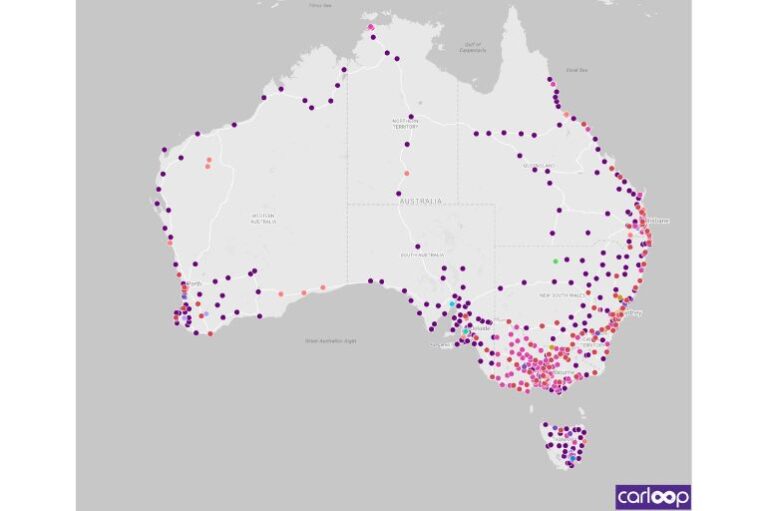
As EV adoption continues to surge in Australia, new data confirms that charging infrastructure is keeping pace — and that’s good news for Fleet Managers.
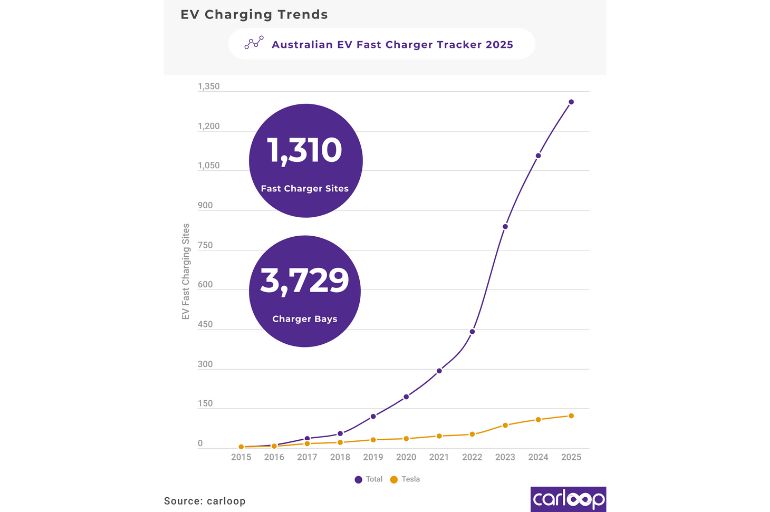
Carloop’s exclusive quarterly report into Australia’s fast-charging network reveals that the number of public fast-charging sites reached 1,310 by the end of June 2025 — a jump of 103 sites or 8.5% in just three months. This milestone reflects not only surging demand but the impact of targeted government incentives across the country.
With the EV fleet population now exceeding 300,000 vehicles, charging infrastructure has become a critical enabler for both corporate and government fleets aiming to meet net zero targets. According to Carloop, “EV uptake has grown by over 80% since the start of 2024,” citing figures from the Federal Chamber of Automotive Industries (FCAI), Electric Vehicle Council (EVC), and its own analysis.
The data-driven insights from Carloop are part of its broader mission to “Empower Australia’s EV Revolution,” providing trusted analytics for decision-makers across the EV ecosystem — from OEMs and charging networks to fleet operators and policymakers.
Key Q2 Highlights from Carloop’s Charging Infrastructure Report
- 1,310 public fast-charging sites are now operational across all states and territories
- Up from 1,207 sites in March 2025 — an 8.5% quarterly increase
- Fastest growth is being driven by government co-funding schemes, like the NSW Electric Vehicle Fast Charging Grants
- The top operators and their site counts as of July 2025:
- Chargefox: 423 sites
- Evie Networks: 325 sites
- Tesla: 126 sites
- NRMA: 110 sites
- JOLT: 98 sites
- Ampol: 72 sites
- BP Pulse: 70 sites
This growth benefits more than just early adopters — it creates new possibilities for fleets.
“For fleets, this means that pool vehicles will have more places to charge if they need a top-up outside of the depot charging stations,” the report notes. This includes grey fleet and sales vehicles that spend considerable time on the road, as well as service vehicles operating in regional areas.
What This Means for Fleet Managers
For Fleet Managers planning their electric vehicle rollout, the expansion of public fast-charging locations reduces a key barrier: range confidence.
Where previously depot charging was essential, the growing number of third-party charging sites allows for more flexible vehicle use and route planning — particularly important for organisations managing mixed-use vehicles across metro and regional operations.
And while not all EVs will need public charging regularly, it’s essential to understand how the landscape is shifting to better support occasional access, emergency top-ups, or route-based charging.
As new OEM models arrive and the number of electric utes, vans, and SUVs increases, Fleet Managers can make more confident deployment decisions knowing the charging infrastructure is maturing.
Backed by Data, Built for Decision Makers
Carloop’s data services are already used by governments, EV charging operators, and automotive brands to model infrastructure rollout, identify EV charging blackspots, and forecast demand. With Carloop’s quarterly charging infrastructure report, fleets can now gain that same strategic insight to support:
- EV transition planning
- Depot vs public charging mix
- Route suitability analysis
- EV driver policy updates
- Engagement with leasing and salary packaging providers
“Empower Australia’s EV Revolution” isn’t just a slogan — it’s a call to action backed by real-time data and trend analysis that Fleet Managers can trust.
Stay Informed — Subscribe for Fleet EV Insights
This article is one of many exclusive insights helping professionals across the EV ecosystem make informed decisions. Don’t fall behind — subscribe to the Fleet EV News newsletter to stay up to date on:
- Charging network developments
- EV sales trends and forecasts
- Infrastructure incentives and grants
- Fleet transition case studies
Australia’s EV future is already accelerating. Make sure your fleet is ready to move with it.

- Why Fleet Depots Should Plan EV Charging Around Energy, Not Charger Power
 One of the first questions fleet managers ask when planning electric vehicle charging is: how much electrical capacity will we need? It sounds straightforward. If a depot installs ten 22kW chargers, it could appear that the site needs more than 200kW of additional capacity. The experience of three Melbourne councils suggests that this can be the
 - Too many apps and accounts: The hidden complexity of fleet EV chargingAdding electric vehicles to a fleet can reduce reliance on petrol and diesel, but it can also introduce a completely different administrative problem for Fleet Managers: paying for public charging. Unlike the established fuel card model, public EV charging can involve multiple charging networks, apps, accounts, credit arrangements and invoices. Matt Arthur, Vice President Mobility
- Apartment EV Charging Gets a Boost Under NSW ReformsProposed changes to strata laws in NSW could make it easier for apartment residents to install electric vehicle chargers, but industry experts are warning that removing approval barriers is only one part of the transition to widespread EV charging. The reforms come as organisations continue to identify capital costs, skills shortages and regulatory complexity as
- NSW Backs EV-Friendly TownsRegional towns across New South Wales are being encouraged to see electric vehicle charging infrastructure as more than a transport issue, with a new program aiming to recognise communities that are making themselves easier and more attractive for EV drivers to visit. The NSW Government and Electric Vehicle Council (EVC) have launched the EV Friendly Towns program,
- Evie Fast Chargers Coming to Coles StoresColes and Evie Networks will install fast electric vehicle charging at up to 30 supermarkets across Australia, allowing drivers to recharge while completing their weekly shop. The two-year rollout will place direct current fast chargers at selected Coles locations, beginning with Middle Camberwell in Victoria. The first site features Kempower charging technology, with up to