

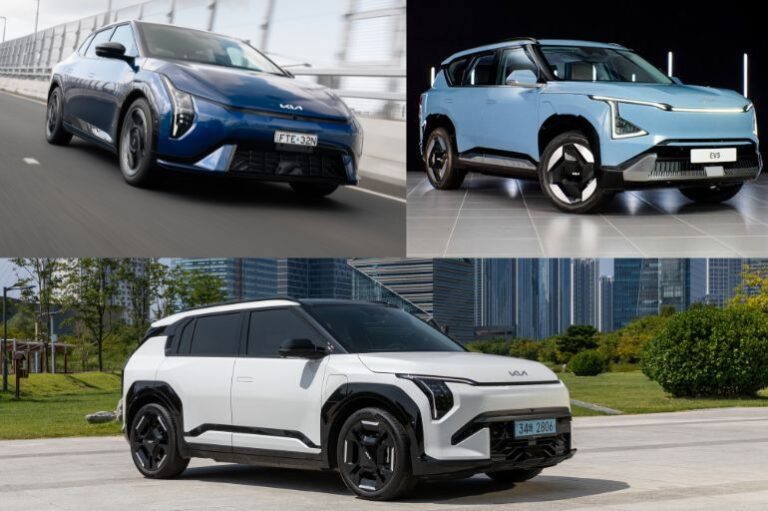
Kia’s expanding electric vehicle line-up now spans three distinct segments with the EV3, EV4 and EV5. While they share Kia’s E-GMP electric platform DNA, each model targets a different buyer profile — from compact urban fleets through to medium SUV users needing more space and flexibility.
For fleet buyers and novated lease customers, the fundamentals remain the same: purchase price, battery capacity and real-world driving range. Here’s how Kia’s three newest EV nameplates stack up using the pricing and specifications at launch as the comparison.
Kia EV3: The price-led entry point
The EV3 is Kia’s most affordable electric vehicle in Australia and is clearly positioned as the high-volume entry point into the brand’s EV range. It sits in the small SUV segment but delivers battery sizes and range figures that rival larger and more expensive EVs.
Two battery options are offered: a 58.3kWh Standard Range and an 81.4kWh Long Range. The standout is the EV3 Air Long Range, which delivers a WLTP driving range of up to 604km, making it one of the longest-range EVs available at this price point.
EV3 pricing and range (RRP):
- 58.3kWh Standard Range: 436km – from $47,600
- 81.4kWh Long Range: up to 604km – from $53,315
- Long Range GT-Line: 563km – up to $63,950
For fleets prioritising whole-of-life cost and maximising kilometres between charges, the EV3 sets a strong baseline.
Kia EV4: Long-range efficiency in a sedan format
The EV4 shifts the conversation from SUV practicality to outright efficiency. Offered exclusively as a sedan in Australia, the EV4 becomes Kia’s longest-range electric vehicle to date.
While the Standard Range EV4 uses the same 58.3kWh battery as the EV3, the Long Range EV4 steps up to the 81.4kWh battery — paired with a more aerodynamic body shape. The result is a class-leading 612km WLTP range, exceeding both the EV3 and EV5.
EV4 pricing and range (RRP):
- 58.3kWh Standard Range Air: 456km – $49,990
- 81.4kWh Long Range Earth: 612km – $59,190
- 81.4kWh Long Range GT-Line: 612km – $64,690
For high-kilometre drivers, sales fleets or novated lease customers wanting maximum driving range without moving into SUV pricing, the EV4 is a compelling proposition.
Kia EV5: Size and versatility over outright range
The EV5 sits one segment above the EV3 and EV4, competing in the medium SUV category. As expected, pricing increases, but so does cabin space, load capacity and AWD availability.
Battery options start at 64.2kWh and extend to a larger 88.1kWh pack in Long Range variants. While range figures are lower than the EV4 due to size and weight, the EV5 still delivers competitive WLTP results for its class.
EV5 pricing and range (RRP):
- 64.2kWh Standard Range Air: 400km – $56,770
- 88.1kWh Long Range Air: 555km – $61,170
- 88.1kWh Long Range Earth AWD: 500km – $64,770
- 88.1kWh Long Range GT-Line AWD: 470km – $71,770
For fleets that need SUV practicality, higher seating position or AWD capability, the EV5 trades some efficiency for versatility.
At-a-glance comparison
| Model | Battery size (kWh) | Max WLTP range | Entry RRP |
|---|---|---|---|
| EV3 | 58.3 / 81.4 | Up to 604km | $47,600 |
| EV4 | 58.3 / 81.4 | Up to 612km | $49,990 |
| EV5 | 64.2 / 88.1 | Up to 555km | $56,770 |
Which one makes the most sense?
- EV3 delivers the lowest entry price and strong long-range credentials, making it well suited to urban fleets and cost-conscious novated lease buyers.
- EV4 offers the best efficiency and longest range in the Kia EV line-up, ideal for high-kilometre drivers.
- EV5 justifies its higher price with SUV space, AWD availability and larger battery capacity, appealing to fleets that need flexibility over outright range.
From a pricing and range perspective, Kia has clearly structured the EV3, EV4 and EV5 to cover distinct use cases — giving fleet buyers more choice without forcing a one-size-fits-all approach to electrification.
- Why Fleet Depots Should Plan EV Charging Around Energy, Not Charger Power
 One of the first questions fleet managers ask when planning electric vehicle charging is: how much electrical capacity will we need? It sounds straightforward. If a depot installs ten 22kW chargers, it could appear that the site needs more than 200kW of additional capacity. The experience of three Melbourne councils suggests that this can be the
 - Too many apps and accounts: The hidden complexity of fleet EV chargingAdding electric vehicles to a fleet can reduce reliance on petrol and diesel, but it can also introduce a completely different administrative problem for Fleet Managers: paying for public charging. Unlike the established fuel card model, public EV charging can involve multiple charging networks, apps, accounts, credit arrangements and invoices. Matt Arthur, Vice President Mobility
- Apartment EV Charging Gets a Boost Under NSW ReformsProposed changes to strata laws in NSW could make it easier for apartment residents to install electric vehicle chargers, but industry experts are warning that removing approval barriers is only one part of the transition to widespread EV charging. The reforms come as organisations continue to identify capital costs, skills shortages and regulatory complexity as
- NSW Backs EV-Friendly TownsRegional towns across New South Wales are being encouraged to see electric vehicle charging infrastructure as more than a transport issue, with a new program aiming to recognise communities that are making themselves easier and more attractive for EV drivers to visit. The NSW Government and Electric Vehicle Council (EVC) have launched the EV Friendly Towns program,
- Evie Fast Chargers Coming to Coles StoresColes and Evie Networks will install fast electric vehicle charging at up to 30 supermarkets across Australia, allowing drivers to recharge while completing their weekly shop. The two-year rollout will place direct current fast chargers at selected Coles locations, beginning with Middle Camberwell in Victoria. The first site features Kempower charging technology, with up to