

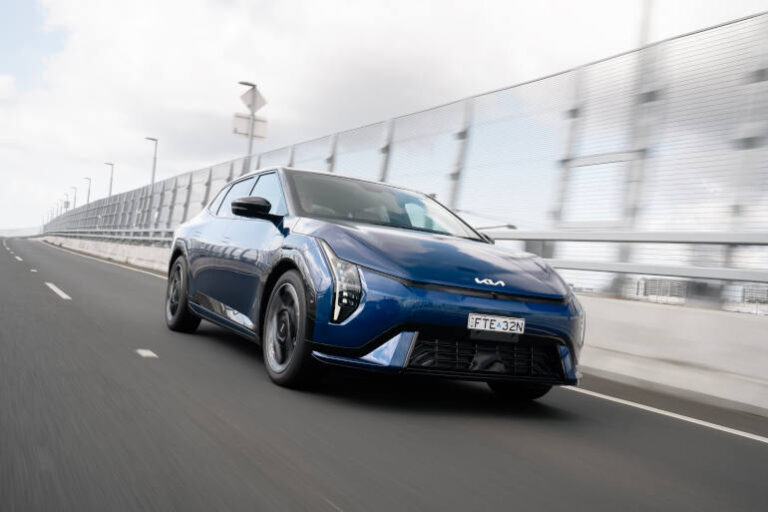
Kia Australia has confirmed local pricing for the all-new Kia EV4 Sedan, marking an important step in the brand’s expanding electric vehicle line-up as the model prepares to arrive in dealerships later this month.
Positioned as a mid-size electric passenger car, the EV4 is built on Kia’s dedicated E-GMP electric platform and will be offered in three trim levels: Air, Earth and GT-Line. The range is designed to give private buyers, novated lease customers and fleets clear choice across price, driving range and specification.
Three variants, two battery options
The EV4 Air opens the range with a Standard Range battery, while the Earth and GT-Line variants are paired with Kia’s larger Long Range battery. In Long Range form, the EV4 delivers a WLTP-rated driving range of up to 612 kilometres, making it the longest-range electric vehicle Kia has offered in Australia to date.
All variants use a single-motor, front-wheel-drive powertrain and have undergone Kia Australia’s local ride and handling program, with suspension and steering tuned specifically for Australian road conditions.
Kia EV4 Sedan pricing (Australia)
| Battery | Variant | Powertrain | WLTP range | RRP* |
|---|---|---|---|---|
| 58.3 kWh | Air (Standard Range) | Single motor FWD | 456 km | $49,990 |
| 81.4 kWh | Earth (Long Range) | Single motor FWD | 612 km | $59,190 |
| 81.4 kWh | GT-Line (Long Range) | Single motor FWD | 612 km | $64,690 |
Strong proposition for fleets and novated leases
With a sub-$50,000 entry point, long-range capability and a dedicated EV platform, the EV4 is expected to attract interest from fleet buyers and novated lease customers looking to transition into electric vehicles without stepping into the SUV segment.
The combination of extended driving range, locally tuned dynamics and multiple trim levels allows organisations to align specification with usage profiles, whether that’s urban commuting, regional travel or salary-packaged personal use.
Kia Australia has confirmed that full specifications and equipment details for each variant will be released shortly, ahead of the EV4’s first customer deliveries.
- EVs are turning employees’ homes into fleet fuel stations
 For decades, fleet fuel management has been relatively straightforward. Give the driver a fuel card, let them visit a service station and receive an invoice detailing the transaction. Electric vehicles are changing that model because the organisation can suddenly be responsible for procuring the energy used to power its fleet — and some of that
 - Ford Brings Range-Extender Bronco to AustraliaFord will add another form of electrification to its Australian line-up when the Bronco Basecamp arrives in the second half of 2027, combining electric drive with a petrol-powered range extender designed to support long-distance travel. Rather than using a conventional hybrid system where both the petrol engine and electric motors can drive the wheels, the
- Why Hyundai sees its dealer network as part of the EV propositionThe specifications of the new Hyundai STARIA Load Electric will attract plenty of attention from Fleet Managers: 450km of WLTP range, a payload of more than a tonne and 800V architecture capable of very fast DC charging. But Hyundai Australia Chief Operating Officer Gavin Donaldson argues that the commercial vehicle proposition extends well beyond what
- AmpolCard plugs into public EV chargingAmpol has added public EV charging to AmpolCard, allowing businesses to manage charging, petrol and diesel purchases through a single card and account. The expansion provides access to all AmpCharge public charging sites across Australia, with unified billing, reporting and account management through the existing AmpolCard platform. For businesses introducing electric vehicles, the change removes
- Back to Buttons: ID.4 Gets a Practical UpgradeVolkswagen has updated its ID.4 electric SUV for MY27, introducing physical steering wheel controls, a new infotainment system and additional driver assistance features across the Pro and GTX variants. For fleet buyers, the changes put everyday usability and safety at the centre of the update, with improvements to navigation, speed assistance and parking technology. Physical