

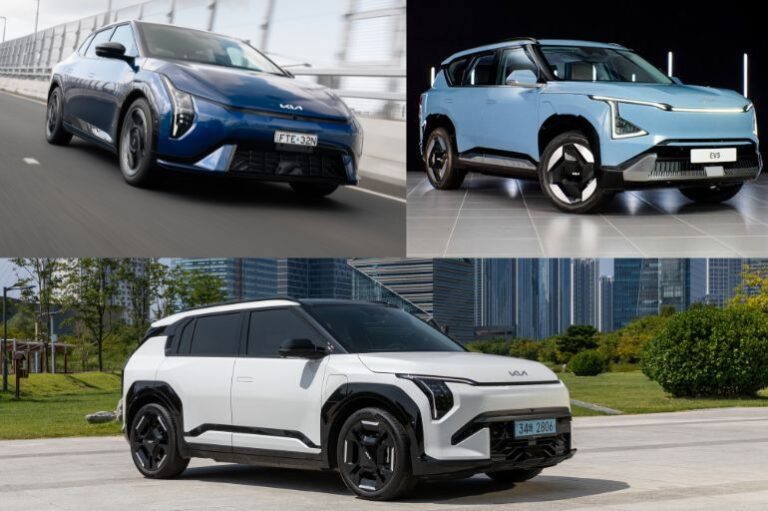
Kia’s expanding electric vehicle line-up now spans three distinct segments with the EV3, EV4 and EV5. While they share Kia’s E-GMP electric platform DNA, each model targets a different buyer profile — from compact urban fleets through to medium SUV users needing more space and flexibility.
For fleet buyers and novated lease customers, the fundamentals remain the same: purchase price, battery capacity and real-world driving range. Here’s how Kia’s three newest EV nameplates stack up using the pricing and specifications at launch as the comparison.
Kia EV3: The price-led entry point
The EV3 is Kia’s most affordable electric vehicle in Australia and is clearly positioned as the high-volume entry point into the brand’s EV range. It sits in the small SUV segment but delivers battery sizes and range figures that rival larger and more expensive EVs.
Two battery options are offered: a 58.3kWh Standard Range and an 81.4kWh Long Range. The standout is the EV3 Air Long Range, which delivers a WLTP driving range of up to 604km, making it one of the longest-range EVs available at this price point.
EV3 pricing and range (RRP):
- 58.3kWh Standard Range: 436km – from $47,600
- 81.4kWh Long Range: up to 604km – from $53,315
- Long Range GT-Line: 563km – up to $63,950
For fleets prioritising whole-of-life cost and maximising kilometres between charges, the EV3 sets a strong baseline.
Kia EV4: Long-range efficiency in a sedan format
The EV4 shifts the conversation from SUV practicality to outright efficiency. Offered exclusively as a sedan in Australia, the EV4 becomes Kia’s longest-range electric vehicle to date.
While the Standard Range EV4 uses the same 58.3kWh battery as the EV3, the Long Range EV4 steps up to the 81.4kWh battery — paired with a more aerodynamic body shape. The result is a class-leading 612km WLTP range, exceeding both the EV3 and EV5.
EV4 pricing and range (RRP):
- 58.3kWh Standard Range Air: 456km – $49,990
- 81.4kWh Long Range Earth: 612km – $59,190
- 81.4kWh Long Range GT-Line: 612km – $64,690
For high-kilometre drivers, sales fleets or novated lease customers wanting maximum driving range without moving into SUV pricing, the EV4 is a compelling proposition.
Kia EV5: Size and versatility over outright range
The EV5 sits one segment above the EV3 and EV4, competing in the medium SUV category. As expected, pricing increases, but so does cabin space, load capacity and AWD availability.
Battery options start at 64.2kWh and extend to a larger 88.1kWh pack in Long Range variants. While range figures are lower than the EV4 due to size and weight, the EV5 still delivers competitive WLTP results for its class.
EV5 pricing and range (RRP):
- 64.2kWh Standard Range Air: 400km – $56,770
- 88.1kWh Long Range Air: 555km – $61,170
- 88.1kWh Long Range Earth AWD: 500km – $64,770
- 88.1kWh Long Range GT-Line AWD: 470km – $71,770
For fleets that need SUV practicality, higher seating position or AWD capability, the EV5 trades some efficiency for versatility.
At-a-glance comparison
| Model | Battery size (kWh) | Max WLTP range | Entry RRP |
|---|---|---|---|
| EV3 | 58.3 / 81.4 | Up to 604km | $47,600 |
| EV4 | 58.3 / 81.4 | Up to 612km | $49,990 |
| EV5 | 64.2 / 88.1 | Up to 555km | $56,770 |
Which one makes the most sense?
- EV3 delivers the lowest entry price and strong long-range credentials, making it well suited to urban fleets and cost-conscious novated lease buyers.
- EV4 offers the best efficiency and longest range in the Kia EV line-up, ideal for high-kilometre drivers.
- EV5 justifies its higher price with SUV space, AWD availability and larger battery capacity, appealing to fleets that need flexibility over outright range.
From a pricing and range perspective, Kia has clearly structured the EV3, EV4 and EV5 to cover distinct use cases — giving fleet buyers more choice without forcing a one-size-fits-all approach to electrification.
- EVs are turning employees’ homes into fleet fuel stations
 For decades, fleet fuel management has been relatively straightforward. Give the driver a fuel card, let them visit a service station and receive an invoice detailing the transaction. Electric vehicles are changing that model because the organisation can suddenly be responsible for procuring the energy used to power its fleet — and some of that
 - Foton and Ampol Target Electric Truck ChargingFoton Mobility Distribution (FMD) and Ampol have signed a Memorandum of Understanding to explore charging solutions for electric truck fleets, with a focus on helping operators charge at depots, commercial hubs and public charging sites. The collaboration will investigate charging options across Ampol’s AmpCharge public network and private facilities for FMD’s fleet, logistics and business
- Ausgrid’s charging strategy goes well beyond the depotInstalling chargers at the depot might be the obvious starting point for fleet electrification. For Ausgrid, it wasn’t going to be enough. As the electricity network continues electrifying passenger vehicles, vans and trucks, it has developed a charging strategy designed around how employees actually use fleet vehicles. Speaking during the Fleet News Group Awards finalists
- Home Charging Enters a New Growth PhaseEvnex has passed 20,000 connected charger installations across Australia and New Zealand, with rapid growth reflecting the shift of home EV charging from an early-adopter product to mainstream infrastructure. The Christchurch-based manufacturer shipped its first charger in 2017. While reaching the first 10,000 installations took eight years, the next 10,000 were added in just nine
- Ampol’s $225 million Evie deal puts a new value on public EV chargingAmpol’s proposed $225 million acquisition of Evie Networks could prove to be a significant milestone for Australia’s EV charging sector, putting a substantial transaction value on a public charging network that was built well before electric vehicles became a mainstream consideration for Australian fleets. Ampol Energy has entered into an agreement to acquire 100% of