

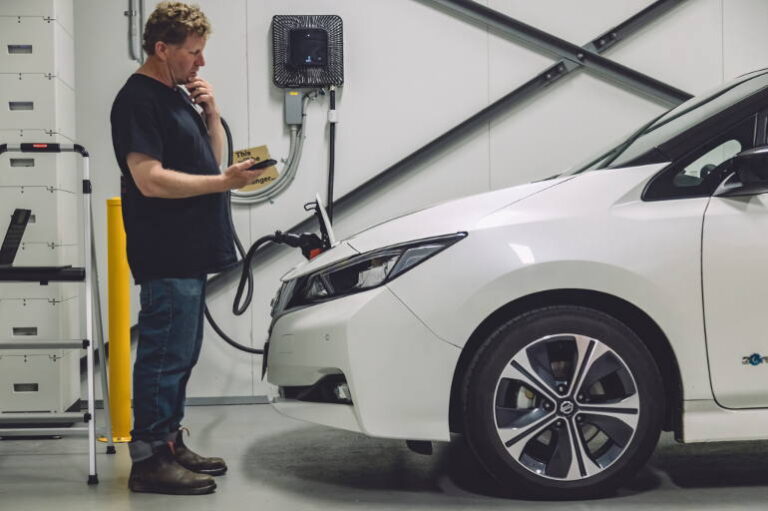
Vehicle-to-Grid technology could transform fleet economics. Here’s what you need to know.
Electric vehicles are no longer just about replacing the fuel bowser with a charging cable. The next phase of fleet electrification is about turning those vehicles into energy assets, and Vehicle-to-Grid (V2G) technology is the key. With ARENA’s (Australian Renewable Energy Agency) recently released National Roadmap projecting that V2G could meet more than a third of the National Electricity Market’s storage needs by the early 2030s, Fleet Managers who don’t have this on their long-term radar risk being left behind.
The question isn’t whether V2G will matter for fleets, it’s whether your fleet will be ready when it does.

What V2G Means for Fleet Operations
At its core, V2G is straightforward: bidirectional charging that allows electric vehicles to export power back to the grid, not just draw from it. Where traditional EV charging is one-way, V2G-enabled vehicles can push stored energy from their batteries into the electricity network when it’s needed most, typically during peak demand periods when wholesale prices spike.
For context, V2G sits alongside its cousins V2H/V2F (vehicle-to-home or vehicle-to-facility, powering your home or facility) and V2L (vehicle-to-load, running appliances directly from your vehicle). V2G is often the headline term used when talking about bidirectional charging and focused on homes but for many organisations, V2G can present significant opportunities done right. V2G is the big prize, grid-scale participation with real revenue potential. For context, the KIA EV3 has 55kWh of usable battery capacity, which is more than double the average daily household usage.
And here’s why fleets are the “killer app” for V2G: fleet EVs often spend a significant portion of their time parked. That’s an enormous battery capacity sitting idle. Combine that with predictable schedules, centralised depot charging, and professional fleet management systems, and you’ve got the perfect conditions for V2G participation. Council vehicles, delivery vans, waste collection trucks, they follow routes, return to base, and can be optimised around grid needs in ways private vehicles simply cannot.
The Opportunity for Australian Fleets
The numbers are compelling. ARENA’s modelling suggests that if just 10% of the projected 1.5 million EVs on Australian roads adopt V2G by 2030, they could meet 37% of the National Electricity Market’s storage requirements.
“By the early 2030s, EV battery capacity is projected to outstrip all other forms of energy storage in the NEM (National Energy Market). V2G represents a game-changer for Australia’s energy future.” – Darren Miller, ARENA CEO
For individual fleets, the value proposition breaks down into four categories. First, revenue generation through participation in grid services, demand response programs, and wholesale energy market arbitrage. UK studies have estimated potential returns of around AU$1,800 per vehicle annually, which could be meaningful money at fleet scale. Second, reducing costs by charging when electricity prices are low and discharging when they’re high, and by reducing peak demand charges that hammer commercial operators. Third, grid resilience contributions that position your organisation as a sustainability leader. Fourth, emergency backup capability, with V2G-enabled vehicles acting as mobile power sources during outages.
Global Proof Points – It’s Already Happening
V2G isn’t theoretical. In the United States, school bus fleets have emerged as the poster child for V2G economics. Highland Electric Transportation and Nuvve have demonstrated that school buses, with their massive batteries, predictable schedules, and idle time during afternoon peak demand, are almost purpose-built for the technology. In one trial, a single school bus generated US$23,500 in V2G revenue over just 158 hours across two summers.
In the UK, waste collection vehicles have been identified as ideal V2G candidates for similar reasons: large batteries, predictable routes and return times, and overnight depot parking when grid flexibility is valuable. Denmark’s Nuvve has been running commercial V2G operations for over four years.
Closer to home, Australia is getting serious. AGL’s landmark V2G trial, launching January 2026 with Hyundai, Kia, BYD, and Zeekr vehicles, represents the first major trial with explicit OEM warranty guarantees, addressing one of the biggest historical barriers to adoption. Origin Energy is also exploring subscription model trials, while Amber Electric is also conducting a trial. Meanwhile, the ARENA-funded REVS project in the ACT has completed its trial with 51 bidirectional chargers demonstrating frequency control ancillary services (FCAS).
The Barriers – Let’s Be Honest
Fleet Managers are paid to be realistic, not optimistic. And V2G has real barriers that need to be acknowledged.
Vehicle availability remains limited. Not all EVs support bidirectional charging, and the CCS standard (ISO 15118-20) is still being deployed. Charger costs are significant, bidirectional units run AU$6,000 to $10,000-plus before installation. Regulatory complexity varies by state, with grid connection approvals and metering requirements adding friction. Revenue models remain immature, with aggregator arrangements, utility programs, and wholesale market access all still finding their feet.
Then there’s the elephant in the room: battery degradation. Fleet Managers have heard horror stories about V2G wearing out expensive battery packs. The evidence, however, is more nuanced. Research from UTS and German field trials indicates V2G adds only around 0.3% additional degradation per year with intelligent management. A comprehensive 2025 study by Sagaria et al. found a 9-14% increase in degradation over 10 years, which is meaningful but potentially offset by V2G revenues. Some research even suggests V2G can improve battery health through optimised charge-discharge cycles.
“Our research shows V2G adds approximately 0.3% additional battery degradation per year with smart management. Some studies actually demonstrate V2G can improve battery health through optimised charge cycles.” – Maria Bengtsson, EY UK&I EV Leader
The warranty question has historically been the killer. Until recently, most OEMs were silent on whether V2G participation would void warranties. AGL’s upcoming trial, with its explicit warranty assurances from participating manufacturers, may finally break this logjam.
A Roadmap for Fleet Managers – Start Now
V2G isn’t ready for mass deployment today. But the window to prepare is open, and first movers will have advantages. Here’s a staged approach:
Stage 1: Assess Your V2G Suitability (Now)
Analyse your fleet’s daily schedules. Which vehicles have extended dwell times at depots? Identify those with predictable, route-based operations, delivery vans, council vehicles, waste collection. Review your depot’s electrical infrastructure capacity and understand your current peak demand profile.
Stage 2: Procure V2G-Ready (2026-2028)
When specifying new EVs, prioritise models with bidirectional charging capability. BYD, Hyundai, Kia, and Nissan models are leading options. Request explicit OEM confirmation on V2G warranty positions. Consider V2G-ready infrastructure even if you’re not immediately deploying bidirectional chargers, future-proofing now is cheaper than retrofitting later.
Stage 3: Engage Your Energy Partners (2027 onwards)
Talk to your electricity retailer about time-of-use optimisation and emerging V2G programs. Engage with your DNSP about grid export requirements. Monitor AGL, Origin, and other utility V2G trials for lessons and commercial offerings that might apply to your fleet.
Stage 4: Pilot and Scale (2027 onwards)
Start with a small pilot of vehicles to build internal capability and understand the operational realities. Partner with aggregators who can manage the complexity of grid participation. Document learnings rigorously.
Stage 5: Optimise and Monetise (2028+)
Scale V2G across your fleet as vehicles and chargers are replaced. Integrate V2G into whole-of-life cost modelling. Position your fleet as a strategic energy asset, not just a cost centre.
Questions Every Fleet Manager Should Ask Today
Before your next procurement cycle, consider: Which vehicles in my fleet have the longest daily dwell times? What is my depot’s current electrical capacity, and what would bidirectional charging require? Which OEMs can guarantee warranty protection for V2G participation? What V2G trials or programs are my energy retailer and DNSP planning? How would V2G participation impact our whole-of-life cost modelling?
“Think of your EVs as batteries on wheels. V2G transforms fleet vehicles from pure cost centres into potential revenue generators and grid stability assets.” – Renae Gasmier, AGL Head of Innovation and Strategy
Final Thought: The Time to Prepare Is Now
V2G isn’t ready for mass deployment today. The chargers are expensive, the standards are still settling, and the revenue models remain works in progress. But that’s exactly why forward-thinking Fleet Managers should pay attention now, not wait until competitors have already positioned themselves.
Fleets are slowly progressing with EVs and V2G represents the next evolution: the transformation of fleet vehicles from cost centres into strategic energy assets that can reduce operating costs, generate revenue, and support grid resilience.
For Fleet Managers willing to start the conversation with their procurement teams, their energy retailers, and their OEM partners, the opportunity is real. V2G won’t happen overnight, but for those who prepare, it could fundamentally change the economics of fleet ownership.
The only question is: will your fleet be ready?
Written by Landon Kahn, CEO and Principal Advisor at SolSombra, a leading sustainability and fleet transition advisory.




