

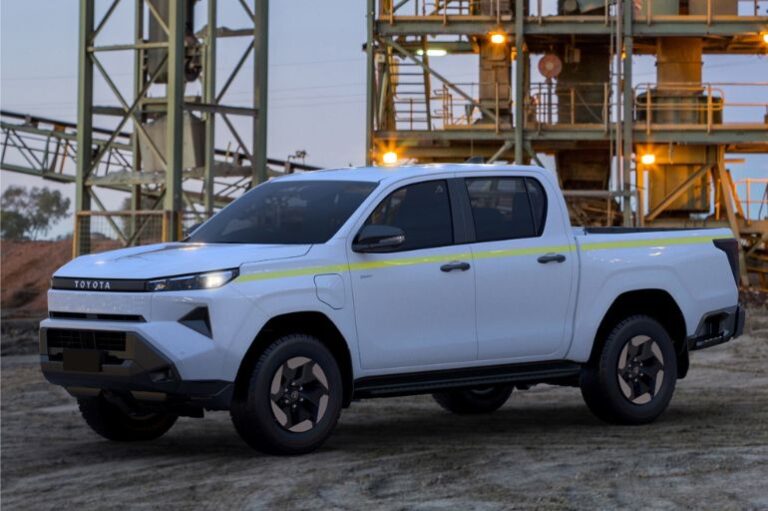
The announcement of a battery-electric version of the Toyota HiLux has generated strong interest across the fleet sector, particularly among organisations that rely on utes as core operational assets.
While attention has focused on capability, range, and charging infrastructure, another question is emerging for Fleet Managers and Leasing Companies: what will the resale value look like in three to five years?
Residual value performance has always been a defining strength of the HiLux nameplate. As the platform transitions to battery-electric power, that reputation will remain an important factor — but technology evolution and market maturity will play an equally critical role.
According to Mike Costello, Corporate Affairs Manager at Cox Automotive Australia, brand strength gives the HiLux BEV a strong starting point in the resale market.
“Toyota has an unimpeachable reputation and well deserved. So if anybody can yield the best residual values on any product it is generally Toyota.”

Strong Foundations: Brand Reputation and Fleet Demand
The HiLux has consistently delivered some of the strongest residual values in the Australian market, supported by reliability, dealer network coverage, and strong demand from both fleet and private buyers.
That legacy is likely to carry over into the electric era, particularly as fleets look for familiar platforms to support decarbonisation targets without compromising operational capability.
Early electric HiLux programs — particularly those developed for mining and industrial applications — provide an indication of the technical direction. These vehicles have been built with battery capacities around 60 kWh and 88 kWh, delivering estimated driving ranges of approximately 260 km to 380 km, along with fast-charging capability to 80 per cent in under an hour. They have also been supported by multi-year battery warranties, reflecting growing confidence in durability and lifecycle performance.
For fleet buyers, these specifications signal that electric utes are moving from demonstration projects to operational assets.
The Real Risk: Technology Obsolescence
Despite strong brand credentials, the biggest variable influencing future resale value may not be reliability or demand — it may be the pace of technological change.
Costello said early passenger EVs experienced volatility in residual values because rapid improvements in battery range made older models less competitive in the secondary market.
“One of the reasons why some of the earlier build passenger EVs struggled with residuals was the obsolescence of their range. Because technology improved rapidly, they probably weren’t quite as in demand as a result.”
This dynamic will be particularly relevant for the HiLux BEV, where capability expectations are high and innovation cycles are accelerating.
For Fleet Managers, this reinforces the importance of aligning replacement timing with technology maturity rather than simply following traditional lifecycle intervals.
Market Maturity Is Working in Favour of EV Residuals
The broader used EV market is now showing signs of stabilisation, which is improving confidence in long-term resale performance.
Growing familiarity with battery technology, falling purchase prices, and increased buyer demand are all contributing to a more predictable secondary market environment.
Costello believes the industry has moved beyond the most uncertain phase of EV residual value performance.
“I think it’s safe to say that we’re through the most volatile period of time.”
For fleets evaluating the HiLux BEV, this shift reduces one of the key financial risks that previously slowed adoption.
What This Means for Fleet Procurement
The future resale value of the HiLux BEV will likely depend on three core factors:
1. Technology competitiveness – Range, charging speed, and durability will determine long-term desirability in the used market.
2. Market demand for electric utes – As more organisations electrify light commercial fleets, demand for proven work vehicles is expected to strengthen.
3. Replacement cycle strategy – Timing disposal to coincide with peak demand and stable technology will be critical to achieving strong residual outcomes.
For Fleet Managers and Leasing Companies, the message is pragmatic rather than speculative. The HiLux BEV is likely to benefit from Toyota’s reputation and the growing maturity of the EV market, but its long-term value will still depend on how quickly the technology evolves.
In practical terms, the transition to electric power does not change the fundamentals of fleet asset management — it simply introduces new variables that need to be monitored alongside utilisation, whole-of-life cost, and operational performance.
- Tesla sharpens Model 3 appeal for fleets and novated buyers
 Tesla has launched a new Model 3 RWD at a sharp entry price, putting the electric sedan into consideration for fleets and value-conscious novated lease buyers. Unveiled to the fleet community at an event in Sydney, the vehicle was introduced at an Australian price of $45,900 (plus inroad costs). Tesla described it as the most
 - Back to Buttons: ID.4 Gets a Practical UpgradeVolkswagen has updated its ID.4 electric SUV for MY27, introducing physical steering wheel controls, a new infotainment system and additional driver assistance features across the Pro and GTX variants. For fleet buyers, the changes put everyday usability and safety at the centre of the update, with improvements to navigation, speed assistance and parking technology. Physical
- Leapmotor B03X Packs More into a Compact EVLeapmotor will expand its Australian electric vehicle range with the arrival of the B03X, an affordable compact SUV offering two battery options, extensive driver assistance technology and flexible cabin storage. For fleet managers assessing electric vehicles for urban operations, the B03X brings another option to the passenger vehicle shortlist. Its compact dimensions, standard connectivity and
- First e VITARA Delivery Launches Suzuki’s Electric EraSuzuki Australia has delivered its first battery electric vehicle to an Australian customer, marking the start of local customer deliveries for the e VITARA and adding another option for fleets considering electric SUVs. The first vehicle, an e VITARA Motion, was collected by existing Vitara owner Nel Mary Davis from Pennant Hills Suzuki in early
- Beyond Range: What BYD ATTO 3 EVO Brings to FleetsThe BYD ATTO 3 EVO offers fleet buyers a choice of two electric SUVs with differences in carrying capacity, towing capability and charging performance that could influence vehicle selection. Available in Dynamic and Premium variants, the five-seat compact SUV offers up to 510 kilometres of claimed WLTP range. However, for organisations assessing vehicles for site