


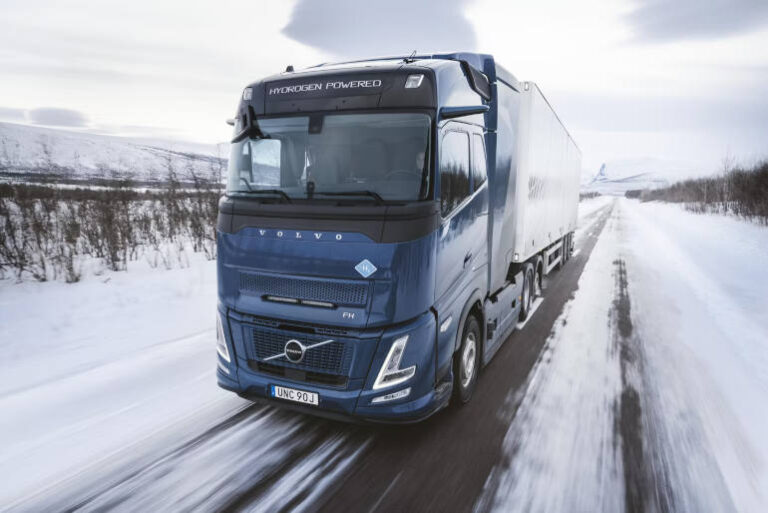
Volvo Trucks has begun on-road testing of heavy trucks powered by hydrogen combustion engines, marking another step in its long-term strategy to deliver net-zero CO2 emissions transport.
The company said the commercial launch of its hydrogen combustion trucks is planned before 2030, with the new models expected to play a role in long-haul applications and in regions where battery-electric charging infrastructure remains limited.
According to Volvo, the new trucks are designed to deliver industry-leading performance through High Pressure Direct Injection (HPDI) technology. The system uses a small amount of ignition fuel injected at high pressure before hydrogen is added, enabling compression ignition and improving efficiency, fuel consumption and power output.
Volvo already has experience with the HPDI system through its gas-powered truck range, with more than 10,000 units sold globally.
“On-road testing is an important milestone for our hydrogen combustion engine trucks. I feel confident that they will be the best in the industry if you look at fuel efficiency, power, torque and drivability. Customers will be able to operate them just like diesel trucks. Our experience with HPDI technology in more than 10,000 gas-powered trucks is strong proof of its performance,” said Jan Hjelmgren, Head of Product Management at Volvo Trucks.

Volvo said its hydrogen combustion engine technology is derived from its diesel powertrain, helping deliver diesel-like performance while substantially reducing CO2 emissions.
The company sees the technology as particularly relevant for longer-distance freight tasks, where payload, range, refuelling time and infrastructure availability remain key operational considerations for fleet operators.
When powered by green hydrogen and using renewable HVO as ignition fuel, Volvo said the trucks have the potential to deliver net-zero CO2 emissions on a well-to-wheel basis. The vehicles are also classified as Zero Emission Vehicles under the agreed EU CO2 emissions standards.
For fleet operators, the announcement reinforces the view that decarbonisation in heavy transport is unlikely to rely on one technology alone. While battery-electric trucks are expected to suit many urban and short-haul applications, hydrogen combustion could offer another pathway for operators running demanding regional or linehaul tasks.
Volvo is positioning hydrogen combustion as part of a broader low and zero-emission product strategy that also includes battery electric trucks, fuel cell electric trucks and vehicles powered by renewable fuels such as biogas and HVO.
“We see great potential for hydrogen combustion engine trucks and they will have a role to play in the transformation to zero tailpipe emission transport. Several technologies will be needed to decarbonize. As a global truck manufacturer we offer a variety of decarbonization solutions and help our customers choose the best alternative based on transport assignment, available infrastructure and green energy prices,” Hjelmgren said.
For organisations developing future fleet decarbonisation plans, Volvo’s trials are another reminder that heavy vehicle transition strategies need to stay flexible. Rather than locking into a single solution too early, Fleet Managers will need to assess vehicle technology against operational requirements, infrastructure readiness and total cost outcomes over time.




