

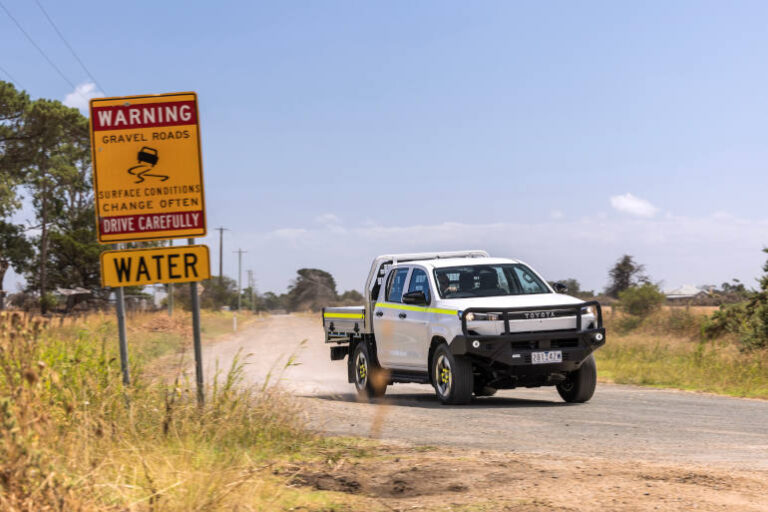
Toyota has not designed the HiLux BEV to win a battery-size contest. Instead, its first battery-electric ute has been developed around a more familiar fleet principle: make the vehicle fit the task, even where that means accepting less range than some competitors.
The HiLux BEV uses a 59.2kWh lithium-ion battery, giving pick-up variants a claimed 315km range and cab-chassis models 245km. Those figures are modest beside some larger electric utes, but Toyota says the battery size was chosen to protect payload, off-road ability, durability and packaging within a traditional body-on-frame vehicle.

Ray Munday, Senior Manager Product Planning and Pricing at Toyota Motor Corporation Australia, said the electric HiLux was developed for specific mining, government and fleet applications rather than as a replacement for every diesel ute.
“For companies and fleets that have easily accessible back-to-base charging facilities and want to reduce their carbon emissions, but still require the flexibility and functionality of a four-wheel-drive pick-up, our double-cab four-wheel-drive HiLux BEV is a strong contender,” Munday said.
The approach is a clear departure from the assumption that more battery capacity automatically creates a better fleet EV.
For a fleet vehicle, a larger battery adds mass, consumes chassis space and can compromise payload, while also increasing cost and charging requirements. Toyota’s argument is that a vehicle returning to a depot or mine site each day may not need the same range as a privately owned ute travelling long highway distances or towing a caravan.
“Core to its development was to maintain as much of the turbo-diesel HiLux’s payload, off-road capability and durability,” Munday said. “That meant optimising the size of the battery from a packaging and a weight perspective to ensure its protection in off-road driving.”
The result is an electric HiLux with payloads ranging from 715kg to 855kg, depending on the variant, and a 2,000kg braked towing capacity. It retains 700mm water-wading depth and 218mm ground clearance, with the battery housed within the chassis rails in a waterproof enclosure.
Toyota has also retained a work-focused rear suspension layout. The HiLux BEV uses leaf springs and a De Dion-style axle, with the rear e-axle mounted to the chassis to reduce unsprung mass. The vehicle has automatic four-wheel drive and a six-mode Multi-Terrain Select system.
That engineering focus reflects the fleet sectors Toyota expects to buy the vehicle first.
John Pappas, Vice President of National Sales, Marketing & Franchise Operations at Toyota Australia, said the company had secured more than 300 HiLux BEV customer orders since sales opened in late May.
“We have secured orders from industry leaders across mining, construction, and the energy sectors,” Pappas said.
“These include BHP, Newcastle Coal, Acciona, and Essential Energy.”
Toyota says pre-production HiLux BEV vehicles completed more than two vehicle-years of Australian site testing, including at mining operations exposed to heat, dust and humidity.
“During more than two vehicle years on site, no major vehicle issues were experienced,” Munday said.
That testing was intended to demonstrate that the HiLux BEV could retain the quality, durability and reliability expected by commercial fleet customers.
The trade-off is that the HiLux BEV will not suit every ute buyer or fleet task. Toyota continues to position its diesel models as the better choice for heavy towing, long-distance regional operation and remote work where charging infrastructure is limited.
Munday said diesel remained important because its energy density, fast refuelling and ability to operate efficiently under sustained load suited many Australian applications.
“Diesel engines maintain efficiency under load, and the fuel can be stored on farms and construction sites,” he said.
“It is therefore ideal for highway towing and remote area usage applications, where payload is critical.”
For fleets with a known operating cycle, accessible charging and emissions-reduction targets, however, the HiLux BEV may offer a more relevant starting point than a larger, heavier electric ute designed to satisfy every possible use case.
Toyota’s message is straightforward: the best fleet EV is not necessarily the one with the biggest battery. It is the one that can complete the required work reliably, carry the required load and return ready for the next shift.