


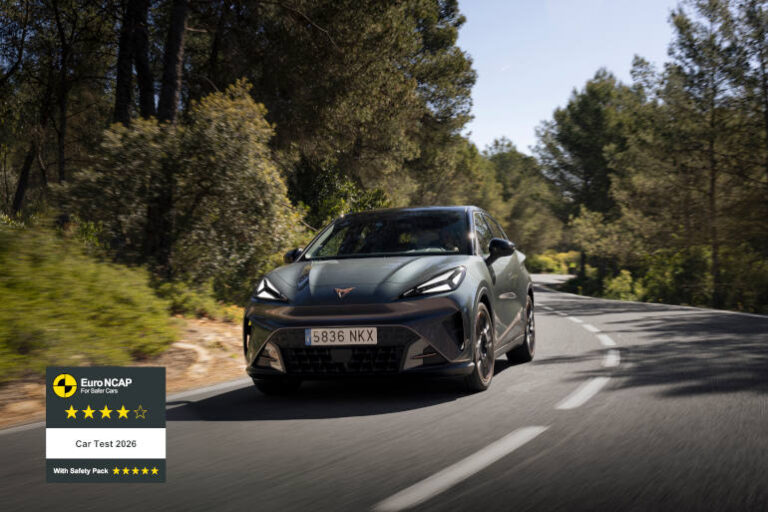
CUPRA’s upcoming Raval electric city car has secured a five-star Euro NCAP safety rating under the organisation’s new 2026 assessment protocol, strengthening its credentials as the brand prepares to expand its electric vehicle range.
The Raval was designed, developed and manufactured at CUPRA’s Martorell facility and joins the Born and Tavascan EVs, along with the Leon, Formentor and Terramar, among CUPRA models to achieve five-star Euro NCAP results.
For fleet operators considering smaller electric vehicles for metropolitan duties, the result is significant because Euro NCAP’s revised 2026 testing program places greater emphasis on the effectiveness of safety technology in real-world situations.
The updated assessment takes a broader approach to vehicle safety across four areas: Safe Driving, Crash Avoidance, Crash Protection and Post-Crash Safety. It places increased emphasis on driver assistance technology, occupant protection and the vehicle’s ability to provide assistance following a collision.
Strong crash protection result
The Raval recorded scores of 72% for Safe Driving, 77% for Crash Avoidance, 91% for Crash Protection and 95% for Post-Crash Safety when equipped with the Safety Pack.
That optional package combines Predictive Adaptive Cruise Control and Front Cross Traffic Alert. CUPRA says the Safety Pack is included as a country setting in most European markets, while Raval Plus, Endurance and VZ versions achieve the five-star rating as standard.
The distinction around specification will be important for Australian fleet buyers, with the equipment fitted to individual variants ultimately determining the safety technology available when the vehicle reaches local markets.
Driver assistance plays a bigger role
CUPRA has equipped the Raval with a range of systems aimed at both preventing collisions and supporting drivers during everyday operation.
These include speed assistance, traffic sign recognition and driver-monitoring functions, while the crash-avoidance technology includes Autonomous Emergency Braking, lane-support systems and surrounding-traffic monitoring.
Passive safety has also been addressed through the vehicle’s body structure, adaptive restraint systems and airbag package, which have been engineered to protect occupants while reducing injury risks to other road users.
Post-crash technology includes automatic emergency calling and systems designed to manage the vehicle following an impact and assist emergency response.
Joost Kessels, R&D Chief Officer at CUPRA, said safety had been incorporated throughout the Raval’s development process.
“Vehicle safety is of utmost importance to us and an essential part of our engineering process, from the earliest stages of development to the final driving experience,” Kessels said.
“The CUPRA Raval Euro NCAP rating, achieved under the stricter 2026 assessment criteria, shows that bold design, electric performance and advanced safety can go hand in hand.”
What it means for fleets
The Raval is positioned as a compact electric vehicle designed primarily for urban use, making the safety result particularly relevant to organisations looking at EVs for metropolitan pool-car, corporate and operational applications.
As fleet electrification moves beyond early-adopter vehicles and into higher-volume passenger categories, safety ratings and the availability of active safety systems are likely to remain important considerations alongside range, charging performance, whole-of-life cost and driver suitability.
The five-star Euro NCAP result gives fleet managers an early indication of the Raval’s safety credentials, although Australian specifications and the availability of individual safety systems will need to be confirmed closer to its local introduction.