

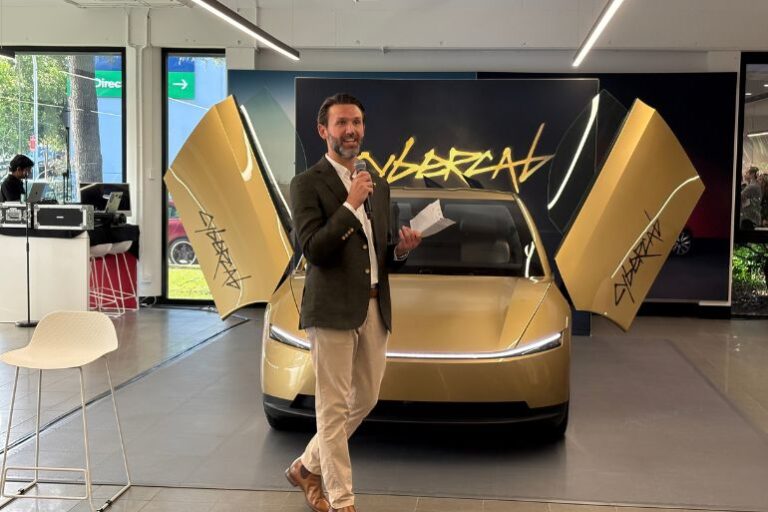
Tesla gave the Sydney fleet community a close look at its Cybercab, showcasing a vehicle designed around a specific transport task: moving people and their luggage without a driver behind the wheel.
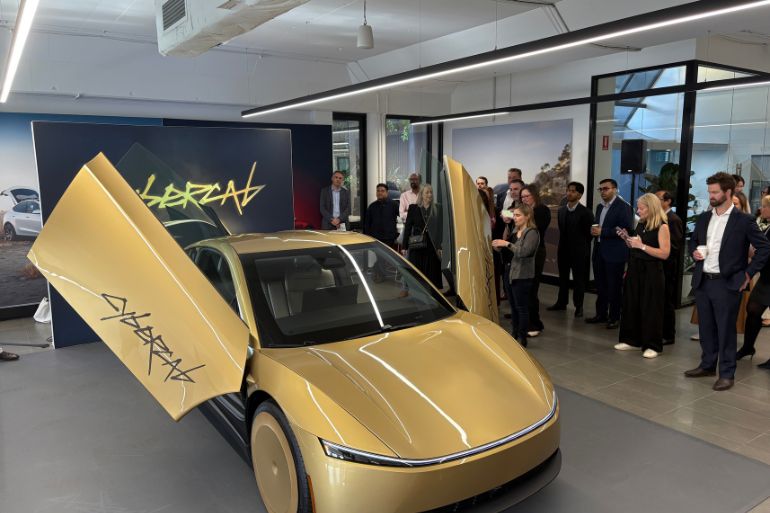
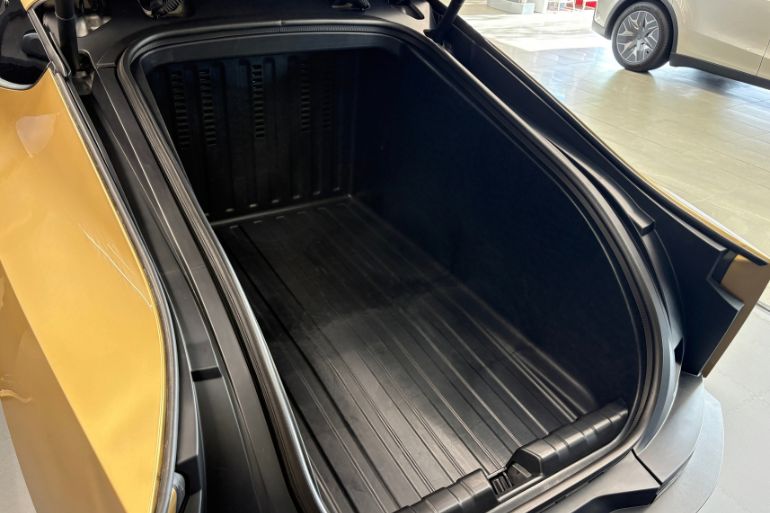
The two-door, two-seat vehicle has no steering wheel or pedals. Its large butterfly doors lift upwards, while a generous boot provides space for luggage.
For fleet buyers accustomed to assessing vehicles across multiple roles, the Cybercab offers a different starting point. Its layout puts the passenger journey at the centre of vehicle selection, with seating capacity, access and cargo space tailored to the intended application.
Thom Drew, Country Director (Motors) for Australia & New Zealand at Tesla, told attendees the two-seat configuration reflected the journeys Tesla was targeting.
“Now, more than 80% of the rides that we see for rideshare customers are one to two passengers maximum,” Drew said. “Hence, the vehicle has been designed as a two-seater only.”
Butterfly doors with a practical purpose
The Cybercab’s doors are among its most distinctive features, but Drew said their purpose went beyond appearance.
“They’re seriously designed to make it simple to get in and out of the vehicle,” he said. “Jump in, swing your legs around, and you’re in the car.”
Seeing the vehicle in person reinforced that practical focus. The large openings make entry and exit straightforward, while the boot gives the compact passenger layout a substantial luggage area.
It looks fit for purpose for the task Tesla has set out to achieve. Rather than accommodating a broad range of seating requirements, it concentrates on the common one- or two-passenger journey.
For fleet managers, that creates an interesting discussion about matching capacity to demand. Passenger numbers, luggage requirements and ease of access become central measures of suitability.
Designed without driving controls
The absence of conventional controls is the clearest expression of Tesla’s autonomous driving ambition.
“So no pedals, no steering wheel,” Drew said.
He explained that previous examples fitted with controls had been used for engineering validation. Drew also said the Cybercab used the same hardware and camera suite as the Model 3 and Model Y.
The Sydney showcase gave fleet attendees an opportunity to inspect what that design means for the passenger experience: a cabin built entirely around its occupants, without the familiar driver’s workspace.
Manufacturing is part of the fleet story
Drew said Tesla’s production approach was also central to the Cybercab project, with the design intended to make manufacturing easier and more affordable.
For fleet operators, the connection between vehicle design and manufacturing matters because acquisition cost is one part of delivering an economical transport service. Utilisation, maintenance, charging, cleaning and vehicle availability would also need to be assessed in any future operating model.
A vehicle designed around a narrow transport task could change how those factors are balanced.
A new vehicle selection conversation
The Sydney showcase put a tangible vehicle in front of the fleet community, giving attendees an opportunity to consider how a purpose-built autonomous vehicle could change passenger transport.
It also highlighted familiar fleet management principles: understand the task, identify the operating requirements and select an asset that matches them.
The Cybercab takes those principles in a new direction. Two seats, luggage space and easy passenger access define the vehicle, while the conventional driver’s workspace disappears entirely.
For Australian fleet managers, the immediate value of the showcase was the conversation it opened about future transport needs. An Australian commercial deployment timetable was not established in the event material provided.