


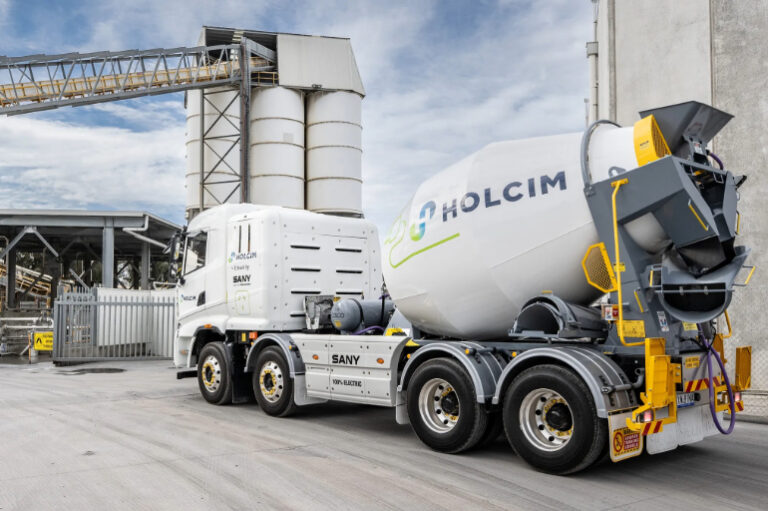
Concrete agitators could become one of the more practical early applications for electric heavy trucks, with short operating distances, significant idle time and high fuel use creating a duty cycle that may suit battery-electric technology.
Speaking with Fleet News Group at Everything Electric in Sydney, Brenton Sweeney, Sales Executive Commercial Vehicles and Equipment at Prancer Australia, said the company was seeing strong interest in electrification from the concrete sector.
Prancer has a long connection with the market through its engineering and service operations and ownership of Cement Mixers Australia, giving the business direct exposure to how agitators are used day to day.

According to Sweeney, the attraction of electric trucks in this sector is not simply about driving range.
“It’s not really the range that they do,” he said. “They’ll go load up, drive 10 kilometres, and sit there for an hour.”
That operating pattern can make electric trucks particularly relevant because conventional diesel agitators can spend long periods idling while waiting at construction sites or concrete plants.
Sweeney said concrete agitators consume significant amounts of fuel while stationary, creating an opportunity to reduce energy use by replacing diesel engines with electric drivetrains.
For Fleet Managers, that highlights the importance of looking beyond annual kilometres when assessing electric truck suitability.
A vehicle may travel relatively short distances but still consume substantial fuel if it spends much of its working day idling, operating auxiliary equipment or moving slowly between sites.
That means the business case for electrification can depend more on the complete duty cycle than on kilometres travelled alone.
Sweeney said interest was not limited to small owner-operators.
He pointed to larger concrete and construction businesses as potential customers, saying major operators were also looking closely at electric technology as they consider ways to reduce operating costs and improve efficiency.
The concrete sector is particularly dependent on construction and infrastructure activity, but its operating patterns can also make it well suited to depot-based charging.
Agitators typically return to known locations and operate within defined geographic areas, giving fleet operators more control over where and when vehicles can recharge.
Prancer is also looking beyond conventional charging.
Sweeney said SANY has developed battery swap technology that could allow a truck to exchange a depleted battery for a charged unit in around five minutes.
For high-utilisation operations, that could help address one of the biggest challenges with heavy vehicle electrification: keeping vehicles productive across multiple shifts.
“If trucks are running, or an Agi or a Prime mover is running dual shifts, two shifts, three shifts, all it needs to do is pull up to a depot, drive in, swap its battery, and away it goes,” Sweeney said.
Sweeney said SANY had designed its own charging and battery swap station, with Prancer expecting to bring that infrastructure to Australia as part of its broader electric truck offering.
For organisations considering electric agitators, the key question will be whether the technology fits the actual operating task.
That will require fleets to understand daily kilometres, idle time, payload, route structure, shift patterns, charging opportunities and the cost of keeping a diesel truck running during periods when it is not travelling.
The concrete sector provides a useful example of why electric truck adoption will not always follow the same path as passenger vehicles.
In heavy fleet operations, the strongest opportunities may emerge where a specific duty cycle aligns with the strengths of electric drivetrains.
For concrete agitators, short distances and long periods of stationary operation could make that alignment particularly compelling.