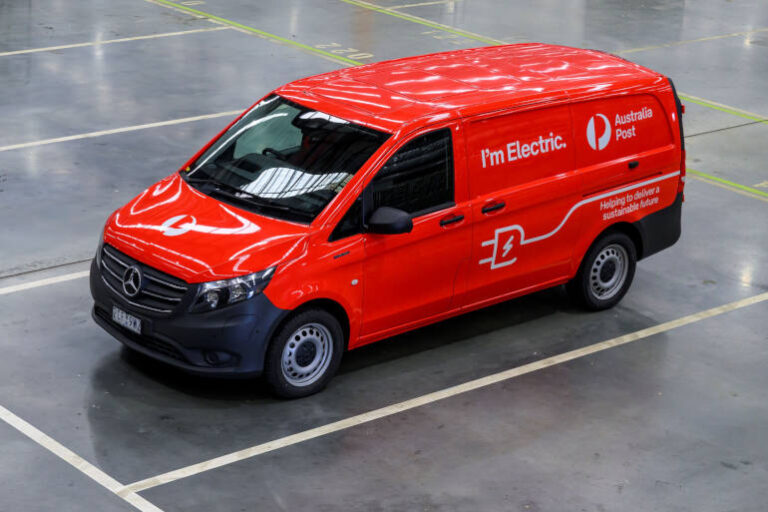
Australia Post is stepping up its commitment to sustainable transport with the launch of a new electric van pilot, marking the organisation’s largest trial of electric delivery vans to date.
From this month, 36 Mercedes-Benz eVito vans will join the Australia Post delivery network, operating across metropolitan areas where their stop-start efficiency is best suited to busy parcel runs. This initiative adds to Australia Post’s existing fleet of more than 5,000 electric vehicles, which already includes e-bikes and smaller delivery vehicles.
Chief Sustainability Officer Richard Pittard said the pilot represents an important milestone in the organisation’s broader decarbonisation efforts.
“The introduction of electric vans is an important milestone in our fleet electrification and decarbonisation strategy. With more Australians shopping online than ever before, we’re delivering more parcels every day and we know we need to find more sustainable ways to do it,” Mr Pittard said.
The vans will run on 100% renewable electricity through Australia Post’s charging network and produce zero tailpipe emissions, making them a natural fit for high-density urban deliveries.
Australia Post will also work closely with Mercedes-Benz to train staff and ensure a smooth transition to operating the new vehicles, highlighting the importance of workforce readiness in the move to low- and zero-emission fleets.
“This is our largest electric van trial to date. It’s a meaningful step forward as we continue building a modern, sustainable delivery network that meets the evolving needs of our customers while reducing our environmental impact,” Mr Pittard said.
The rollout over the coming months forms part of Australia Post’s broader strategy to reach Net Zero emissions by 2050. With parcel volumes continuing to grow on the back of eCommerce, the trial signals a strong focus on scaling up zero-emission vehicles to meet future delivery demands.
For fleet operators, this trial provides another real-world example of how electric light commercial vehicles can be integrated into large-scale logistics operations. It also underlines the importance of pairing vehicle trials with investment in charging infrastructure, training, and operational planning.
- New Navara: Big Grunt, Now with a Plug
 Nissan will bring a plug-in hybrid Navara to Australia in 2027, giving fleet buyers another electrified option for work that demands towing capacity, payload and four-wheel-drive capability. The all-new Navara Pro PHEV will be Nissan’s first plug-in hybrid model in Australia and its first electrified ute globally. Australia and New Zealand will become the first
 - Could concrete agitators be an EV sweet spot?Concrete agitators could become one of the more practical early applications for electric heavy trucks, with short operating distances, significant idle time and high fuel use creating a duty cycle that may suit battery-electric technology. Speaking with Fleet News Group at Everything Electric in Sydney, Brenton Sweeney, Sales Executive Commercial Vehicles and Equipment at Prancer
- BYD ATTO 2 DM-i Plugs into Fleet DemandBYD’s ATTO 2 DM-i offers fleet buyers a compact plug-in hybrid SUV with up to 90 kilometres of claimed electric driving range, creating an option for organisations looking to electrify daily journeys while retaining petrol capability for longer trips. The five-seat, front-wheel-drive SUV comes in Essential and Premium variants, with different battery capacities and electric
- FREELANDER Takes on the Luxury SUV MarketFREELANDER will launch in Australia and New Zealand in 2027, bringing a new premium SUV brand developed by Chery and Jaguar Land Rover (JLR) into the local market. The FREELANDER 8 will lead the Australian launch, combining JLR-led British design with Chery’s electrified vehicle technology. Australian specifications, pricing and the detailed launch schedule will be
- First e VITARA Delivery Launches Suzuki’s Electric EraSuzuki Australia has delivered its first battery electric vehicle to an Australian customer, marking the start of local customer deliveries for the e VITARA and adding another option for fleets considering electric SUVs. The first vehicle, an e VITARA Motion, was collected by existing Vitara owner Nel Mary Davis from Pennant Hills Suzuki in early