
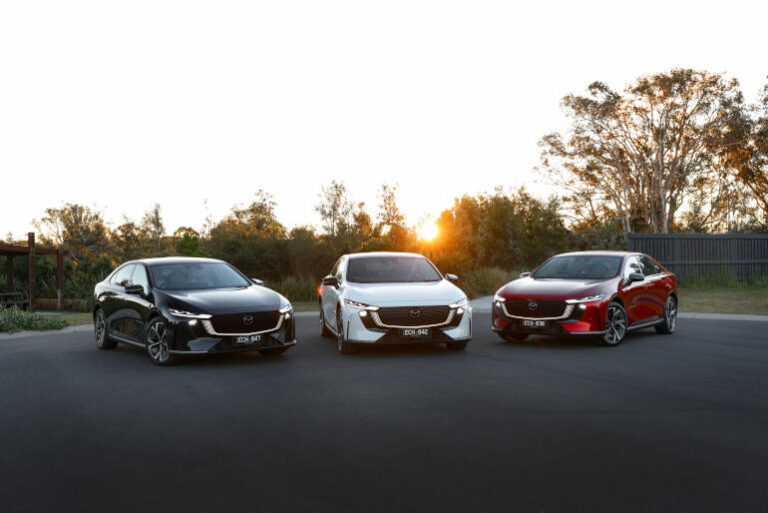
Mazda’s new 6e electric sedan has added a five-star ANCAP safety rating to its credentials as the brand looks to establish a stronger presence in Australia’s growing electric vehicle market.
The all-electric Mazda 6e achieved 93 per cent for Adult Occupant Protection and 93 per cent for Child Occupant Protection in ANCAP testing, giving fleet and private buyers another reason to consider the new battery-electric sedan.
The result applies to both the GT and Atenza grades, with Mazda fitting a comprehensive suite of active and passive safety technology as standard across the range.

Nine airbags are included, along with Autonomous Emergency Braking featuring pedestrian and cyclist detection, lane keeping assistance, emergency lane keeping, blind spot monitoring, rear cross-traffic alert, driver monitoring and traffic sign recognition.
The Mazda 6e received maximum points in ANCAP’s side impact and far-side impact assessments, while its Child Occupant Protection performance included maximum points for restraint installation and dynamic testing in both frontal and side-impact scenarios.
For fleet operators considering the transition to electric vehicles, the result strengthens the 6e’s proposition by combining a battery-electric powertrain with a high level of standard safety equipment.
Driver monitoring is also becoming an increasingly important consideration for fleet buyers as vehicle safety systems evolve beyond traditional crash protection and increasingly focus on preventing incidents before they occur.
Mazda National Manager of Product and Business Strategy Daniel Wakelam said the five-star result was an important endorsement for the company’s first mainstream electric sedan.
“We are extremely pleased that the Mazda 6e is backed by a five-star ANCAP safety rating,” Wakelam said.
He said the result should give customers confidence when considering the transition to an electric vehicle, while retaining the design, driving dynamics and safety attributes expected from Mazda.
The 6e represents an important step for Mazda in Australia as the company expands its electrified vehicle offering and competes in a rapidly growing field of battery-electric sedans and SUVs.
For fleet buyers, ANCAP performance remains an important part of vehicle selection, particularly for organisations with formal safety policies or minimum five-star requirements within their fleet procurement standards.
The combination of a five-star rating, strong occupant protection scores and a broad suite of standard driver assistance technology gives the Mazda 6e a solid foundation when being assessed for corporate, government and novated lease applications.
- Is your repair network ready for an electric fleet?
 Fleet managers preparing to add electric vehicles often spend considerable time assessing range, charging and whole-of-life costs. But there is another question worth asking before signing the purchase order: who is going to repair the vehicle after an accident? Dmitri Feigin from DingGo says Australia’s collision repair sector is adapting to electrification, but the transition
- 2026 Fleet Excellence Award WinnersThe inaugural Fleet News Group Awards have recognised organisations setting a high standard for fleet management across Australia and New Zealand. The Fleet Excellence winners demonstrate the value of strong leadership, safer operations, practical sustainability initiatives, effective technology and trusted supplier partnerships. Their achievements offer inspiration for fleet teams managing the transition to electric vehicles
- DingGo data reveals the EV repair cost fleets need to budget forElectric vehicles may deliver savings in energy and scheduled maintenance, but accident repair costs need to be considered when fleets calculate whole-of-life costs. Dmitri Feigin from DingGo told an Everything Electric Sydney panel that its data was currently showing higher repair costs for EVs compared with internal combustion engine vehicles. DingGo was participating alongside FleetGuru,
- Start small, learn fast, then scale your EV fleetFor organisations planning to introduce electric vehicles, Charlie McIntyre from Origin Energy has a simple recommendation: start with a trial. Rather than attempting a large-scale transition immediately, McIntyre believes fleet operators should use data to identify suitable vehicles, introduce EVs into real-world operations and build organisational confidence before scaling. Speaking at Everything Electric Sydney during
- EV maintenance costs are falling — but don’t forget the inspectionsLower maintenance costs have long been part of the business case for electric vehicles, but fleets shouldn’t interpret fewer moving parts as meaning less attention needs to be paid to maintenance. That’s the warning from Eden Shirley, CEO and Co-founder of FleetGuru, who told fleet managers at Everything Electric Sydney that EVs introduce a different