


JAC Motors has put Australian engineering at the centre of the launch of its new Hunter PHEV, confirming that every production vehicle sold locally will receive the complete suspension and vehicle dynamics tune developed during an extensive Australian testing program.
The company says it has invested several million dollars beyond its standard product development costs to prepare the Hunter for Australian roads, with the locally developed setup also destined for New Zealand and other Asia-Pacific markets.
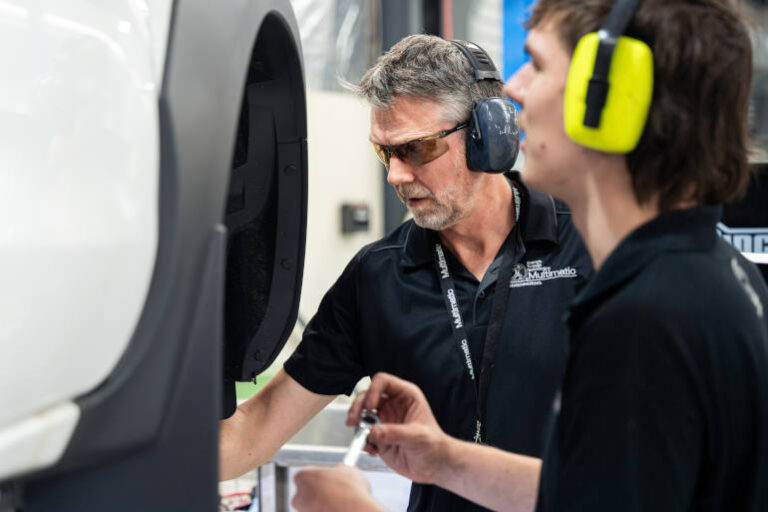
The vehicle dynamics program was led by Australian engineer Michael Barber of Multimatic, whose career includes senior engineering roles with Holden Special Vehicles and the global automotive engineering company.
Barber initially evaluated and tested the plug-in hybrid ute in Australia before travelling to JAC’s engineering facilities in China, where he worked alongside the manufacturer’s engineers to incorporate his recommendations into the production vehicle.
Importantly, JAC says the changes are not limited to selected items or being held over for a future model update. Every recommendation made during the program has been incorporated into the vehicles arriving for Australian customers.
Local development becomes part of the product
For fleet buyers, the significance of the program is less about creating a uniquely Australian variant and more about ensuring a new electrified ute has been tested and calibrated for the environments in which it will actually operate.
JAC says its investment covered local testing, engineering, validation and vehicle dynamics development, with the aim of preparing the Hunter for Australian roads, driving conditions and customer expectations.
“JAC’s multi-million dollar engineering and development investment in the Hunter goes well beyond what would ordinarily be expected for a new-market vehicle launch,” said Ahmed Mahmoud, Managing Director of JAC Motors Australia.
“It demonstrates that JAC is not simply bringing a vehicle to Australia and asking customers to accept it as it is. We have invested in understanding this market, testing the Hunter locally and making the engineering changes required to deliver the right vehicle for Australian drivers.”
The changes focused on areas including steering response, high-speed stability, body control, ride composure and predictability across changing road conditions.
JAC says the calibration has also been designed to improve the balance between everyday ride comfort and the load-carrying requirements expected of a ute.
For fleet operators considering plug-in hybrid utilities, those characteristics will be particularly important. Electrification may change the powertrain, but vehicles still need to handle long-distance highway use, regional roads, varying loads and daily operational demands.
Australian tune headed overseas
The development work will also influence Hunter models outside Australia.
JAC has confirmed New Zealand will be the first additional market to receive Barber’s complete vehicle dynamics tune, with the Australian-developed setup also included in the product roadmap for several other international markets.
“To see an Australian-developed tune adopted internationally is a strong endorsement of Michael’s expertise and JAC’s willingness to listen to local markets,” Mahmoud said.
“Our ambition is for every future JAC vehicle launch to demonstrate this same level of Australian testing, engineering rigour and responsiveness. The Hunter is the beginning of that commitment, not the end.”
The arrival of the Hunter PHEV adds another electrified option to the Australian ute market at a time when fleet operators are looking for ways to reduce fuel consumption and emissions without necessarily moving immediately to a fully battery-electric vehicle.
For JAC, the local engineering program is also an important statement of intent: the Hunter PHEV has not simply been imported for Australia, but has undergone additional development specifically for the conditions its local customers will encounter.