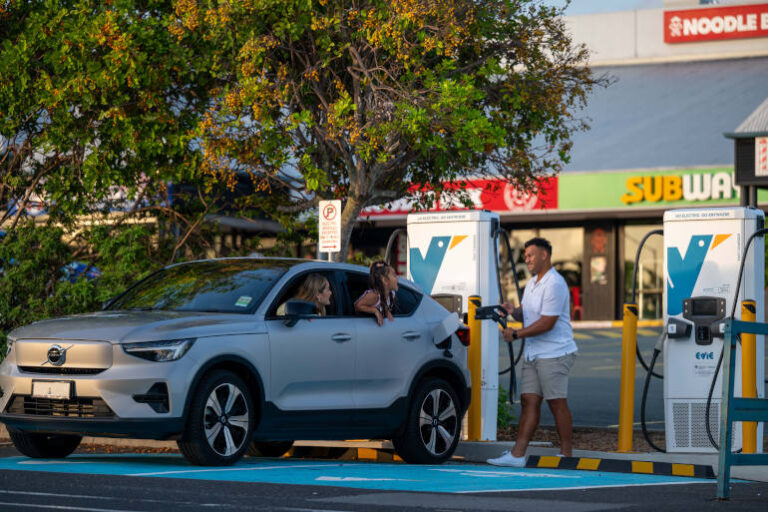
As fleets move from pilot projects to scaled electric vehicle (EV) deployment, one of the most important infrastructure questions arises: how should you balance the number of plugs, the number of sites, and their geographic distribution?
It’s not a simple “more is better” equation. The choices you make will determine whether your charging strategy meets operational needs, keeps vehicles moving, and delivers return on investment.
Plugs: Capacity and Redundancy
When people talk about network size, the first metric that comes up is often the number of plugs. This makes sense: plugs equal capacity. More plugs mean more vehicles can charge simultaneously and reduce wait times.
As Evie Networks’ Paul Fox explained, “Overseas they’ve been measuring plugs for a long time because it gives you an idea of total market capacity. It’s also about redundancy – if you’ve only got one charger and it breaks, you’ve got nothing.”
For fleets, redundancy is critical. A single-point failure can disrupt deliveries, service schedules, or driver productivity. Having multiple plugs per site ensures continuity and reduces downtime risk.
Sites: Coverage and Access
While plugs measure capacity, sites measure coverage. A network with fewer, larger sites may have plenty of plugs, but if they’re not in the right places, they don’t help your fleet.
“Most people top-line talk about plugs,” Fox noted, “but it is good to look at sites as well, because that gives you an idea of coverage. For a fleet customer, they’re interested in both capacity and coverage. But at the moment, most are more interested in coverage – knowing you’ve got a site near them.”
For fleets with dispersed operations – local government, utilities, or regional service providers – spreading sites strategically may matter more than building mega-hubs. Coverage is also valuable where vehicles are garaged at the driver’s home.
Geographic Location: The Deciding Factor
Neither plugs nor sites deliver value if they aren’t in the right place. For consumer drivers, proximity to home is key. For fleets, location needs to align with vehicle movement patterns:
- Where do your vehicles park overnight?
- Where do they start and finish routes?
- Are there natural dwell points during the day (near depots, retail stops, or logistics hubs)?
Fox highlighted how even small details matter: “One fleet told me their drivers liked our charger at Hungry Jack’s. They could grab a coffee or walk back to the office to pick up dispatch while the van charged.”
Location is about more than geography – it’s about integrating charging into daily operations.
Finding the Balance
For Fleet Managers, the right balance between plugs, sites, and geography depends on fleet profile:
- Urban delivery fleets may prioritise multiple plugs at fewer sites near industrial hubs.
- Regional service fleets may prefer more sites with fewer plugs each, ensuring coverage across wide areas.
- Mixed fleets (cars, vans, utes) may need a hybrid approach – strong metro hubs plus strategic regional sites.
The key is to avoid over-investing in one dimension at the expense of the others. A dozen plugs in the wrong suburb won’t solve operational challenges. Likewise, a network of single-plug sites may look good on paper but fail under load.
Lessons from Public Networks
Public charging networks face the same challenge. Tesla has focused on larger sites with many plugs, while Evie Networks has built broader coverage with more sites. Both strategies have trade-offs, and both show why fleets need to model their specific use cases rather than copying one approach.
Practical Next Steps for Fleet Managers
- Map vehicle movements – use telematics or driver logs to understand where charging is most needed.
- Prioritise redundancy – ensure key sites have multiple plugs to avoid downtime.
- Plan for growth – build sites that can be scaled as your EV fleet expands.
- Think about dwell time – co-locate chargers where drivers can safely and productively spend 20–40 minutes.
- Engage partners early – energy providers, landlords, and charging operators can help optimise location and scale.
The transition to EVs isn’t just about vehicles – it’s about building the right charging backbone. For Fleet Managers, success will come from balancing plugs, sites, and location in a way that fits operational patterns.
As Paul Fox’s insights highlight, capacity matters, coverage matters, but geography decides whether charging works for your fleet or leaves vehicles stranded.
- Parramatta found a simple way to tackle EV resistance
 Range anxiety isn’t always solved with another spreadsheet. Sometimes you need to hand someone the keys. That’s one of the lessons from City of Parramatta’s fleet electrification program, where an EV drive week has become an important tool for building employee support for the transition. Speaking at Everything Electric Sydney during a panel featuring finalists
 - Ausgrid’s charging strategy goes well beyond the depotInstalling chargers at the depot might be the obvious starting point for fleet electrification. For Ausgrid, it wasn’t going to be enough. As the electricity network continues electrifying passenger vehicles, vans and trucks, it has developed a charging strategy designed around how employees actually use fleet vehicles. Speaking during the Fleet News Group Awards finalists
- For Allianz, EVs are now business as usualFor many organisations, fleet electrification still means pilots, trials and discussions about what might happen next. At Allianz, the conversation has moved on. After starting its transition with a small pilot of 12 vehicles two years ago, the insurer has reached the point where electric vehicles are becoming part of its normal fleet replacement process.
- A Charger That Powers Up Isn’t Finished: Why Commissioning Matters for Fleet EV ChargingAn EV charger can be installed, connected and apparently operating — and the charging system can still be wrong. That is one of the more important lessons from the Local Council EV Integration Project involving Wyndham, Brimbank and Moonee Valley councils. As fleet charging installations become larger, depots are adding not only chargers but load
- How to Install EV Charging Without Shutting Down the DepotBuying electric vehicles may be the visible part of fleet electrification, but much of the hard work can happen underground. Trenching, conduits, electrical upgrades, switchboards, charger foundations, communications, traffic management and electrical shutdowns all need to be completed while the depot continues doing its normal job. Experience from the Local Council EV Integration Project involving