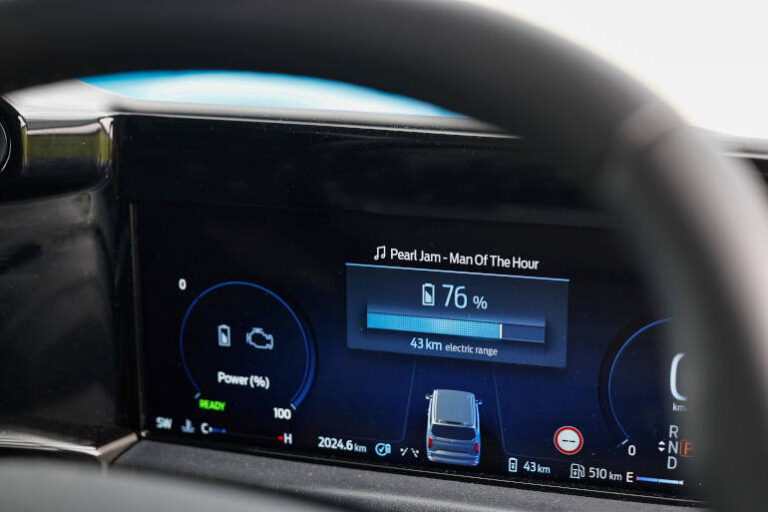
When Ford confirmed the Transit Custom PHEV would use an 11.8 kWh battery, a few eyebrows lifted across the fleet world. In an age when plug-in hybrids are chasing triple-digit electric ranges, why would one of the most advanced light-commercial vehicles in its class stop at just 54 km of electric-only driving?
According to Ford, it’s all about data — real data from thousands of connected Transit vans already working across Australia and around the world.
Learning from real-world fleets
At the local launch, Ambrose Henderson, Ford Australia’s Marketing Director, explained that the company now knows exactly how its commercial customers use their vehicles.
“Our average Transit Custom customer in Australia drives around 24,000 kilometres a year,” Henderson said.
“That’s roughly 100 kilometres a day, and a big proportion of that is done in short urban routes or between jobs.”
By analysing connected-vehicle data through Ford Pass, engineers found that many vans spend their days doing multiple short trips with time parked between them — perfect conditions for plug-in operation. The result: a battery that’s large enough to cover the majority of daily work cycles, without the added cost, weight or packaging penalty of an oversize pack.
Balancing battery size with payload
In a van, every kilogram matters. A larger battery would eat into payload and load volume — critical factors for fleets that still need to carry tools, parts or deliveries. At 11.8 kWh, the Transit Custom PHEV keeps its payload above 1.2 tonnes and retains the same 6.8 m³ load volumeas the diesel and BEV versions.
That balance between EV capability and practicality is what Ford calls its “multi-energy” strategy: designing one platform flexible enough for electric, hybrid and diesel powertrains without compromise.
The business case behind the battery
Henderson acknowledged that price sensitivity remains high among small-business buyers.
“At the end of the day, the technology is expensive, and I don’t think anyone would shy away from that,” he said. “But we wouldn’t bring something in we weren’t confident customers wanted.”
For the average tradesperson or council operator charging at home or depot, 54 kilometres of electric range covers an entire day’s work — often without touching a drop of petrol. The petrol engine is there for flexibility, kicking in on longer jobs or when towing up to 2,300 kg. Combined output reaches 171 kW, giving the van plenty of performance for its size.
Charging for the real world
The battery can recharge from a standard 15 A wall socket in about 4 hours 15 minutes, or overnight from a 10 A outlet in roughly seven hours. That means most fleets can integrate the PHEV without investing in new depot infrastructure — a key advantage for early adopters easing toward electrification.
Why less is more
Henderson summarised Ford’s thinking simply:
“For those who are in a city that have a defined route, that are back to base or back to home every night, the ability to charge a plug-in hybrid or a BEV makes absolute sense.”
Rather than chasing headline numbers, Ford targeted the sweet spot of efficiency, cost, and practicality.
Smaller battery, lighter van, lower price — and the same cargo capacity as a diesel.
Designed for today, ready for tomorrow
The Transit Custom PHEV isn’t a half-measure; it’s a transitional tool built on real-world evidence.
For fleets exploring emission reductions, the NVES-driven product changes are offering immediate CO₂ savings without operational disruption.
And when drivers plug in each night, they’ll know Ford sized that battery not for marketing, but for their actual working day.