

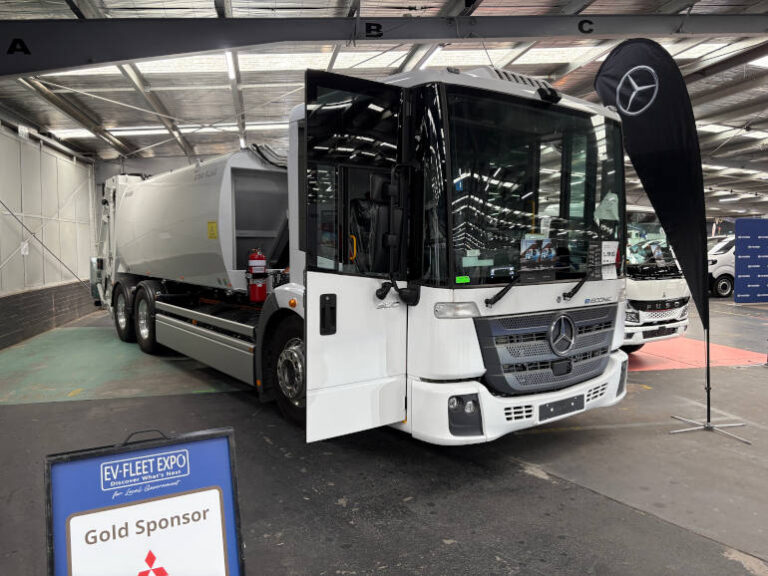
Daimler Truck Australia Pacific has marked a major milestone in its electric vehicle program, unveiling the first Mercedes-Benz eEconic in Australia fitted with a fully operational Bucher rear-loader waste body. After years of showing the low-entry cab at industry events, this is the first time the eEconic has been presented in a ready-to-work waste configuration — a turning point for councils and contractors preparing for zero-emission waste collection.
Romesh Rodrigo, Head of Regulatory Affairs and Emerging Mobility Sales at Daimler Truck Australia Pacific, said the truck arrived at the Fleet EV Expo for Local Government straight from Bucher’s workshop — with the build so fresh that the paperwork was still taped to the windscreen.
He described the moment as the transition from concept to reality. The eEconic is configured as a six-by-two waste collection platform, engineered specifically for dense urban environments and central business districts. Rodrigo noted the deep windscreen and low-entry layout provide visibility “unrivalled for inner-city operation,” and the crew-cab format pairs naturally with rear-loader duties.
A key breakthrough was integrating Bucher’s traditional hydraulic body with the factory electric power take-off (PTO) system. Rodrigo said Bucher had been “proactive and pragmatic” in working through the new interface requirements, ensuring the body performs exactly as operators expect. While Bucher was chosen for this first build, Daimler is simultaneously assembling another eEconic rear loader with Superior Pak — signalling strong engagement from Australia’s body-building sector.
Interest in the vehicle is already strong among major waste contractors. Rodrigo said the large national operators — Cleanaway, Remondis, Veolia and others — are leading early demand, with the first unit set to enter real-world testing with a major fleet customer. Although this will be the initial Australian deployment, he emphasised that the technology is mature, with eEconics already operating in waste applications across Europe for several years.
While rear-loader applications are the immediate focus, Rodrigo acknowledged that side-loader electrification remains technically challenging due to dual-control requirements and more complex body integration. He said Daimler’s approach is to prioritise fit-for-purpose deployments, learn from in-service data, and expand once the engineering and operational parameters are fully validated.
Beyond the electric drivetrain, the eEconic brings several safety and ergonomic advantages. Rodrigo highlighted the left-side concertina door, which allows crews to exit without the door swinging into traffic or obstacles — particularly valuable in laneways, alleyways and airport environments where space is tight. Air suspension front and rear enhances ride quality and supports the low-entry design that reduces operator fatigue during frequent stop-start collection cycles.
The arrival of a fully operational eEconic marks a significant step in the decarbonisation of waste fleets, particularly for councils where waste collection is one of the highest-emitting service categories. With Bucher and other body builders now proving compatibility, Daimler’s Australian rollout is moving from display stands to real-world conditions — and the industry is paying close attention.
More units are expected to follow as testing progresses, providing a pathway for councils and contractors seeking genuine zero-emission options that don’t compromise on daily productivity.
- Foton and Ampol Target Electric Truck Charging
 Foton Mobility Distribution (FMD) and Ampol have signed a Memorandum of Understanding to explore charging solutions for electric truck fleets, with a focus on helping operators charge at depots, commercial hubs and public charging sites. The collaboration will investigate charging options across Ampol’s AmpCharge public network and private facilities for FMD’s fleet, logistics and business
 - Ausgrid’s charging strategy goes well beyond the depotInstalling chargers at the depot might be the obvious starting point for fleet electrification. For Ausgrid, it wasn’t going to be enough. As the electricity network continues electrifying passenger vehicles, vans and trucks, it has developed a charging strategy designed around how employees actually use fleet vehicles. Speaking during the Fleet News Group Awards finalists
- Home Charging Enters a New Growth PhaseEvnex has passed 20,000 connected charger installations across Australia and New Zealand, with rapid growth reflecting the shift of home EV charging from an early-adopter product to mainstream infrastructure. The Christchurch-based manufacturer shipped its first charger in 2017. While reaching the first 10,000 installations took eight years, the next 10,000 were added in just nine
- Ampol’s $225 million Evie deal puts a new value on public EV chargingAmpol’s proposed $225 million acquisition of Evie Networks could prove to be a significant milestone for Australia’s EV charging sector, putting a substantial transaction value on a public charging network that was built well before electric vehicles became a mainstream consideration for Australian fleets. Ampol Energy has entered into an agreement to acquire 100% of
- A Charger That Powers Up Isn’t Finished: Why Commissioning Matters for Fleet EV ChargingAn EV charger can be installed, connected and apparently operating — and the charging system can still be wrong. That is one of the more important lessons from the Local Council EV Integration Project involving Wyndham, Brimbank and Moonee Valley councils. As fleet charging installations become larger, depots are adding not only chargers but load