

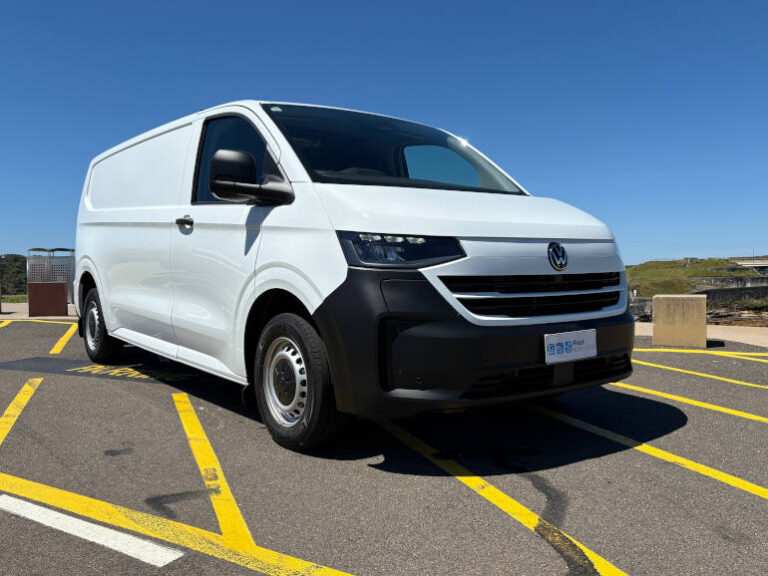
Volkswagen Commercial Vehicles has officially unveiled the all-electric Transporter T7, marking the start of a new era for the brand’s most recognisable workhorse. The new Transporter range offers diesel and battery-electric options, with a plug-in hybrid (PHEV) to follow in 2026 — giving Fleet Managers the broadest choice of powertrains in the van segment.
For the first time, the Transporter becomes available as a pure battery-electric vehicle (BEV), offering zero tailpipe emissions without compromising the capability and practicality that fleets expect from a Volkswagen van.
Power and Performance
The new Transporter BEV sits at the top of the T7 range, powered by a single electric motor producing an impressive 210 kW and 415 Nm of torque, driving the rear wheels via a single-speed transmission.
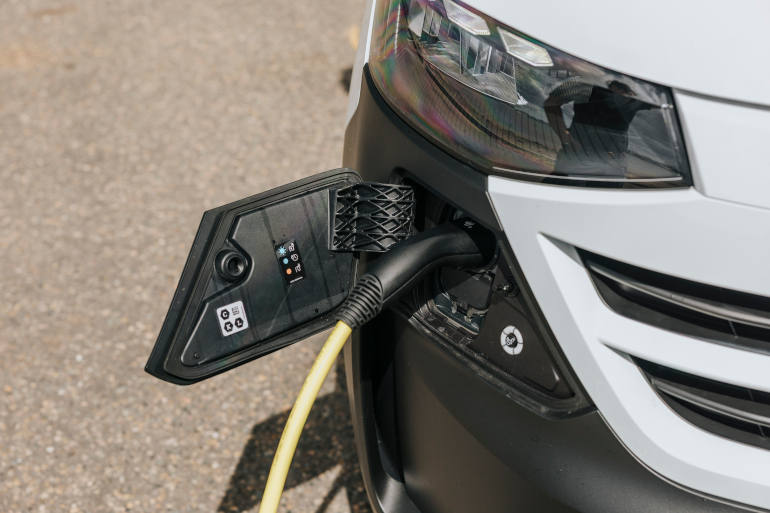
Power comes from a 64 kWh lithium-ion battery pack, offering an estimated WLTP range of 330 km. Charging flexibility is built in — with 11 kW AC (three-phase) charging completing a full charge in 7 hours and 30 minutes, or DC fast-charging up to 125 kW, delivering 10–80% in just 38 minutes.
That makes it one of the fastest-charging electric vans on the market — ideal for fleets that can’t afford downtime.
Payload and Towing
Unlike some electric vans that trade capacity for range, Volkswagen has ensured the Transporter BEV remains a genuine workhorse.
| Specification | SWB BEV | LWB BEV |
|---|---|---|
| Power | 210 kW | 210 kW |
| Torque | 415 Nm | 415 Nm |
| Payload | 806 kg | 760 kg |
| GVM | 3,225 kg | 3,225 kg |
| Towing (braked/unbraked) | 2,300 kg / 750 kg | 2,300 kg / 750 kg |
| Towbar load limit | 95 kg | 95 kg |
| Load volume | 5.8 m³ | 6.8 m³ |
| Load length | 2,602 mm | 3,002 mm |
The BEV offers rear-wheel drive, with a robust chassis and an identical 3.2-tonne GVM to diesel variants, giving fleets flexibility in upfitting and conversions.
For perspective, the electric Transporter’s payload and towing exceed that of the smaller ID. Buzz Cargo, positioning it as the more capable option for trades, logistics, and commercial operators.
Pricing in Australia
Volkswagen has confirmed national recommended retail pricing (RRP) for the Transporter BEV as follows:
| Variant | Powertrain | Drivetrain | RRP (MLP)* |
|---|---|---|---|
| Transporter SWB BEV | 210 kW electric | RWD | $83,590 |
| Transporter LWB BEV | 210 kW electric | RWD | $85,590 |
*Manufacturer’s List Price (including GST, excluding on-road costs)
This pricing sits just above the high-spec diesel 4MOTION models, reflecting the BEV’s high performance and zero-emission drivetrain. It also positions the Transporter below the Luxury Car Tax (LCT) threshold, allowing fleets to maximise potential FBT and depreciation benefits.
Standard Equipment
Volkswagen has taken the opportunity to overhaul the van’s specification, moving the Transporter into premium territory with a long list of standard features across all variants.
Exterior and Body:
- LED headlights and tail-lights
- Light Assist (automatic high beam)
- Black grained bumpers and mirrors
- Power-adjustable, heated and folding mirrors
- Sliding door on passenger side
- Tailgate with heated rear window and wiper
- Roof-mounted tie rails and 170 kg roof load limit
Cabin and Interior:
- 13-inch touchscreen with navigation and wireless App-Connect
- 12-inch Digital Cockpit display
- Wireless phone charging
- 7 USB ports (Type-C)
- Heated driver and passenger seats
- Keyless Start
- Single-zone climate control
- Armrests and adjustable lumbar support
- 4-speaker audio system
- Load partition with window and load-through hatch
Safety and Driver Assistance:
- Front Assist with pedestrian and cyclist detection
- Adaptive Cruise Control (ACC) with predictive speed limiter
- Lane Assist and Lane Centering
- Blind Spot Monitoring and Exit Assist
- Reverse Emergency Braking
- Traffic Sign Recognition with Wrong Way Alert
- Rear View Camera
- Front & Rear Park Distance Control with manoeuvre braking
Volkswagen says these inclusions make the Transporter “the safest and most technologically advanced van” the brand has ever sold in Australia.
Maintenance and Servicing
One of the biggest benefits for Fleet Managers is the low servicing demand of electric vehicles.
Volkswagen has aligned BEV service intervals with the diesel versions — every 12 months or 30,000 km (whichever comes first) — and includes Roadside Assistance after each scheduled service.
For fleets that prefer fixed costs, Volkswagen Care Plans will be available at launch, covering scheduled maintenance at a discounted pre-paid rate.
While detailed pricing for BEV service packages is still to be finalised, Volkswagen has indicated that the BEV’s maintenance costs will be lower than equivalent diesel variants — a key total-cost-of-ownership advantage for large fleet buyers.
Conversions and Fit-for-Purpose Options
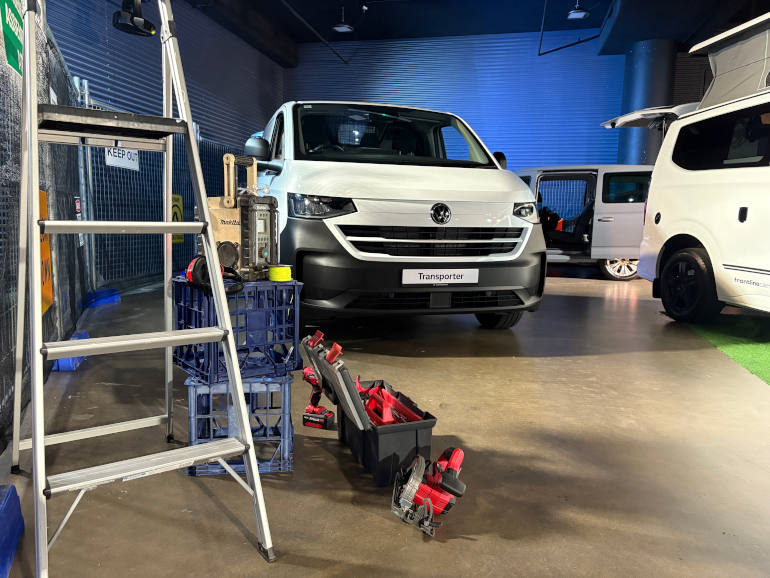
The BEV Transporter is also compatible with Volkswagen’s Approved Converter Network, which supports full integration for service bodies, racking systems, and camper setups.
Through the new Sortimo “One-Click” system, fleets can configure, order, and finance shelving or tool storage directly through Volkswagen’s configurator — all covered under warranty. This system allows fleet operators to transfer storage systems between vehicles, reducing waste and lifetime costs.
As Andrew Hester, Volkswagen’s National Manager of Vehicle Conversions and Partner Solutions, explained during the launch:
“Our partners like Frontline, AutoSafe and Sortimo can access all the data and integration points they need. That ensures the Transporter BEV can be tailored for fleet applications without compromising safety or warranty.”
Fit-for-Purpose Electrification
Volkswagen says the Transporter BEV is aimed squarely at commercial and government fleets with clear decarbonisation goals.
While diesel models will remain the sales mainstay at launch, Director Nathan Johnson expects the BEV to gain traction as fleets trial and expand their electric operations:
“It’s not about chasing lifestyle sales. The Transporter BEV is about providing a practical, capable, and electric solution for businesses that need to move people and gear efficiently,” Johnson said.
The Start of Something Bigger
The BEV Transporter is just the first step in Volkswagen’s broader commercial electrification roadmap.
The Transporter PHEV will arrive in mid-2026, offering 171 kW of combined output and 60 km of electric-only range, followed by a BEV Cab Chassis dual cab variant in late 2026 for fleet buyers needing a six-seat, tray-back electric utility.
Together with the ID. Buzz Cargo and updated Crafter range, Volkswagen Commercial Vehicles now offers one of the most complete portfolios in the light commercial segment.
In Summary: Key Specs – Volkswagen Transporter BEV
| Feature | Specification |
|---|---|
| Power | 210 kW |
| Torque | 415 Nm |
| Drive | Rear-wheel drive |
| Battery capacity (net) | 64 kWh |
| Range (WLTP) | ~330 km |
| Charging (AC/DC) | 11 kW / 125 kW |
| Charging time (DC 10–80%) | 38 minutes |
| Payload (SWB/LWB) | 806 / 760 kg |
| Towing capacity (braked) | 2,300 kg |
| GVM | 3,225 kg |
| Load volume (SWB/LWB) | 5.8 / 6.8 m³ |
| Service interval | 12 months / 30,000 km |
| RRP (MLP) | $83,590 (SWB) / $85,590 (LWB) |
For fleets searching for a reliable, full-size electric van that can deliver serious performance and capability, the new Volkswagen Transporter T7 BEV brings substance to the sustainability conversation.
It’s built for work, designed for fleets, and engineered to reduce running costs without sacrificing payload or towing power. After seven generations, the Transporter is still doing what it’s always done best — carrying Australia’s businesses forward.