

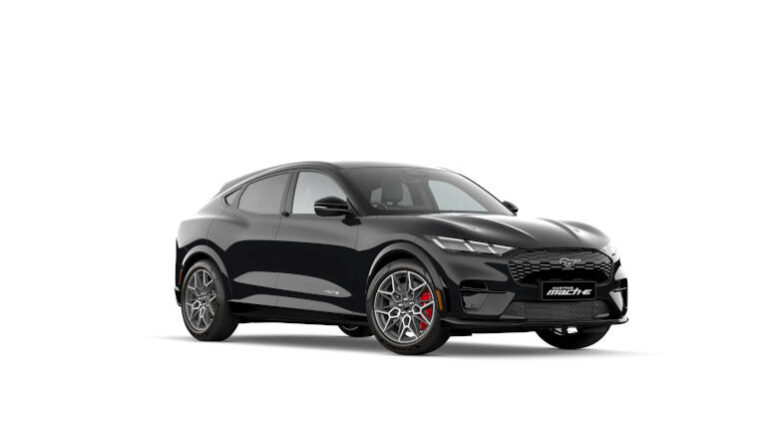
Ford Australia has lifted the lid on the updated MY25 Mustang Mach-E — and it’s not just a facelift. The refreshed range brings stronger performance, smarter efficiency, and sharper design inside and out.
Landing in local showrooms from October 2025, the Mach-E line-up continues with three familiar variants: Select (RWD), Premium (RWD Extended Range), and the GT (AWD). But under the skin, there’s plenty that’s new.
More power, less waiting
The flagship GT gets a serious boost — now producing434 kW and 955 Nm, while still delivering up to 515 km (WLTP) of range. The entry-level Select also gets more punch, climbing to 212 kW and 525 Nm, and the Premium matches that torque figure with its 88 kWh extended-range battery good for 600 km.
Charging is faster too, with Premium and GT models now able to recharge from 10% to 80% in about 36 minutes using a 150 kW DC fast charger — down from 45 minutes.
Smarter efficiency and smoother ride
A new energy-efficient heat pump is standard across the range, cutting energy use for heating and cooling the cabin. Suspension hardware has also been revised on Select and Premium variants for a more comfortable ride without losing that sporty Mach-E edge.
Design refresh and new tech
Ford has tweaked styling across the board, with new alloy wheel designs and fresh colour options — including Eruption Green, Molten Magenta, Velocity Blue, Glacier Grey, Grabber Yellow, and Terrain.
Inside, a new column-mounted shifter replaces the rotary dial to free up console space, while 10-way power seats improve driver comfort. Even the base Select now scores the same projector beam headlamps as the Premium and GT for a more unified look.
Pricing (MLP)
- Mach-E Select: $65,990
- Mach-E Premium: $80,490
- Mach-E GT: $98,490
A stronger case for EV fleets
For Fleet Managers weighing up premium electric SUVs, the Mach-E’s combination of longer range, faster charging, and updated technology make it a more compelling proposition in 2025. Ford’s focus on efficiency and comfort — alongside the addition of a heat pump — will be particularly relevant for corporate and government fleets pursuing emissions and running-cost reductions.
- EVs are turning employees’ homes into fleet fuel stations
 For decades, fleet fuel management has been relatively straightforward. Give the driver a fuel card, let them visit a service station and receive an invoice detailing the transaction. Electric vehicles are changing that model because the organisation can suddenly be responsible for procuring the energy used to power its fleet — and some of that
 - Ford Brings Range-Extender Bronco to AustraliaFord will add another form of electrification to its Australian line-up when the Bronco Basecamp arrives in the second half of 2027, combining electric drive with a petrol-powered range extender designed to support long-distance travel. Rather than using a conventional hybrid system where both the petrol engine and electric motors can drive the wheels, the
- Why Hyundai sees its dealer network as part of the EV propositionThe specifications of the new Hyundai STARIA Load Electric will attract plenty of attention from Fleet Managers: 450km of WLTP range, a payload of more than a tonne and 800V architecture capable of very fast DC charging. But Hyundai Australia Chief Operating Officer Gavin Donaldson argues that the commercial vehicle proposition extends well beyond what
- AmpolCard plugs into public EV chargingAmpol has added public EV charging to AmpolCard, allowing businesses to manage charging, petrol and diesel purchases through a single card and account. The expansion provides access to all AmpCharge public charging sites across Australia, with unified billing, reporting and account management through the existing AmpolCard platform. For businesses introducing electric vehicles, the change removes
- Back to Buttons: ID.4 Gets a Practical UpgradeVolkswagen has updated its ID.4 electric SUV for MY27, introducing physical steering wheel controls, a new infotainment system and additional driver assistance features across the Pro and GTX variants. For fleet buyers, the changes put everyday usability and safety at the centre of the update, with improvements to navigation, speed assistance and parking technology. Physical