

The end of the year is a good time to step back, breathe, and think about the bigger trends shaping fleet strategy. Somewhere between the Boxing Day Test, a beach towel, and a cold drink, many Fleet Managers find themselves reflecting on next year’s challenges. And this summer, there’s one reality that keeps surfacing across the industry: EV price parity has finally arrived.
It’s not a forecast anymore. It’s here. And it’s already changing the way urban fleets operate—and how depots need to prepare for 2026.
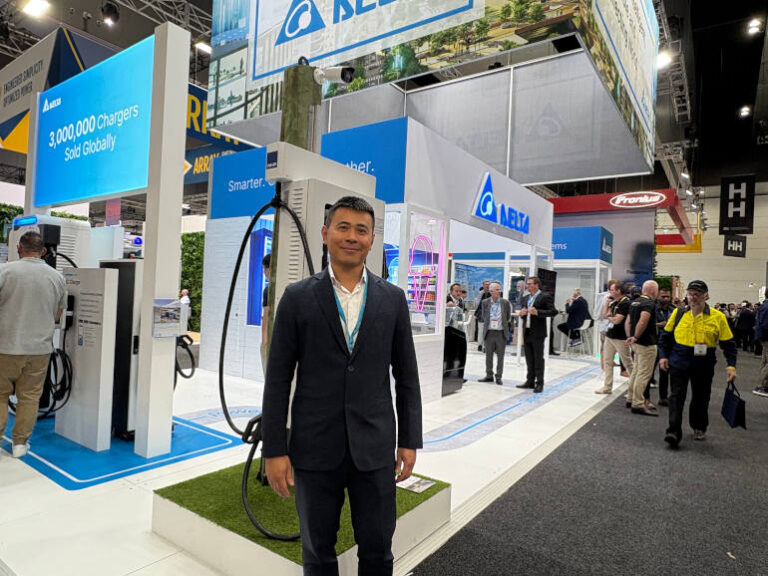
At All Energy 2025, Delta Electronics Australia’s Country Manager Tom Hew summed up the moment with a quiet certainty that said more than any headline could. “They’re starting to see the return on investment… and they’re starting to see that,” he told us, emphasising that the financial case is no longer theoretical. It’s visible every day in real fleet conversations.
This article takes a slow, summer-friendly walk through what that means for fleet operations, depot planning, and the rising pressure on public charging in our cities.
The Summer When EV Price Parity Became Real
For years, Fleet Managers heard the same story: EV prices were dropping, and one day they’d be equal to petrol. But that day always seemed to be just over the horizon. In 2025, the horizon arrived.
Hew put it clearly: the industry is no longer talking about EVs as a long-term possibility but as a practical, immediate decision. “In terms of the new cars coming into the industry, there’s plenty of them,” he said. “We’re not talking about when. We’re talking about how we’re going to make this happen.”
And with that shift comes a new kind of summer thinking. Instead of debating EV viability, fleet managers are working out how quickly they can scale.
Affordable EVs—especially compact models perfectly suited to city routes—have pushed the conversation into new territory. Electrification is no longer a premium undertaking. It’s a mainstream operational step.
Urban Fleets Are About to Change Faster Than Expected
Price parity matters most in cities. That’s where small hatchbacks, pool cars, inspectors, social workers, parking officers, community nurses, technicians and short-hop delivery vehicles rack up kilometres without leaving the metro zone.
These are the vehicles most sensitive to upfront cost—and now that EV versions match their ICE counterparts, fleet electrification becomes not just achievable, but strategically attractive.
Hew highlighted the environmental pressure building inside organisations, noting that “a lot more companies are very concerned about their impact to the world, and so they’re pushing a lot of this as well.” With the financial and ESG cases now aligned, urban fleets are facing the perfect conditions for rapid transition.
This is the moment when planning accelerates, the number of EVs entering service grows, and depot managers start feeling the early signs of charging pressure.
The Depot Becomes the Next Strategic Battleground
Price parity is wonderful for procurement—but it creates ripple effects for infrastructure. Every new EV entering an urban fleet adds a little more load to the depot, the office car park, the kerbside, or the driver’s home.
More EVs means more charging, and more charging means rethinking how sites use energy.
Hew didn’t hold back when describing the biggest challenge: “The grid is just not quite there yet,” he said, acknowledging that Australia’s distribution networks are still catching up to the energy demands of widespread fast charging.
The good news is that fleets are not stuck waiting for grid upgrades. The industry has pivoted towards battery-supported charging that sits on the depot property, acting as a buffer between real-world energy needs and grid limitations. Hew reinforced this shift toward decentralised solutions, explaining that “we’re no longer looking at a centralised model. We’re looking at a decentralised model.”
For Fleet Managers lounging under a summer umbrella, the key realisation is simple: depot design is evolving from parking layout to energy layout. It’s not a stressful idea—but it’s a strategic one worth thinking about before 2026 begins.
Cities Will Feel the Pressure Too
Urban depots won’t carry the full load. As price parity drives EV adoption deeper into fleets, more vehicles will rely on public or semi-public infrastructure. Staff living in apartments or older townhouse streets will increasingly depend on kerbside or workplace charging, nudging councils and employers to provide more accessible DC charging options.
Hew acknowledged the pace of change and the need for solutions that slot easily into the real world. Delta’s approach focuses on turnkey systems that combine chargers, solar, storage and energy management, making installations quicker and less dependent on perfect grid conditions. “What we’re trying to do at Delta is make it easier,” he said.
That philosophy matches what fleets are experiencing: EVs are no longer rare, and their drivers can’t always rely on depots alone. Charging must expand outward into the places people already park.
A Summer Takeaway: Start Planning Before the Rush
EV price parity doesn’t just change the cost conversation—it changes the infrastructure conversation, the timing conversation, and the organisational readiness conversation. In 2026, fleets won’t be asking whether they should electrify. They’ll be working out how to support the growing number of EVs that have already joined the fleet.
As Hew put it, Delta sees itself as part of an industry working towards a shared environmental future. “Delta is always proud to be part of an industry that’s contributing so positively to the environment… we will continue to do that.”
This summer is the perfect moment to think ahead—gently, without spreadsheets—about how price parity will shape your operations. The pressures will build quickly in 2026. Fleets that use the quiet months to reflect, plan and sketch out their charging strategy will enter the new year comfortably ahead of those who wait.
And the best part? You can start that planning from a deckchair.
- REMONDIS Puts Electric Waste Collection to the Test
 REMONDIS Australia has trialled a Mercedes-Benz eEconic battery-electric waste collection truck in Brisbane, testing how the technology performs in local commercial operations. The trial marks another step in the company’s fleet decarbonisation program. With 600 waste collection trucks operating across Australia, REMONDIS sees significant potential to reduce emissions through alternative powertrains. The next phase will
 - Back to Buttons: ID.4 Gets a Practical UpgradeVolkswagen has updated its ID.4 electric SUV for MY27, introducing physical steering wheel controls, a new infotainment system and additional driver assistance features across the Pro and GTX variants. For fleet buyers, the changes put everyday usability and safety at the centre of the update, with improvements to navigation, speed assistance and parking technology. Physical
- Leapmotor B03X Packs More into a Compact EVLeapmotor will expand its Australian electric vehicle range with the arrival of the B03X, an affordable compact SUV offering two battery options, extensive driver assistance technology and flexible cabin storage. For fleet managers assessing electric vehicles for urban operations, the B03X brings another option to the passenger vehicle shortlist. Its compact dimensions, standard connectivity and
- New Navara: Big Grunt, Now with a PlugNissan will bring a plug-in hybrid Navara to Australia in 2027, giving fleet buyers another electrified option for work that demands towing capacity, payload and four-wheel-drive capability. The all-new Navara Pro PHEV will be Nissan’s first plug-in hybrid model in Australia and its first electrified ute globally. Australia and New Zealand will become the first
- Could concrete agitators be an EV sweet spot?Concrete agitators could become one of the more practical early applications for electric heavy trucks, with short operating distances, significant idle time and high fuel use creating a duty cycle that may suit battery-electric technology. Speaking with Fleet News Group at Everything Electric in Sydney, Brenton Sweeney, Sales Executive Commercial Vehicles and Equipment at Prancer