


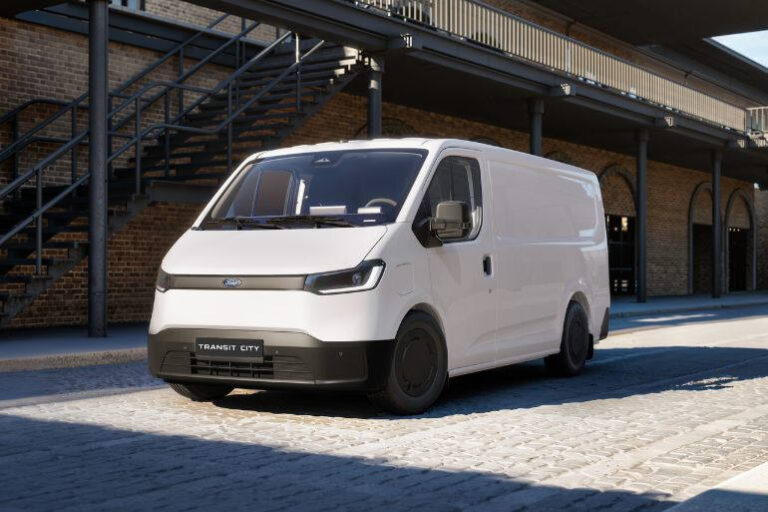
Ford Australia is taking a different approach to electric commercial vehicles with the new Transit City, using real-world fleet data to match battery size and driving range to the daily requirements of metropolitan delivery and service fleets.
Customer deliveries are expected to begin in November 2026, with Ford offering Transit City in a single specification aimed specifically at urban work rather than positioning it as an electric replacement for every Transit application.
A city van built around the fleet task
Transit City uses a 56kWh lithium-iron phosphate battery paired with a 110kW front-wheel-drive electric motor.
Ford quotes up to 254km of WLTP combined driving range and up to 380km on the WLTP City cycle. Maximum payload is up to 1,085kg, while the cargo area provides 6.4 cubic metres of load volume.
The specification highlights one of the important questions emerging as fleets move towards electric commercial vehicles: how much battery does a working van actually need?
Rather than chasing maximum range, Ford has focused on retaining useful payload while providing enough battery capacity for the types of urban routes the company expects Transit City to complete.
Ford Australia and New Zealand President and CEO Fadi Mawal said the model reflects a different way of approaching commercial vehicle electrification.
“Transit City represents a new way of thinking about commercial vehicles for Australian and Kiwi businesses.”
For Fleet Managers, that approach makes vehicle utilisation data particularly important. Transit City could work well where daily kilometres are predictable and vehicles return to a depot or regular charging location, but fleets will still need to understand individual vehicle duty cycles before making the switch.
Fleet data helped determine the battery size
Ford says it analysed telematics data from 2,312 Transit Custom vans operating in Australia between November 2024 and July 2026.
The analysis found typical urban daily travel averaged 76km, while 90 per cent of daily routes required 200km or less.
Those figures helped Ford make the case for fitting a smaller battery rather than adding capacity that many operators may rarely use.
For fleets, the findings reinforce the value of analysing existing vehicle movements before deciding what an electric replacement needs to deliver.
A vehicle travelling 70 or 80 kilometres most days has a very different battery requirement to one routinely covering several hundred kilometres, and matching the EV to the application can help avoid carrying unnecessary battery weight throughout the vehicle’s working life.
That becomes particularly important in commercial vehicles, where payload remains a fundamental operating requirement.
Charging supports overnight fleet operations
Transit City can accept DC charging at up to 87kW, with Ford quoting approximately 33 minutes for a 10-to-80 per cent charge.
Under the stated conditions, a 10-minute DC charging session can add up to 68km of driving range.
For fleets returning vehicles to base overnight, 11kW AC charging is likely to be more relevant. Ford quotes approximately 5.5 hours to charge the battery from 10 to 100 per cent using an 11kW AC charger.
That combination gives operators the option of routine overnight charging while retaining DC charging for occasions when additional range is required during the working day.
It also means infrastructure planning remains part of the vehicle procurement decision. Fleets considering Transit City will need to assess where vehicles are parked, how long they remain there and whether available electrical capacity can support the required charging schedule.
A deliberately focused electric van
Ford’s recommended $50,000 driveaway offer provides additional context around the Transit City’s positioning, although eligibility and availability conditions apply and fleet buyers will need to confirm their own purchasing arrangements.
More significant for fleet operators will be whether the vehicle’s range, payload and charging profile match the work being performed.
Transit City also carries an eight-year/160,000km high-voltage battery warranty and is eligible for Ford’s conditional seven-year unlimited-kilometre vehicle warranty when servicing requirements are met.
The result is a deliberately narrow proposition.
For metropolitan delivery, service and other urban fleets with predictable routes and access to charging, Transit City presents an alternative to simply fitting increasingly large batteries to electric commercial vehicles.
For applications involving longer distances, towing or different operational requirements, Ford will continue to direct customers towards other vehicles in the Transit range.
The broader fleet message may be more important than the vehicle itself: electrification does not necessarily mean maximising battery range. It means understanding how vehicles are actually used and selecting an EV that can perform that task without carrying more battery than the operation requires.