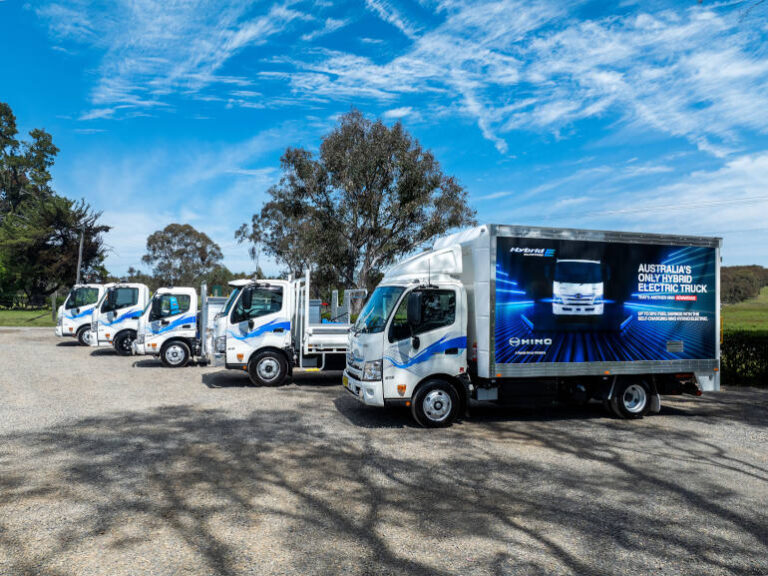
The transition to electric trucks in Australia is likely to take longer than some fleets originally expected, with Hino Australia President and CEO Richard Emery suggesting 2029–2030 remains a realistic timeframe for a broader shift in customer demand.
Speaking while driving a Hino 700 Series at a recent customer event, Emery said fleet interest in battery-electric trucks had changed noticeably over the past two years.
Hino does not currently offer a battery-electric truck for sale in Australia, although an electric version of the smaller Dutro has been brought to Australia for evaluation.
“Obviously, we don’t have an electric truck offering at this point in time in Australia,” Emery said.
He said there had previously been significant discussion with fleet customers about electric trucks, with some businesses moving early through trials supported by government funding.
But the level of enquiry subsequently eased.
“I have to say it kind of stalled last year,” Emery said.
That does not mean fleets have abandoned plans to electrify. Instead, the conversation appears to be moving towards what can practically be deployed now while organisations prepare for the next generation of zero-emission trucks.
Emery said some customers that had previously discounted hybrid technology while focusing on a move directly to battery-electric trucks were now reconsidering that position.
“Now it’s kind of drifted back to well, we’re not sure electric’s quite ready and practical, so we might try some hybrids.”
Timing remains difficult for fleets
For Fleet Managers developing replacement plans today, timing the transition is one of the biggest challenges.
Heavy vehicles have long replacement cycles and their operational requirements can make electrification more complicated than replacing a passenger vehicle.
Payload, range, charging infrastructure, depot power supply and the time available to recharge all become part of the vehicle selection process.
Emery believes the broader change will come, but does not expect an immediate step change in electric truck adoption.
“I think it’s still 2029, 2030,” he said.
Importantly, Emery is not questioning whether electric trucks have a future.
“Look, it’s going to happen,” he said.
The challenge for fleets is therefore deciding what to do during the years before battery-electric trucks become practical across a larger number of applications.
Hybrid finds another audience
That gap is providing renewed relevance for Hino’s existing hybrid technology.
Emery said Hino had recorded an increase in interest in the 300 Series Hybrid, including from customers that had previously considered the technology but decided not to proceed.
“Yeah, we have. I would say there’s been a bit of a surge,” he said.
Hino has been selling hybrid trucks in Australia for many years, giving fleets an option that reduces fuel use without requiring charging infrastructure or fundamentally changing the way the vehicle is operated.
The economics have also changed as diesel prices have increased.
Emery said Hino’s earlier comparison work between diesel and hybrid trucks had been based around diesel at approximately $2 per litre. Higher fuel prices improve the potential financial case for technologies that can reduce consumption.
He pointed to councils, regional government fleets and businesses operating in stop-start metropolitan conditions as applications that have shown interest in hybrid.
No single pathway for every truck
For Fleet Managers, the comments highlight why truck electrification strategies may need to be staged rather than based on a single replacement date.
Some applications can already accommodate battery-electric vehicles. Others may be suited to hybrid technology, while demanding regional and heavy-duty operations could remain dependent on internal combustion powertrains for longer.
That creates a fleet planning challenge, but also provides an opportunity to assess each vehicle according to its actual duty cycle rather than attempting to apply one technology across the entire fleet.
The direction towards lower-emission road transport is becoming clearer. The timing — and the technology used to get there — remains far less uniform.
- A Charger That Powers Up Isn’t Finished: Why Commissioning Matters for Fleet EV Charging
 An EV charger can be installed, connected and apparently operating — and the charging system can still be wrong. That is one of the more important lessons from the Local Council EV Integration Project involving Wyndham, Brimbank and Moonee Valley councils. As fleet charging installations become larger, depots are adding not only chargers but load
 - How to Install EV Charging Without Shutting Down the DepotBuying electric vehicles may be the visible part of fleet electrification, but much of the hard work can happen underground. Trenching, conduits, electrical upgrades, switchboards, charger foundations, communications, traffic management and electrical shutdowns all need to be completed while the depot continues doing its normal job. Experience from the Local Council EV Integration Project involving
- Design the Depot Once: Future-Proofing EV Charging for the Fleet You’ll Have LaterFleet electrification rarely happens in one hit. Passenger vehicles may move first, followed by light commercial vehicles and, as suitable products become available, trucks and other specialised equipment. That creates a challenge for depot charging: how much infrastructure should a fleet build today for vehicles it may not purchase for several years? The Local Council EV
- Kinetic Turns Heatherton Into an Electric Bus HubKinetic has completed a major charging infrastructure upgrade at its Heatherton bus depot in Melbourne’s south-east, paving the way for every urban route bus operating from the site to become zero-emission by the end of 2026. The project increases the depot’s electric bus charging capacity from 12 vehicles to 30, allowing the site to support
- Duratec Accelerates Fleet ElectrificationAustralian engineering, construction and remediation contractor Duratec has started electrifying its vehicle fleet as part of a broader strategy to reduce diesel use across its operations. The company has acquired an initial eight fully electric BYD vehicles, along with an electric van, as it begins replacing diesel-powered utility vehicles. One of the new EVs will