


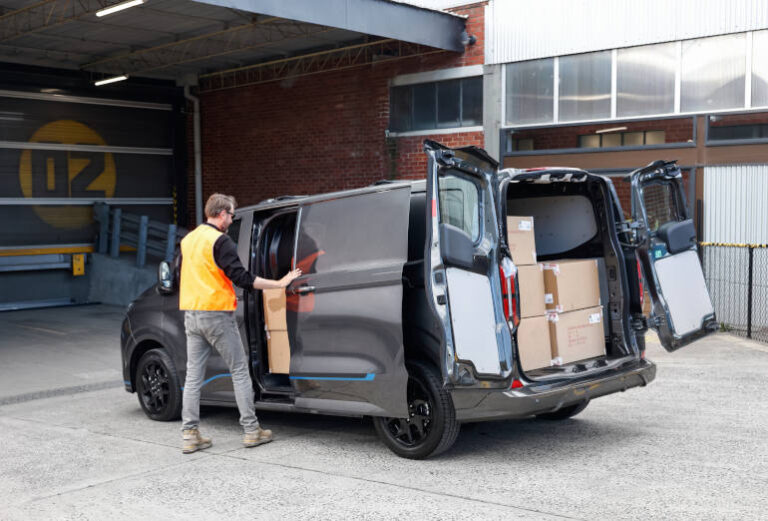
The new Ford Transit Custom family marks a turning point for working vans in Australia. With three drivetrains — diesel, plug-in hybrid (PHEV) and full battery-electric (BEV) — Ford now gives Fleet Managers a range that spans every duty cycle, budget and emissions target.
It’s the first time Transit Custom buyers can choose between traditional fuel and zero-emission power, all on the same platform. And for fleets preparing for NVES and sustainability targets, this flexibility makes the decision far easier.
E-Transit Custom (BEV)
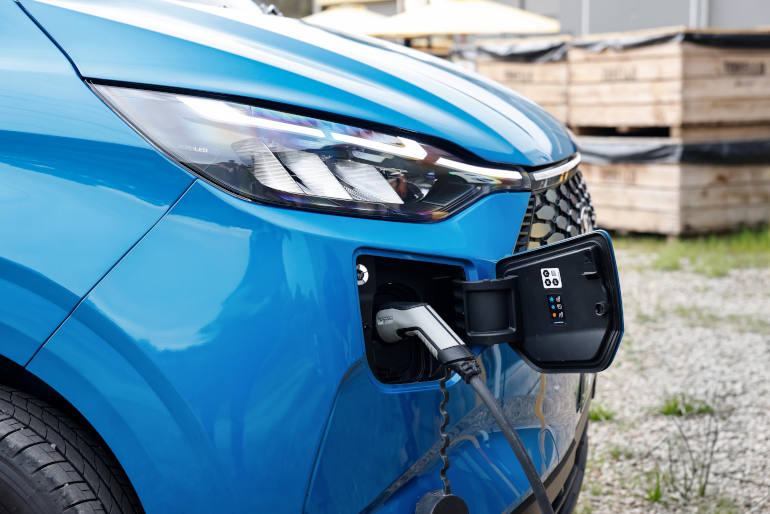
The fully electric E-Transit Custom is the headline act in Ford’s new lineup — designed for urban deliveries, service technicians and councils moving toward zero-emission operations.
| Specification | SWB Sport | LWB Trend |
|---|---|---|
| Power | 160 kW | 160 kW |
| Torque | 415 Nm | 415 Nm |
| Drivetrain | Rear-wheel drive | Rear-wheel drive |
| Battery | 64 kWh usable (NMC lithium-ion) | 64 kWh usable (NMC lithium-ion) |
| Range (WLTP) | ≈ 307 km | ≈ 301 km |
| Energy consumption | 242–248 Wh/km | 242–248 Wh/km |
| Charging | 11 kW AC (6.7 h 0–100%) / 125 kW DC (15–80% ≈ 32 min) | same |
| Braked towing | 2,300 kg | 2,300 kg |
| Payload (max.) | ≈ 1,200 kg | ≈ 1,200 kg |
| Service intervals | 12 months / 30,000 km | 12 months / 30,000 km |
Every E-Transit Custom comes with one-pedal driving, independent rear suspension, and the same 13-inch SYNC 4 touchscreen used in Ford’s latest passenger vehicles. The 5G-enabled Ford Pass Connect modem lets managers monitor charge levels, vehicle location and maintenance alerts in real time.
Ford estimates real-world operating costs will be substantially lower than diesel. As Ambrose Henderson, Marketing Director at Ford Australia, explained during the launch, actual savings depend on each customer’s setup:
“It really depends on the customer — what their life cycle is, how they’re charging the car, how they’re fuelling the car. If you’re an electrician with solar panels and charging at home, you’ll certainly make that money back over the vehicle’s ownership life.”
Indicative Australian pricing (drive-away and on-roads vary by state):
- E-Transit Custom Trend LWB: ≈ $79,990 + on-roads
- E-Transit Custom Sport SWB: ≈ $83,990 + on-roads
Transit Custom PHEV
For fleets not yet ready to go all-electric, the Transit Custom PHEV offers an intelligent bridge. It pairs a 2.5-litre Duratec petrol engine with an 111 kW electric motor and an 11.8 kWh battery, providing up to 54 km of pure-electric range.
| Specification | SWB Sport | LWB Trend |
|---|---|---|
| System output | 171 kW combined | 171 kW combined |
| Torque | 320 Nm (e-motor) + 209 Nm (engine) | same |
| Drivetrain | Front-wheel drive | Front-wheel drive |
| Battery | 11.8 kWh usable (NMC) | 11.8 kWh usable (NMC) |
| EV range (WLTP) | 54 km | 54 km |
| Combined fuel use | 1.7 L/100 km | 1.7 L/100 km |
| CO₂ emissions | 38 g/km | 38 g/km |
| Charging (AC 3.5 kW) | ≈ 4 h 15 min (15 A) / 7 h (10 A) | same |
| Braked towing | 2,300 kg | 2,300 kg |
| Service intervals | 12 months / 30,000 km | 12 months / 30,000 km |
Pricing at launch:
- Transit Custom PHEV Trend LWB: ≈ $72,990 + on-roads
- Transit Custom PHEV Sport SWB: ≈ $76,990 + on-roads
The plug-in’s 54 km electric-only range might seem modest, but as Henderson explained, it’s shaped by real-world data from connected Transit fleets. The average Australian Transit travels around 24,000 km a year, typically well within a 50 km daily route — meaning most operators can complete their workday on electricity alone, with petrol backup for longer trips.
Interior tech and driver comfort
Across all powertrains, the cabin layout is identical. Highlights include:
- 13-inch SYNC 4 touchscreen with wireless Apple CarPlay / Android Auto
- 12-inch digital instrument cluster
- Heated seats, QuickClear heated windscreen, and fold-down tray table
- Optional dual-zone climate control (Sport)
- Over-the-air updates via Ford Pass
The uniform cabin design means less driver training and smoother transitions for mixed fleets.
For fleet buyers, flexibility is everything
As Ian Foston, Product Development Director – Commercial Vehicles at Ford Pro Europe, noted:
“It’s all down to what you do with your vehicle every day. If I was carrying a lot of things and wanted them secure, I’d choose a Transit Custom — it’s exactly the right tool for the job.”
That’s the thinking behind Ford’s multi-energy strategy: one van platform, three propulsion choices, all offering the same load volume and refinement.
For fleet decision-makers, the key numbers are simple — 54 km EV range (PHEV) or 307 km (WLTP BEV), service intervals every 30,000 km, and the reassurance of five-year/unlimited-kilometre warranty coverage across the range.
In a market where emission reduction targets and whole-of-life cost analysis now sit side by side, the Transit Custom gives Fleet Managers genuine options to hit both targets — without rewriting their operational playbook.