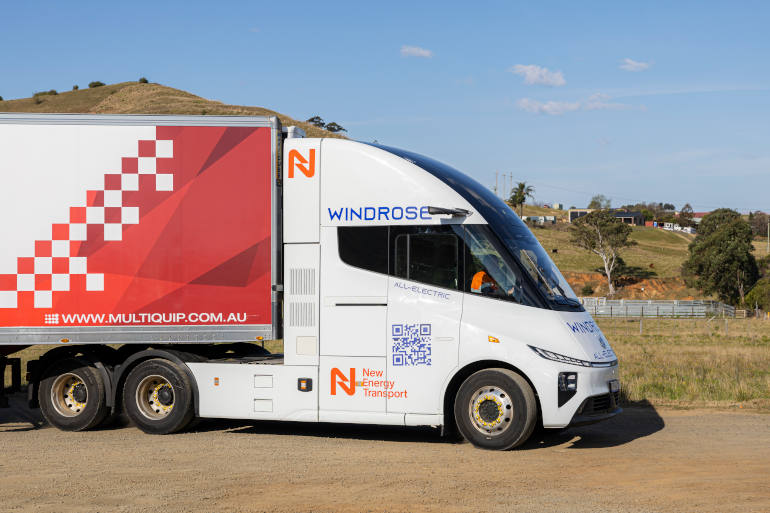


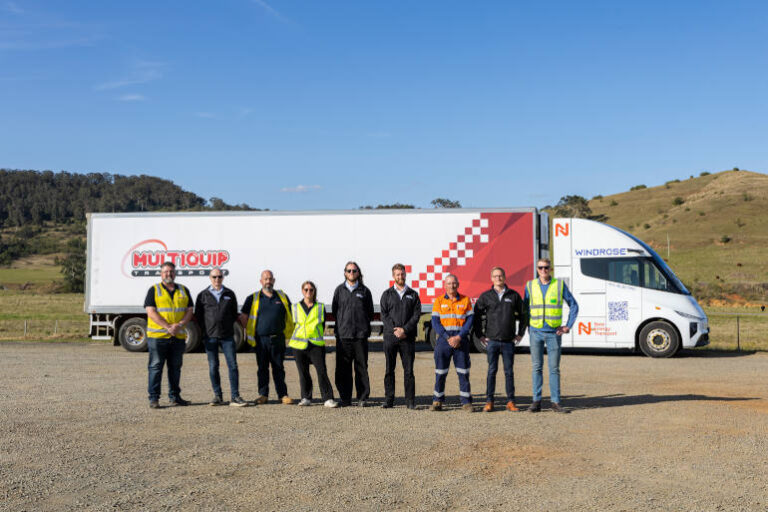
New Energy Transport (NET) has completed Australia’s longest single-charge electric heavy-vehicle delivery, successfully hauling 36 tonnes from Picton to Beresfield and back — a 480-kilometre round trip completed without recharging.
The record-setting journey, completed with partners Multiquip and Windrose, demonstrates that battery-electric heavy trucks can now match — and in some areas outperform — diesel on cost and productivity.
“This is the longest single-charge electric trucking demonstration in Australia to date,” said Daniel Bleakley, Co-CEO of NET. “The successful journey proves that it’s possible to do zero-emission road freight in a cost-competitive way while improving productivity and performance outcomes when compared to diesel-based freight.”
Faster, cleaner, and cost-competitive
On the Picton-to-Beresfield route, the Windrose electric prime mover cut 40 minutes from the usual diesel journey time — a 12 percent improvement. The truck maintained an average highway speed of 98 km/h compared with the diesel average of 85 km/h, thanks to its ability to sustain high speed on gradients where conventional trucks slow.
David Muir, National Compliance Manager at Multiquip, said the performance surprised even experienced operators.
“Timing is a huge factor for any business, particularly a just-in-time business like ours,” he said. “It was very surprising to see how much time our driver was able to save… Constantly being able to maintain that speed is amazing.”
Australia’s largest heavy-EV depot planned near Wilton
To build on the trial, NET has secured land near Wilton, south-west of Sydney, to develop what will become Australia’s largest heavy-electric-truck depot, capable of supporting up to 50 vehicles. Strategically positioned between Sydney, Wollongong and Canberra, the site will also form the launch point for future electric line-haul services linking Sydney and Melbourne.
The project has the backing of Judy Hannan MP, Member for Wollondilly, who said:
“It is wonderful to see heavy road transport becoming more environmentally friendly… The testing of the trucks shows there are alternatives that are not only better for the environment but also better for the driver and the business owner.”
A network vision for 2031
NET has already signed six Memoranda of Understanding with major transport buyers and partners and is in advanced investment negotiations to accelerate the rollout of cost-competitive zero-emission freight.
Co-CEO Fredrik Pehrsson said the company’s long-term strategy goes beyond vehicle deployment to include its own charging infrastructure.
“Our vision is based on also being able to deliver our own charging infrastructure… We’re building our own charging network to support our own electric heavy prime movers for our customers,” he said.
The company aims to establish electric freight routes between Adelaide, Melbourne, Sydney, Canberra and Brisbane by 2031 — effectively electrifying the Hume and Pacific Highway corridors.
Windrose technology leads performance breakthrough
James Walmsley, Director Business Development at Windrose Australia, said the demonstration confirms that purpose-built EV trucks can now meet Australian freight demands.
“Windrose trucks have been servicing duty cycles of over 1,000 km a day, six days a week overseas,” he said. “We’ve achieved a range of 670 km at 49 tonnes and 750 km at 31 tonnes overseas — now it’s Australia’s turn to set some records.”
The Windrose prime mover delivers 1,400 horsepower — roughly double that of a diesel equivalent — with 68-tonne B-double capability and rapid 860 kWh charging, allowing a full recharge in about an hour.
Why it matters for fleets
For Fleet Managers, the demonstration shows that heavy-duty electrification is moving rapidly from concept to commercial reality. With road freight responsible for 40 percent of Australia’s transport emissions — and the sector projected to be the nation’s highest emitter by 2030 — projects like NET’s Wilton depot provide a blueprint for operational decarbonisation.
The trial also reinforces that electric line-haul can be faster, quieter, and more efficient, while the ability to charge at dedicated depots eliminates range anxiety for scheduled freight routes.
Fleet Managers planning future procurement or infrastructure investments can expect to see new heavy-EV options capable of diesel-equivalent payloads and duty cycles, with lower running costs and stronger driver appeal.