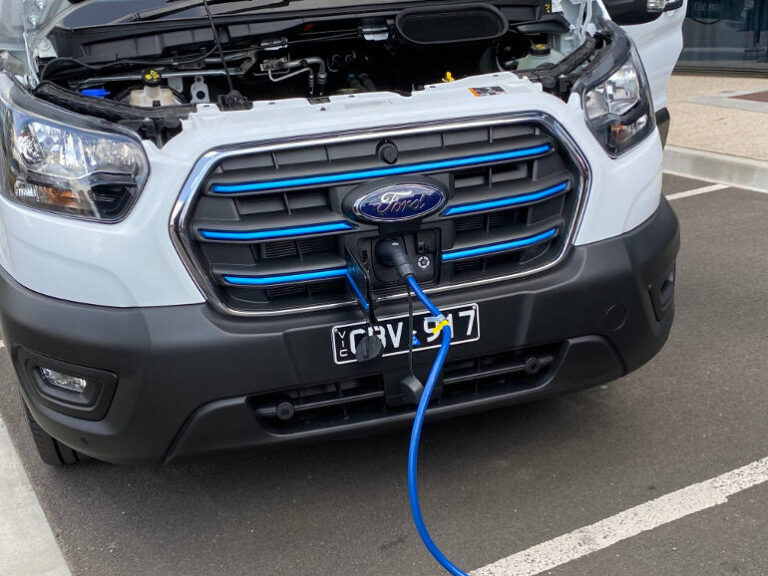
Fleet electrification has been a boardroom priority for several years, but on the ground the transition has been slower than many expected.
According to Daniel Antonello, General Manager Sales and Business Development across Australia and New Zealand at HERE Technologies, the challenge is not simply about battery range or vehicle capability.
“Go back two or three years and EV emissions was such a boardroom topic,” Antonello said. “Transport assets are typically the biggest emitters, so the first thing organisations look at when they set emissions targets is their fleet.”
However, moving from strategy to execution has proven more complex. “In reality, it’s a lot harder to do that than simply go and buy or transition a fleet to EVs,” he said.
Range anxiety is a data problem
Antonello believes the industry has misunderstood what is holding fleets back.
“The biggest issue in the early days was batteries – range anxiety and charging times,” he said. “But I don’t think that’s really the issue anymore.”
Instead, he argues the core problem is visibility.
“What causes a lot of this range anxiety is not really driven from a battery problem. It’s more a data problem.”
Daniel Antonello, General Manager Sales and Business Development across Australia and New Zealand at HERE Technologies
For fleets running route optimisation systems, EV deployment introduces new complexity. Energy use is not determined by kilometres alone. Elevation, traffic, road surface, detours and driving conditions all influence consumption.
“When you’re on the road, you’ve got to factor in not just your end point from kilometres, but traffic, elevation, road condition and detours, because that’s going to impact your energy levels,” he said.
Most optimisation tools used in transport management systems were built around fuel-based logic.
“Optimisation tools today still don’t have battery built into their conditions. It’s still using fuel consumption, cost and distance,” Antonello said. “We are bringing battery into this, but it requires a connection to the vehicle.”
For fleet operators with tight service level agreements (SLAs), that gap matters.
“If you’ve signed up to SLAs and cost commitments, it’s very hard to pass additional delivery costs through to the end customer,” he said.
Infrastructure confidence remains uneven
Even when routing can be solved, infrastructure introduces another layer of uncertainty. Antonello points to differences between personal EV ownership and fleet operations.
“As a passenger vehicle owner, you plug in at home and do your 400 kilometres,” he said. “A fleet might need to charge along the way or at a destination to finish the route.”
The challenge is not just charger location, but availability and access to live data.
“It’s really easy to drive past a petrol station and see 20 bowsers available,” Antonello said. “Not so much with EV charging. They’re often tucked around the side, and the last thing you want to do is turn up and wait 20 minutes because someone else has it.”
While standards are not the issue, data sharing is.
“It’s not a challenge for data standards and protocols. It’s more getting access to the feeds,” he said. “Some operators will open up locations, but they won’t open up reserve bays or availability.”
For national fleets, this inconsistency across states creates operational risk.
“New South Wales has been pretty proactive,” Antonello said. “But fleets are often national, and some states are not at that scale yet.”
Total cost of ownership uncertainty
Beyond operational concerns, financial modelling remains a hurdle.
“The higher upfront cost can be built into capex,” Antonello said. “But EVs are depreciating at a much faster rate than ICE vehicles, and that’s impacting balance sheet and lease pricing.”
In traditional fleet cycles, assets are moved into the second-hand market at a predictable point. That predictability is less certain for EVs.
“We know an ICE vehicle will depreciate at a very predictable rate,” he said. “EVs are a much smaller aftermarket, and it’s quite unknown.”
Battery technology evolution also influences buyer confidence. “The battery technology is evolving so fast, and connectors are evolving. You don’t want to be caught out with first-generation technology,” Antonello said.
He expects the market to stabilise as volumes grow. “The second-hand market will still need a little bit more convincing to become more mainstream,” he said.
Data maturity will determine EV maturity
For Antonello, the message to fleet buyers is clear: EV transition is as much about digital infrastructure as it is about vehicles.
Routing logic must incorporate energy consumption. Charging networks must provide reliable availability data. Financial models must reflect realistic depreciation assumptions.
“In fleet, optimisation heavily impacts the daily log of where drivers are going,” he said. “If battery logic isn’t built into that, you’re not getting ideal output.”
The industry focus is shifting from vehicle capability to ecosystem capability.
For Fleet Managers and Procurement Managers under pressure to meet emissions targets, the implication is that electrification strategy should start with data readiness, not just vehicle selection.
The battery may no longer be the biggest constraint. The integration of data, optimisation and infrastructure is.