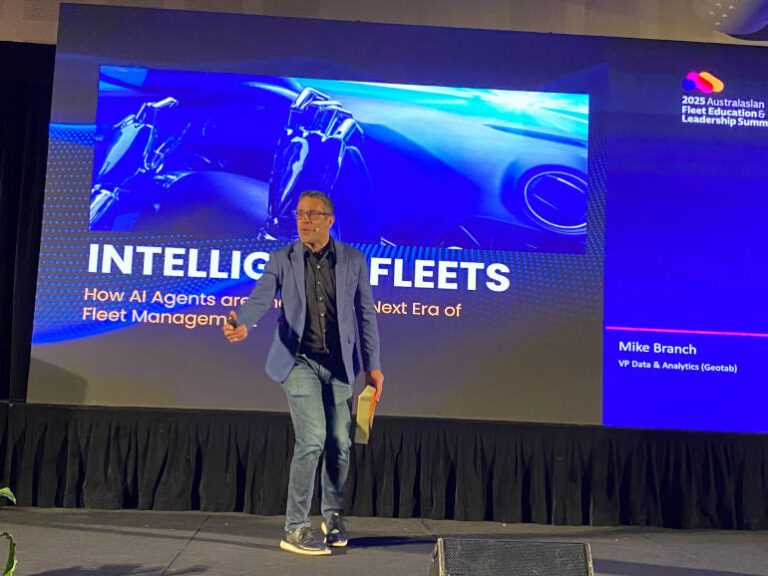
At AfMA 2025, Mike Branch—Vice President of Data & Analytics at Geotab—challenged fleet managers to rethink their role in the age of AI. In a one-on-one interview with Fleet News Group, Branch explored how artificial intelligence is shifting the nature of decision-making in fleet management—not just by generating answers, but by helping ask better questions.
“We found that people didn’t always know what to ask,” said Branch, referring to early use of Geotab’s ACE platform. “Now we’ve built up a library of common questions—mostly around safety—and we’re seeing how the role of the fleet manager is evolving from analyst to strategist.”
That evolution is being accelerated by tools like ACE, which allow managers to ask natural language questions like, “Where are my vehicles coming from before arriving at this depot?” and receive sophisticated geospatial analysis in seconds. “That kind of analysis used to take days. Now it’s immediate,” Branch explained.
From Technician to Translator
The real shift, Branch argued, is about mindset. Fleet managers no longer need to be data scientists or spreadsheet masters—they need to understand how to frame problems clearly and interpret insights effectively.
“If the pivot table is used to come up with an answer to a question, then yes—go to ACE and ask the question instead,” he said. The platform even includes “trusted insights” with a green tick, ensuring that the results are drawn from validated data, not generative guesses.
Branch believes the future belongs to fleet leaders who can move beyond reactive management to proactive planning—using AI not just for reporting, but for optimisation. “You’ll be able to say, ‘Help me optimise my fleet,’ and it will figure out where to start—whether that’s safety, maintenance, or downtime.”
The Human Role Remains Critical
Despite the increasing automation, Branch emphasised that AI won’t replace human judgement. “Anything that connects to a system can be automated,” he said. “But interpreting goals, aligning them with organisational strategy, that still requires people.”
This is especially true in areas like utilisation, where broad goals can quickly become too vague for AI to interpret. “You can’t just say, ‘I want better utilisation.’ You have to be specific—define what active means, how it’s measured, and what outcome you’re chasing.”
According to Branch, this is where many fleets are struggling—not because of lack of technology, but because of unclear strategy. “If you can’t measure every single piece, you’re going to have these agents go bananas,” he warned.
A New Role for Fleet Managers
Rather than being the person who finds the answer, the modern fleet manager becomes the person who knows which question matters most. That’s a fundamental shift—one that requires confidence, curiosity, and a willingness to let go of legacy tools.
“In the next three to five years, we’ll see far more automation,” said Branch. “But we’ll still need people who can guide the systems, trust the insights, and define what success looks like.”
In other words, the most valuable skill in the AI-enabled fleet team may soon be asking the right question at the right time.
- Sunshine West Ready for Next Wave of Electric Buses
 Kinetic has completed a major electrification upgrade at its Sunshine West bus depot in Melbourne’s west, preparing the site to operate 60 zero-emission buses by the end of 2026. The project increases the number of electric buses that can be charged at the depot from 24 to 66, while the underlying infrastructure has been designed
 - Subaru Uncharted review: An EV that still feels like a SubaruSubaru is rapidly expanding its electric vehicle range, and the new Uncharted could be the model that makes the transition to electric feel most natural for existing Subaru owners. The Subaru Uncharted is an interesting addition to Australia’s increasingly crowded electric SUV market because it doesn’t feel like Subaru has tried to reinvent itself simply
- BYD ATTO 1 Brings Right-Sized EVs into FocusBYD is strengthening the case for compact electric vehicles in Australian fleets, with a new offer on the ATTO 1 Essential highlighting the potential role of smaller EVs in urban and metropolitan applications. The ATTO 1 is BYD’s compact electric hatch, offering up to 220km of driving range under the WLTP test cycle and targeting
- How Much EV Range Does a Fleet Really Need?Ford is making the case that electric commercial vehicles should be sized around the work they actually do, rather than chasing the biggest possible battery and the longest headline range. That thinking sits behind the new Ford Transit City, which uses a 56kWh battery and offers a quoted 254km WLTP combined driving range. While that
- Kia EV6 Air review: The EV market moved on, but this Kia still gets the fundamentals rightThere is something slightly ironic about revisiting the Kia EV6 in 2026. When it arrived in Australia in 2022, it felt like one of the cars defining the electric vehicle market. It was futuristic without being strange, quick without being difficult to live with, and it came from a manufacturer that already understood what Australian