


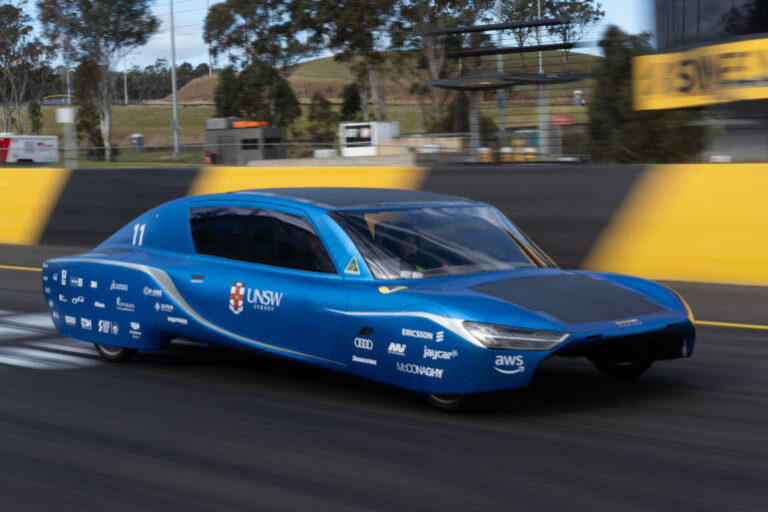
UNSW’s Sunswift Racing team is preparing for one last test with its record-breaking solar car, Sunswift 7, as it lines up for the 2025 Bridgestone World Solar Challenge.
The 3,000km endurance race from Darwin to Adelaide has long been a proving ground for zero-emission transport technologies, and UNSW’s undergraduate team wants to confirm its dominance by driving across the finish line under its own power.
From Record Holder to Champion
In 2022, Sunswift 7 entered the record books after completing 1,000km on a single charge in under 12 hours, securing a Guinness World Record. The following year, the car outperformed global rivals in the Cruiser Class, only for extreme winds to halt all competitors short of the Adelaide finish. Despite being awarded overall victory on race points, the team has unfinished business.
“In 2023, we were the fastest car in the pre-race time trial, we were ahead on the road, we were ahead on points, and we travelled further than any other team,” said Sunswift team principal, Professor of Practice Richard Hopkins.
“But along with everyone else, we didn’t finish the event, so there is a bit of unfinished business and hopefully there will be redemption this year.”
Reinvented for 2025
For this year’s race, Sunswift 7 has been re-engineered to meet new rules and deliver even stronger performance.
- Converted from a four-seater to a two-seater, the car is now 250kg lighter, weighing just 500kg in race trim.
- With an ultra-low drag coefficient of 0.095, aerodynamic efficiency remains its hallmark.
- Revised charging regulations have forced the team to rethink strategy from the ground up.
“Even though the car might look very similar to two years ago, we haven’t just been sitting around polishing it and waiting for the 2025 race,” Prof Hopkins said.
“In truth, everything’s been rewritten and we’ve had to reinvent our whole approach. It’s really a whole new team, a whole new set of regulations, and a whole new strategy approach.”
Lessons for the Fleet Sector
For Fleet Managers and Sustainability Managers, Sunswift’s journey offers a glimpse into the rapid pace of innovation in clean transport. Lightweight design, energy efficiency, and adaptability under changing regulations are the same pressures commercial fleets face when planning vehicle replacement and emissions strategies.
The team’s ability to balance durability, efficiency, and practicality reflects the challenges fleets will encounter when shifting towards solar, hydrogen, or battery-electric vehicles. Sunswift’s success demonstrates that pushing boundaries often requires combining proven technology with bold re-engineering.
Looking Ahead: Sunswift 8
While the 2025 race may be Sunswift 7’s final outing, the UNSW program is already preparing the next generation. Sunswift 8 is designed as the world’s first road-legal “tri-brid,” combining solar panels, batteries, and hydrogen fuel cells. Scheduled for a 2026 unveiling, the car aims to push the boundaries of zero-emission mobility even further.
“Sunswift 8 won’t just be the world’s first tri-brid – it will be the world’s first road-legal tri-brid. So it will be a really big deal. And all designed and built by students here in Australia,” Prof Hopkins said.
Why It Matters
For over two decades, UNSW’s solar car program has been a training ground for engineers who go on to shape the future of transport. The 2025 challenge is more than a race – it’s a live testbed for innovation that will influence the vehicles fleets adopt in the years ahead.
As Prof Hopkins noted:
“Last time, we proved we’re the best in the world by the numbers. But for this amazing group of undergraduate students, nothing will feel as sweet as driving Sunswift 7 right into Adelaide’s heart as winners again, with the whole team waiting under the finishing banner.”




