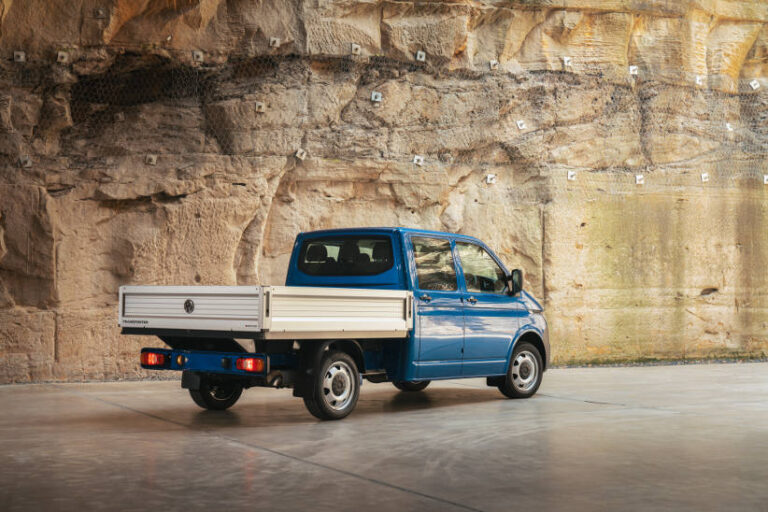
Volkswagen Commercial Vehicles is set to shake up the light commercial segment in mid-2026 with the launch of a battery-electric Transporter Cab Chassis — a six-seat dual-cab workhorse designed not for lifestyle buyers, but for organisations that move both people and equipment every day.
It might not have the street presence of an Amarok with a two inch lift kit and aggressive mud-terrain tyres, but for Fleet Managers focused on safety, efficiency, and sustainability, the Transporter BEV Cab Chassis could be the most sensible new vehicle on the market next year.
A Dual Cab Ute for Fleet Operators
The new Transporter BEV Cab Chassis will be the second all-electric dual-cab ute from a mainstream manufacturer offered in Australia. Built on the same platform as the recently launched Transporter T7 van, the new variant combines a six-seat cabin with a versatile tray back that can be adapted for toolboxes, service bodies, or site gear.
Under the skin sits Volkswagen’s 210 kW / 415 Nm single-motor electric drivetrain — the same proven setup from the Transporter BEV van. Power is sent to the rear wheels through a single-speed transmission, fed by a 64 kWh lithium-ion battery that supports 125 kW DC fast charging for a 10–80 percent top-up in around 38 minutes.
While range and payload figures are still being finalised for the cab chassis, the BEV van delivers an estimated 330 km (WLTP) range, with payloads between 760 kg (LWB) and 806 kg (SWB) and a 2.3-tonne braked towing capacity. Expect the dual-cab variant to offer comparable numbers — more than enough for most trade, utility, and local-government applications.
Purpose-Built for Fleet Use
During the Australian media launch, Nathan Johnson, Director of Volkswagen Commercial Vehicles Australia, described the cab chassis as “a niche but highly capable addition to the Transporter family” — one designed for fit-for-purpose fleets, not lifestyle buyers.
“It sits in the pickup segment, but this isn’t about lifestyle. The Transporter dual cab gives us a solution for organisations that need to carry both people and gear, and it creates new possibilities for converters in areas like refrigerated transport, utilities, and even mining,” Johnson said.
The Transporter BEV Cab Chassis will feature six seats, making it ideal for council work crews, maintenance teams, and contractors needing to move workers and equipment in one vehicle instead of running separate vans and utes.
Volkswagen’s Conversions and Partner Solutions team, led by Andrew Hester, is already working with Australian upfit partners to ensure the cab chassis is compatible with existing tool-body systems and service-body frameworks. That includes collaborations with Frontline, AutoSafe, and Sortimo, ensuring accessories and custom builds can be ordered and financed through Volkswagen’s Approved Converter network.
Fleet-Friendly by Design
Like the rest of the new Transporter range, the BEV Cab Chassis will be designed for fleet simplicity and safety. It’s expected to share the van’s robust safety suite, including:
- Front Assist with pedestrian and cyclist detection
- Adaptive Cruise Control with predictive speed limiter
- Lane Assist and Blind Spot Monitoring
- Reverse Emergency Braking
- Traffic Sign Recognition and Dynamic Road Sign Display
- Rear View Camera and Park Distance Control
Inside, the cabin will mirror the Transporter BEV’s digital workspace, featuring a 13-inch touchscreen, 12-inch digital cockpit, wireless App-Connect, seven USB ports, and multiple storage compartments.
For fleets managing total cost of ownership, Volkswagen has confirmed that the BEV Transporter’s service interval will match the diesel version — every 12 months or 30,000 kilometres — with roadside assistance included after each scheduled service.
Fit for a Low-Emission Future
While lifestyle buyers will continue to flock to diesel and hybrid dual-cab utes, the Transporter BEV Cab Chassis represents something different — a fit-for-purpose electric alternative for government, utilities, and corporate fleets with clear emissions-reduction targets.
Daniel DeGasperi, Acting General Manager Corporate Communications at Volkswagen Group Australia, says the Transporter BEV line-up provides “an enormous leg-up” for fleets under pressure to decarbonise operations.
“Fleets have CO₂-emission pressures just like manufacturers. With the Transporter and ID. Buzz ranges, we can now offer electric commercial solutions that fit real-world duty cycles,” he said.
Volkswagen expects demand to grow gradually as fleet operators trial BEVs in specific applications and gain confidence in their performance, charging reliability, and total-cost advantages over diesel equivalents.
A New Electric Option for Practical Fleets
Set to arrive in the second half of 2026, the Volkswagen Transporter BEV Cab Chassis will give Fleet Managers something the Australian market has lacked — an electric dual cab with the payload, towing, and seating to do a day’s work.
It won’t appeal to those shopping for a weekend adventure vehicle, and that’s precisely the point. This Transporter is about practicality, not posing — a fleet-grade electric workhorse designed to get people and gear where they need to go, quietly and efficiently.
For fleets ready to carry six people, a full load of tools, and zero tailpipe emissions, Volkswagen’s new Transporter BEV Cab Chassis might be the most logical electric ute of all.