


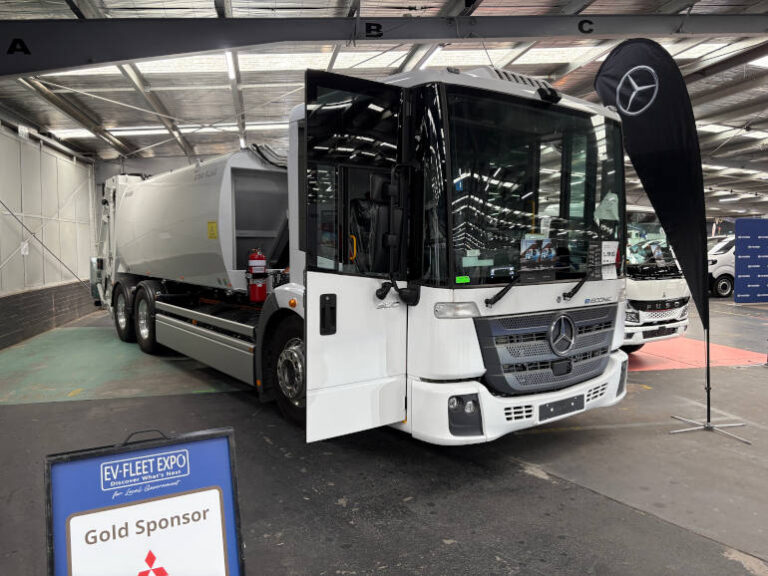
Daimler Truck Australia Pacific has marked a major milestone in its electric vehicle program, unveiling the first Mercedes-Benz eEconic in Australia fitted with a fully operational Bucher rear-loader waste body. After years of showing the low-entry cab at industry events, this is the first time the eEconic has been presented in a ready-to-work waste configuration — a turning point for councils and contractors preparing for zero-emission waste collection.
Romesh Rodrigo, Head of Regulatory Affairs and Emerging Mobility Sales at Daimler Truck Australia Pacific, said the truck arrived at the Fleet EV Expo for Local Government straight from Bucher’s workshop — with the build so fresh that the paperwork was still taped to the windscreen.
He described the moment as the transition from concept to reality. The eEconic is configured as a six-by-two waste collection platform, engineered specifically for dense urban environments and central business districts. Rodrigo noted the deep windscreen and low-entry layout provide visibility “unrivalled for inner-city operation,” and the crew-cab format pairs naturally with rear-loader duties.
A key breakthrough was integrating Bucher’s traditional hydraulic body with the factory electric power take-off (PTO) system. Rodrigo said Bucher had been “proactive and pragmatic” in working through the new interface requirements, ensuring the body performs exactly as operators expect. While Bucher was chosen for this first build, Daimler is simultaneously assembling another eEconic rear loader with Superior Pak — signalling strong engagement from Australia’s body-building sector.
Interest in the vehicle is already strong among major waste contractors. Rodrigo said the large national operators — Cleanaway, Remondis, Veolia and others — are leading early demand, with the first unit set to enter real-world testing with a major fleet customer. Although this will be the initial Australian deployment, he emphasised that the technology is mature, with eEconics already operating in waste applications across Europe for several years.
While rear-loader applications are the immediate focus, Rodrigo acknowledged that side-loader electrification remains technically challenging due to dual-control requirements and more complex body integration. He said Daimler’s approach is to prioritise fit-for-purpose deployments, learn from in-service data, and expand once the engineering and operational parameters are fully validated.
Beyond the electric drivetrain, the eEconic brings several safety and ergonomic advantages. Rodrigo highlighted the left-side concertina door, which allows crews to exit without the door swinging into traffic or obstacles — particularly valuable in laneways, alleyways and airport environments where space is tight. Air suspension front and rear enhances ride quality and supports the low-entry design that reduces operator fatigue during frequent stop-start collection cycles.
The arrival of a fully operational eEconic marks a significant step in the decarbonisation of waste fleets, particularly for councils where waste collection is one of the highest-emitting service categories. With Bucher and other body builders now proving compatibility, Daimler’s Australian rollout is moving from display stands to real-world conditions — and the industry is paying close attention.
More units are expected to follow as testing progresses, providing a pathway for councils and contractors seeking genuine zero-emission options that don’t compromise on daily productivity.
- Why Fleet Depots Should Plan EV Charging Around Energy, Not Charger Power
 One of the first questions fleet managers ask when planning electric vehicle charging is: how much electrical capacity will we need? It sounds straightforward. If a depot installs ten 22kW chargers, it could appear that the site needs more than 200kW of additional capacity. The experience of three Melbourne councils suggests that this can be the
 - Too many apps and accounts: The hidden complexity of fleet EV chargingAdding electric vehicles to a fleet can reduce reliance on petrol and diesel, but it can also introduce a completely different administrative problem for Fleet Managers: paying for public charging. Unlike the established fuel card model, public EV charging can involve multiple charging networks, apps, accounts, credit arrangements and invoices. Matt Arthur, Vice President Mobility
- Apartment EV Charging Gets a Boost Under NSW ReformsProposed changes to strata laws in NSW could make it easier for apartment residents to install electric vehicle chargers, but industry experts are warning that removing approval barriers is only one part of the transition to widespread EV charging. The reforms come as organisations continue to identify capital costs, skills shortages and regulatory complexity as
- NSW Backs EV-Friendly TownsRegional towns across New South Wales are being encouraged to see electric vehicle charging infrastructure as more than a transport issue, with a new program aiming to recognise communities that are making themselves easier and more attractive for EV drivers to visit. The NSW Government and Electric Vehicle Council (EVC) have launched the EV Friendly Towns program,
- Evie Fast Chargers Coming to Coles StoresColes and Evie Networks will install fast electric vehicle charging at up to 30 supermarkets across Australia, allowing drivers to recharge while completing their weekly shop. The two-year rollout will place direct current fast chargers at selected Coles locations, beginning with Middle Camberwell in Victoria. The first site features Kempower charging technology, with up to