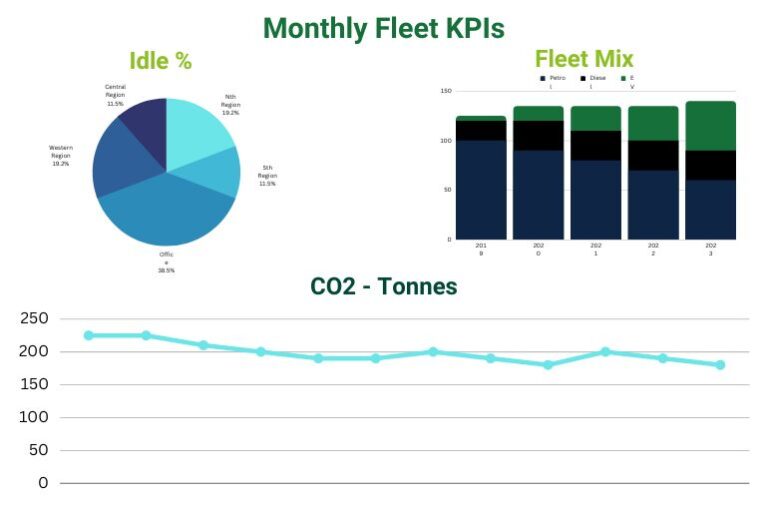
At Geotab Connect 2026, the EV conversation moved quickly past vehicles and charging infrastructure and into a more demanding question: how do fleets turn electrification data into reporting that holds up in executive and board discussions?
In an exclusive interview, Neil Cawse, CEO and Founder at Geotab, Mike Branch, VP Data and Analytics at Geotab, and Sabina Martin, VP Product Management at Geotab, each described a common shift underway — from “insights” to outcomes that can be measured, tracked, and defended.
From insights to outcomes executives care about
Branch framed the problem clearly: many tools can generate insights, but that doesn’t automatically translate into results.
“Oftentimes, there’s so many solutions out there that give you insights, but it doesn’t translate insight to outcome.”
He linked this directly to the outcomes organisations are now expected to demonstrate:
“We’re trying to reduce collisions, we’re trying to reduce emissions, we’re trying to reduce downtime.”
For fleet leaders, that’s the shift. The question isn’t whether you have EV data — it’s whether you can show, with practical indicators at scale, that the program is delivering on its targets.
Turn fleet goals into objective KPIs
Cawse’s advice was to make fleet performance legible to the business by translating fleet activity into measurable KPIs tied to company goals.
“Turn what you do into like objective KPIs, like measures that can be tied back to the goals of the company.”
He gave examples of how fleet outcomes are often defined in executive terms:
“I need a safer fleet. I need to save money on fuel.”
And the discipline required to make reporting credible over time:
“If you can create a number and you can track it… you can follow the progress over time.”
That approach matters for EV transition reporting because boards increasingly want to see trendlines, normalisation (so comparisons are fair), and evidence of what’s working versus what isn’t.
Reverse-engineer the data you need for the KPI
Martin described a practical method for building reporting that aligns with executive expectations: start with the KPI, then work backwards to define the data requirements.
“The key is to start with those customer KPIs, and then we reverse engineer. What data do we need to actually achieve solving that problem?”
She also highlighted a real-world challenge for EV fleets: keeping data consistency as vehicles change over time.
“How do we make sure that we continue to support those data sets as they procure new vehicles to maintain that support.”
This is where EV reporting can get messy in mixed fleets: if the data set changes by model, brand, or generation, the KPI story becomes harder to defend.
Make it board-ready: translate performance into cost and risk
Beyond emissions reporting, the discussion also went to the heart of internal buy-in: connecting fleet performance to financial language decision-makers respond to.
Martin put it bluntly:
“You want the product to be able to… demonstrate those KPIs and ROI for the business.”
She described why converting operational signals into dollars matters in executive settings:
“Here is your risk of breakdown, so you can translate that into cost when you’re getting into a board meeting and get people bought in.”
For EV programs, that same principle applies to executive reporting: emissions improvements are important, but boards often move fastest when emissions, risk, downtime, and cost are presented together as a single performance narrative.
The EV reporting challenge is now a governance challenge
The takeaway from the interview with the leadership team at Geotab Connect 2026 is that the next phase of fleet electrification will be judged less on ambition and more on accountability. Fleets will be expected to show progress against emissions targets in ways that stand up to executive scrutiny — through objective KPIs, stable data sets, and reporting that connects operational performance to cost, risk, and outcomes.
- Parramatta found a simple way to tackle EV resistance
 Range anxiety isn’t always solved with another spreadsheet. Sometimes you need to hand someone the keys. That’s one of the lessons from City of Parramatta’s fleet electrification program, where an EV drive week has become an important tool for building employee support for the transition. Speaking at Everything Electric Sydney during a panel featuring finalists
 - Ausgrid’s charging strategy goes well beyond the depotInstalling chargers at the depot might be the obvious starting point for fleet electrification. For Ausgrid, it wasn’t going to be enough. As the electricity network continues electrifying passenger vehicles, vans and trucks, it has developed a charging strategy designed around how employees actually use fleet vehicles. Speaking during the Fleet News Group Awards finalists
- For Allianz, EVs are now business as usualFor many organisations, fleet electrification still means pilots, trials and discussions about what might happen next. At Allianz, the conversation has moved on. After starting its transition with a small pilot of 12 vehicles two years ago, the insurer has reached the point where electric vehicles are becoming part of its normal fleet replacement process.
- A Charger That Powers Up Isn’t Finished: Why Commissioning Matters for Fleet EV ChargingAn EV charger can be installed, connected and apparently operating — and the charging system can still be wrong. That is one of the more important lessons from the Local Council EV Integration Project involving Wyndham, Brimbank and Moonee Valley councils. As fleet charging installations become larger, depots are adding not only chargers but load
- How to Install EV Charging Without Shutting Down the DepotBuying electric vehicles may be the visible part of fleet electrification, but much of the hard work can happen underground. Trenching, conduits, electrical upgrades, switchboards, charger foundations, communications, traffic management and electrical shutdowns all need to be completed while the depot continues doing its normal job. Experience from the Local Council EV Integration Project involving