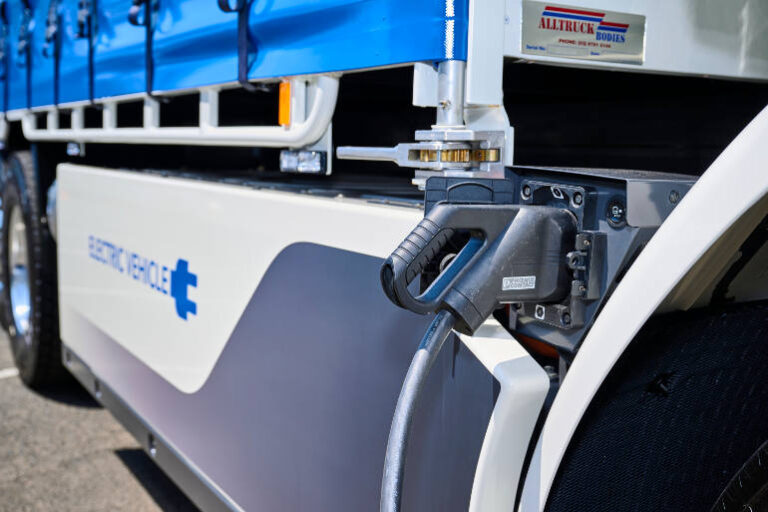
For years, the conversation around fleet electrification has centred on vehicle range, payload, purchase price and charging technology.
Speaking to the founders of Country Fleet, one of Australia’s fastest-growing electric delivery operators, at Sustainability Business Live, the biggest challenge isn’t the trucks themselves. It’s charging.
After building a fleet of almost 30 electric vehicles across Victoria, Western Australia, New South Wales and South Australia, Co-Founders Jaskirat Singh Ghuman and Lakshay Ahuja have learned that electric trucks can do the job. The bigger question is whether operators can make charging practical, efficient and profitable.
“We have started from the ground and we know every aspect,” said Ghuman. “If you have to work EV, as in for Country Fleet, you have to make it sustainable. It should work for the drivers number one.”
Electric Trucks Are Already Doing the Work
Country Fleet started in 2024 with just two electric vehicles delivering for IKEA. Today the company operates electric trucks and vans for major retailers including IKEA, JB Hi-Fi, Winnings and Appliances Online.
The business has successfully deployed electric trucks in some of Australia’s most challenging operating environments, including Western Australia, where charging infrastructure remains less developed than the eastern states.
“We bought two Fotons for IKEA WA, and those Fotons were first electric vehicles for the whole state that worked in WA,” said Ghuman.
The company has also demonstrated that longer delivery routes can be completed using electric vehicles.
“There was a route which was doing over 250 kilometres to 300 kilometres, so we got that route to be done on EV instead of a diesel,” said Ahuja.
The vehicles worked. The routes worked. The customers were happy. The challenge was everything that happened before and after the deliveries.
The Hidden Cost of Public Charging
Like many operators entering the EV market, Country Fleet initially relied on a combination of depot charging and public charging infrastructure.
What they quickly discovered was that charging wasn’t just costing money—it was costing productivity.
“Most of the drivers rent out homes, so they can’t put a charger on their rental property,” said Ghuman.
As a result, many drivers were forced to queue at public charging stations before starting work.
“They used to wait in line at public chargers in the morning, waste their one hour, spend $60 to $65 a day to charge, and then start their run,” he said.
That one hour may not sound significant until it is multiplied across an entire fleet.
“We have got about 40 to 45 people in Victoria working for Country Fleet,” said Ghuman. “If they spend one hour of their day, that will be 45 hours just wasted on charging.”
For a delivery business operating under tight schedules and customer commitments, that lost time quickly becomes expensive.
“That’s costly, that’s frustrating, and that’s inefficient,” he said.
Driver Acceptance Matters More Than Technology
One of the recurring themes throughout Country Fleet’s growth has been the importance of designing EV operations around drivers rather than vehicles.
While much of the industry debate focuses on batteries, chargers and vehicle specifications, Ghuman believes Fleet Managers need to think differently.
“It needs to work for the driver,” he said. “Driver is happy, he’ll drive and he’ll deliver the stuff. Then it will work for the financials.”
The founders argue that many electrification projects fail because organisations focus on spreadsheets before considering how the vehicles fit into day-to-day operations.
“It has to go not top to bottom, but bottom to top,” said Ghuman.
Making drivers spend extra time finding chargers, waiting in queues or dealing with charging uncertainty creates resistance to EV adoption.
“We need to make it easy for drivers so that they say yes, that I am okay to drive an EV,” he said. “There shouldn’t be resistance.”
Building the Missing Piece
To solve the problem, Country Fleet is investing in its own dedicated charging hub in Melbourne.
Rather than simply installing chargers, the company has designed the site around the practical needs of delivery operators.
Drivers will be allocated dedicated charging bays where vehicles can be parked overnight, charged and prepared for the next day’s work. The concept is aimed particularly at owner-drivers and operators who do not have access to depot charging or suitable charging facilities at home.
The facility is being developed in partnership with EVSE and will accommodate around 40 vehicles.
For Ghuman and Ahuja, the project represents a natural evolution of the lessons they’ve learned operating electric vehicles in the real world. Rather than seeing charging as an energy problem, they see it as an operational challenge.
The goal is simple: eliminate wasted time and make electric vehicles easier to operate than diesel vehicles.
The Next Phase of Fleet Electrification
As more organisations commit to fleet emissions reduction targets, attention is often focused on vehicle procurement.
Country Fleet’s experience suggests that fleets may be looking in the wrong place. The electric trucks are already available. The vehicles are already proving themselves in demanding delivery applications.
The next challenge is building charging systems that work for the people using them. For Ghuman, the solution comes down to one simple principle.
“Kill the resistance and build an infrastructure so that it’s easier for the drivers.”
It is a lesson learned from experience rather than theory—and one that many fleets may need to understand before their own electrification programs can succeed.