


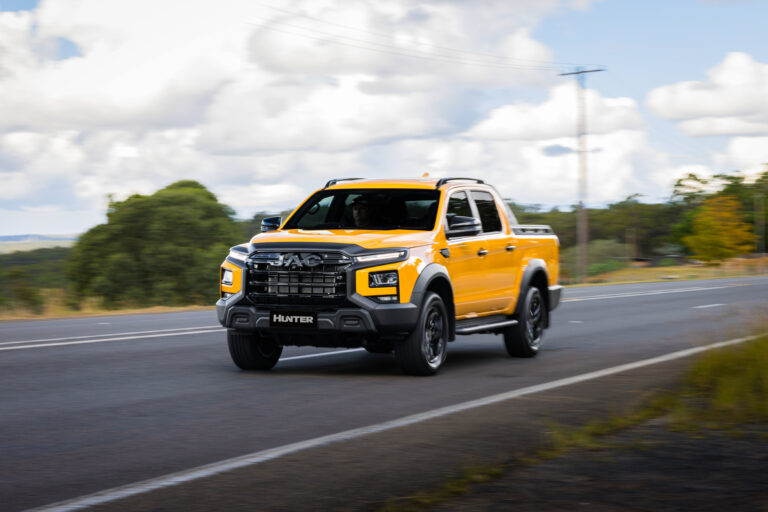
JAC Motors Australia has confirmed pricing for its new Hunter plug-in hybrid ute, positioning the dual-cab 4×4 as one of the most affordable electrified work vehicles entering the Australian market.
The Hunter Pro 4×4 will start from $49,988 plus on-road costs, while the higher-specification Hunter X 4×4 will be priced from $54,844 plus on-road costs. Vehicles are expected to begin arriving in Australian showrooms during August 2026.
For fleet operators considering a transition away from diesel, the pricing could make the Hunter an important new option. Its plug-in hybrid powertrain offers up to 100km of electric-only driving while retaining a petrol engine for longer journeys, towing and operations where charging infrastructure remains limited.
Strong performance and towing credentials
The Hunter combines a 2.0-litre turbocharged petrol engine with front and rear electric motors.
JAC quotes total system output of 360kW and combined driveline torque of 1010Nm. The manufacturer says this gives the Hunter the highest power output among the plug-in hybrid utes currently competing in Australia.
Both variants offer up to 3500kg of braked towing capacity and a payload of 915kg, giving the Hunter specifications that should allow it to compete for genuine work applications rather than being limited to lifestyle buyers.
The Hunter also has a claimed combined range of 1005km and an official combined fuel-consumption figure of 1.6L/100km under NEDC testing.
As with all plug-in hybrid vehicles, however, real-world fuel use will depend heavily on how often the battery is charged and how the vehicle is operated. Fleets completing regular daily routes within the electric range may achieve significant fuel savings, while vehicles driven long distances without regular charging will rely more heavily on the petrol engine.
Tested for Australian conditions
Before customer deliveries begin, JAC says the Hunter will have completed more than 100,000km of local testing.
The development program included towing, load carrying, durability testing, hot-weather operation and on-road and off-road evaluation. Australian vehicle dynamics engineer Michael Barber oversaw the local tuning program, with JAC stating that his recommendations have been incorporated into the production vehicle.
“In Australia, respect isn’t given to a ute. It’s earned,” JAC Motors Australia Managing Director Ahmed Mahmoud said.
“This isn’t a trade-off between price and capability. It’s proof that premium performance, advanced hybrid technology and genuine capability don’t have to come with a premium price tag.”
Local validation will be particularly important for fleet buyers assessing ride quality, handling under load and durability across regional and remote operating environments.
Hunter Pro and Hunter X compared
The Hunter Pro and Hunter X share the same plug-in hybrid powertrain, towing capacity, payload, electric range and core performance figures.
The Hunter X adds several comfort, appearance and off-road features, including front and rear differential locks, heated front seats, a 360-degree camera, front parking sensors, power-folding mirrors, black roof rails, privacy glass and a rear 220-volt accessory socket.
A new option for fleet electrification
The arrival of another plug-in hybrid ute broadens the choices available to organisations that need towing, payload and regional driving capability but are not yet ready to move directly to a fully electric ute.
The Hunter’s relatively low entry price could also help fleets build a business case around reduced fuel use without accepting a large increase in acquisition cost.