
Fleet electrification does not necessarily mean moving every vehicle directly from petrol or diesel to battery electric.
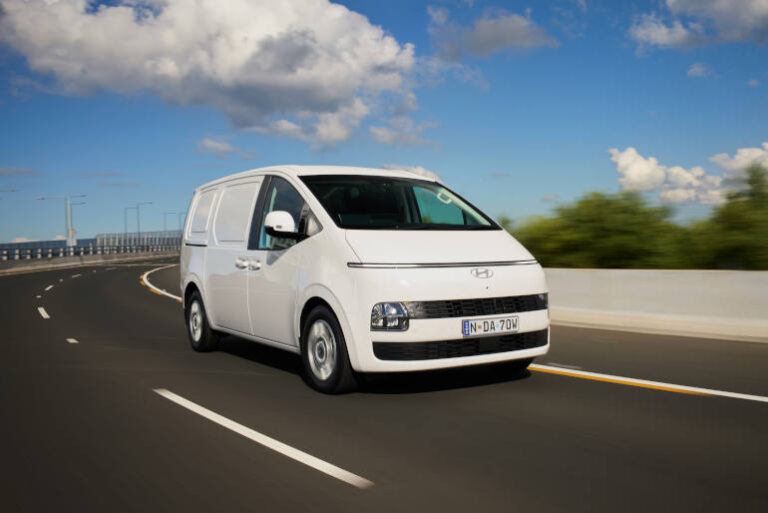
Hyundai Australia is seeing strong fleet interest in its Staria Load Hybrid while customers are already asking to evaluate the forthcoming electric version, suggesting many organisations are taking a staged approach to reducing fuel use and emissions.
Akshat Ahuja, Senior Manager, Fleet at Hyundai Australia, said the hybrid version is attracting attention from fleet operators looking to reduce running costs without introducing charging requirements.
“For the fleet customers or any customers, out in the regional areas, or who do a lot of driving every day, they can still get their business done with very low running costs and also reducing the emissions with Staria Load Hybrid,” Ahuja said.
Evaluation vehicles heavily booked
Ahuja said Hyundai has placed Staria Load Hybrid evaluation vehicles around Australia to allow fleet customers to assess the vehicle in their own operations.
Demand for those vehicles has been strong.
“The evaluation vehicles that we put in each state are fully booked out for the next few months because everyone wants to evaluate those vehicles so they can place the order,” he said.
That evaluation process is particularly important for commercial fleets.
Unlike private buyers, Fleet Managers need to assess whether a lower-emission vehicle can complete established routes, carry the required loads and operate without creating additional downtime or infrastructure problems.
For fleets that cover high daily kilometres or operate outside metropolitan areas, hybrid technology can therefore offer an intermediate option where a battery electric vehicle is not yet practical.
Electric Staria Load next
Hyundai is also preparing to add a battery electric Staria Load to the Australian range.
Ahuja said during the interview that production had commenced and the vehicle was expected to reach Australia by October 2026, although detailed Australian specifications had not yet been announced.
Fleet customers are already seeking access to evaluation vehicles.
“We are already receiving a lot of inquiries about our Staria Load electric van,” Ahuja said.
“Our regional fleet managers, I talk to them every week, everyone wants to know how soon they can get the evaluation vehicle so they can start taking it out to the customers who have been waiting for this.”
The electric Staria Load is expected to provide another option for fleets that can match daily utilisation with charging access.
Ahuja referred during the interview to a range of up to approximately 400 kilometres, while stressing that detailed Australian specifications were still to be announced.
V2L could have commercial value
Vehicle-to-load technology could also make an electric van more useful in some fleet applications by allowing stored battery energy to power external equipment.
Asked whether the electric Staria Load would offer the feature, Ahuja said final specifications had not been confirmed.
“It would make absolute sense to have that in that vehicle, especially for the tradies who are out doing their day-to-day jobs,” he said.
“They should be able to, plug in their tools or whatever, and utilise that energy to be able to use those tools as well.”
However, he cautioned that Hyundai was yet to announce the final specification.
More than one path to lower emissions
The emerging fleet interest in both Staria Load Hybrid and the electric model highlights an important point for Fleet Managers developing emissions reduction plans.
Different applications can require different powertrains.
A metropolitan vehicle returning to base every night may suit battery electric operation. A vehicle covering long distances across regional areas may currently be easier to operate as a hybrid.
Rather than waiting for one technology to suit every application, fleets can assess each replacement according to utilisation, operating environment, infrastructure and whole-of-life cost.
The strong demand Hyundai says it is seeing for both versions of the Staria suggests fleet buyers are already taking that approach.