


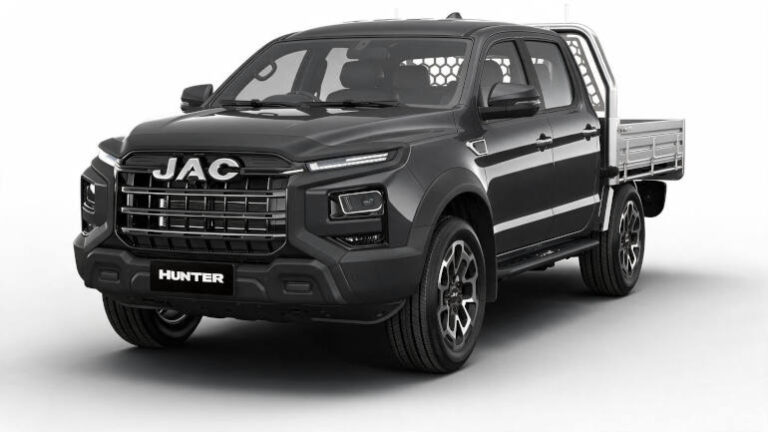
Strong fleet demand has prompted JAC Motors Australia to confirm a Cab Chassis version of its Hunter plug-in hybrid ute, with the work-focused model scheduled to arrive in Australia in early 2027.
The dedicated Cab Chassis will be aimed at tradies, farmers and fleet operators, with the platform designed to accept trays, canopies, toolboxes and other specialised bodies.
It follows the Australian launch of the Hunter PHEV dual-cab, which has started arriving at JAC dealerships.
“More than half of the prospective fleet customers we are speaking with want a Cab Chassis,” said Ahmed Mahmoud, Managing Director of JAC Motors Australia.
“That is a clear signal that Australian businesses are looking for a more flexible PHEV work platform.”
Plug-in hybrid option for working fleets
While final specifications remain to be confirmed, JAC expects the Cab Chassis to use the same core powertrain as the Hunter PHEV dual-cab.
That would give it up to 100km of pure-electric driving range under NEDC testing, allowing fleets with suitable duty cycles to complete shorter journeys on battery power while retaining a petrol engine and 77-litre fuel tank for longer trips, towing and regional work.
JAC is quoting 360kW of power, a 3.5-tonne braked towing capacity, NEDC fuel consumption of 1.6L/100km, CO₂ emissions of 38g/km and up to 1,005km of theoretical combined range for the Hunter PHEV powertrain. Actual fuel use and range will vary with operating conditions, vehicle configuration and accessories.
For fleet operators, the significance of the Cab Chassis is less about outright performance and more about giving businesses another electrified option in a part of the market where payload, body configuration, towing and regional capability remain important purchasing criteria.
A PHEV configuration may also appeal to organisations that want to increase electric kilometres without moving immediately to a fully electric ute across every application.
Vehicle-to-Load adds worksite capability
The Hunter PHEV Cab Chassis is also expected to offer 3.3kW Vehicle-to-Load capability, allowing compatible tools and equipment to be powered directly from the vehicle.
JAC’s Idle Charge system can use the petrol engine to replenish the battery while the vehicle is stationary, which could allow operators to maintain battery charge when using Vehicle-to-Load at remote sites or locations without another convenient power source.
Drivers will also have access to different power and energy-management settings, including a HEV mode that manages the balance between petrol and electric operation according to driving and energy requirements.
“The Cab Chassis will give operators the freedom to configure the vehicle around the job,” Mahmoud said.
That flexibility will be important for fleet buyers because the usefulness of a cab-chassis vehicle often depends as much on the body fitted behind the cab as it does on the underlying vehicle.
JAC says information on genuine body and tray options will be released closer to launch.
Fleet support part of the pitch
JAC is also positioning its ownership package as part of the Hunter’s fleet proposition.
The Cab Chassis is expected to receive a seven-year, unlimited-kilometre vehicle warranty that includes commercial use, seven years of capped-price servicing and roadside assistance, plus an eight-year/150,000km battery warranty.
The company’s Ute-for-Ute Warranty Loan Program is also designed to provide eligible owners with a replacement JAC ute during warranty repairs.
For fleets considering a relatively new brand, aftersales support, parts availability and vehicle uptime will be important considerations alongside the drivetrain and purchase price.
“The majority of our local team is focused on product and aftersales because we know those areas are critical to our customers,” Mahmoud said.
“For fleet operators in particular, vehicle uptime directly affects their business.”
Pricing, final specifications, available configurations and the confirmed Australian launch date for the Hunter PHEV Cab Chassis will be announced closer to its arrival in early 2027.