


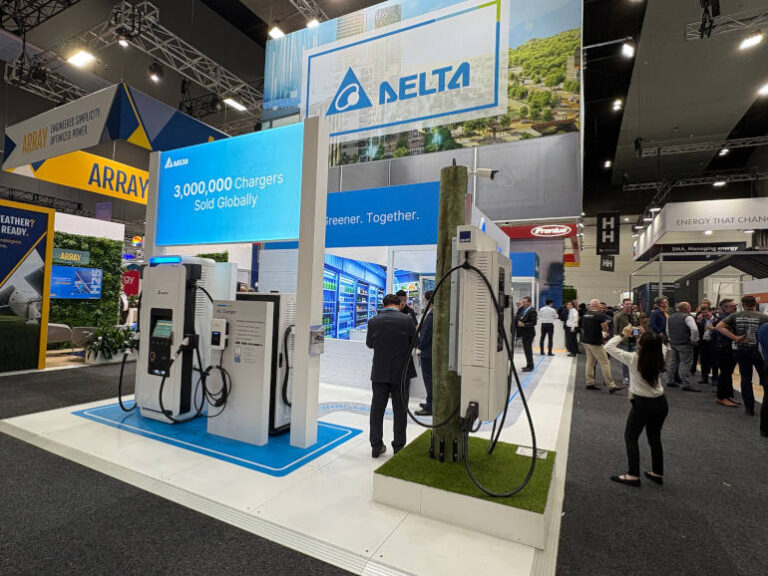
Australia has taken a major step forward in solving one of the most persistent problems in EV adoption—how to charge electric vehicles in dense urban areas where off-street parking is limited. At All Energy 2025, Delta Electronics unveiled Australia’s first pole-mounted DC fast charger, a breakthrough that enables fast, low-cost charging directly from existing street power infrastructure.
For fleets operating in cities, councils planning kerbside projects, or CPOs searching for profitable urban sites, this development marks a significant shift in what’s possible.
A Fast-Charging Solution Designed for the Realities of Australian Streets
Unlike the AC pole-mount chargers already trialled in pockets of Australia, Delta’s new 50 kW DC charger is in a league of its own. It uses existing distribution network service provider (DNSP) poles with low-voltage three-phase supply—meaning it can be installed without digging up footpaths, pouring new concrete, or waiting for costly grid upgrades.
The result is the first DC charger in Australia that delivers meaningful charging speeds in a two-hour parking zone.
According to Delta’s EV sales specialist Matt Nolan, reaction from CPOs has been immediate:
“Why hasn’t someone done this sooner?”
He says that once Delta began talking with CPOs, it became obvious the business case was compelling. Installation becomes close to a “virtual fixed cost”, with operators largely paying only for labour, lifting equipment and DNSP approval.
Addresses the Dwell-Time Challenge in High-Density Suburbs
The charger delivers up to 50 kW through a single plug, or 25 kW each when used simultaneously. Crucially, it can take an average EV from 20% to 80% in roughly two hours, perfectly aligning with existing 2P parking limits.
For inner-city drivers who do not have off-street parking—an increasing segment given the surge in affordable BEVs—this is the charging model that finally fits their daily routine.
“AC pole-mount chargers simply don’t provide enough energy in those timeframes,” Nolan explains. “If you’re parked for two hours to grab dinner or shop, AC won’t move the needle. A 50 kW charger does.”
A DNSP-Led Model That Can Scale Nationally
Delta developed the pole-mounted DC charger with distributor NHP and Essential Energy, which identified around 80,000 poles in its network that are technically suitable for this type of deployment. Of those, as many as 8,000 locations could become ideal kerbside charging sites.
The three critical requirements:
- A pole in front of a parking space
- A pole in good condition
- Low-voltage three-phase supply already connected
With these conditions met, installation is fast and approvals are streamlined. Nolan says DNSPs are increasingly motivated to help because co-location creates a predictable revenue stream for them.
Other DNSPs around Australia are already taking notice. While Essential Energy led the way with specifications and safety requirements, CPOs expect similar frameworks to roll out across the country.
Lower Costs, Faster ROI and a Better Business Case for CPOs
For charge point operators, kerbside charging has historically been slow, expensive and constrained by:
- complex civil works
- AC chargers with limited utilisation
- inconsistency in council permitting
- costly grid upgrades for fast charging
Delta’s pole-mount DC model cuts through those barriers.
What improves the business case?
- No need for concrete footings or trenching
- No transformer upgrades
- Lower installation labour
- DNSP-approved design reduces planning headaches
- Higher revenue per hour than AC charging
With installation time measured in hours—not days—the speed to market is also dramatically improved.
Supporting Fleets That Operate in Tight Urban Networks
While the charger is aimed at public kerbside use, the model has several implications for fleets:
- More reliable charging for take-home vehicles – Fleets relying on employees who park on-street in apartments or older urban areas finally have access to meaningful overnight or “during-shift” charging options.
- Faster turnaround for ride-share, car-share and logistics fleets – Two hours is a realistic dwell time for city-based vehicles. With 50 kW charging, operators can recover significant range without needing depots.
- Supports low-cost BEVs entering the fleet market – With vehicles like the BYD Dolphin, GWM Ora and MG4 now becoming common pool and commuter vehicles, demand for fast kerbside charging will rise sharply.
- Reduces need for depot expansion – As some fleets grow staff numbers without expanding onsite parking, kerbside charging becomes a practical overflow strategy.
Why This Matters for the EV Transition
Delta’s pole-mounted DC charger addresses one of the fundamental barriers to scaling EV adoption in cities: fast, fair and accessible charging for anyone without a driveway.
It unlocks:
- CPO profitability
- council planning efficiency
- DNSP participation
- fleet operational reliability
- greater utilisation of smaller, cheaper EVs
- higher turnover of parking spaces
- lower grid impact compared with large DC hubs
Most importantly, it does so without adding new stress to the grid, thanks to manageable load requirements that fit within existing pole infrastructure.
A Turning Point for Urban EV Charging in Australia
The concept isn’t new overseas, but Australia’s first real execution of pole-mounted DC fast charging is a significant milestone. It represents the type of innovation needed as EV uptake accelerates and affordable BEVs enter the mainstream.
Delta has confirmed the solution is ready for rollout now, and with DNSPs and CPOs driving interest, scale is expected to follow quickly.
As Nolan summarised at All Energy:
“We need lots of this. The industry is ready. The demand is here. And the technology finally matches what the market needs.”