


As more organisations transition to electric vehicles, the conversation around charging infrastructure is shifting from hardware specifications to operational strategy.
According to Henry He, CEO APAC at Autel, the most successful charging projects are not built around the fastest charger or the biggest power output. Instead, they are designed around the unique operating patterns of each fleet.
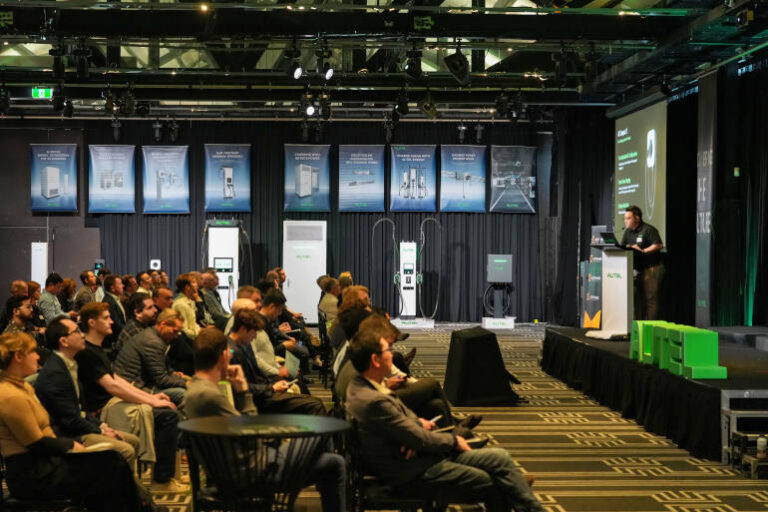
“For fleet the most important thing is to have an end to end solution, tailor made for the operation requirements,” said He during an exclusive interview with Fleet EV News at the Autel EV Charging Innovation Seminar 2026 in Sydney.
“Every fleet, the operation pattern is different.”
That approach reflects the growing maturity of the Australian EV charging market, where fleet operators are increasingly looking beyond the charger itself and focusing on uptime, energy management and long-term operational efficiency.

Every fleet needs a different solution
One of the biggest mistakes organisations can make is assuming there is a standard formula for fleet charging.
Rather than selecting a charger based on power output alone, He believes fleet operators need to understand how vehicles are actually used throughout the day before making infrastructure decisions.
“We work with partners like JET Charge to design the solution for them based on their operation pattern and the charging time, which is just enough to fulfil the daily operation while having the least capital investment and future proof,” he explained.
“It’s really like you need a solution, so it’s not like one formula you can pick for every customer.”
For Fleet Managers, that means understanding daily kilometres travelled, dwell times, shift patterns, site power availability and future fleet growth before investing in charging infrastructure.
Charging is becoming an operational system
The days of viewing an EV charger as little more than a power outlet are rapidly disappearing.
Modern charging projects increasingly incorporate battery energy storage, load balancing, energy management software and intelligent charging controls that work together to reduce costs and maximise asset utilisation.
He said the right combination depends entirely on the customer’s operating environment.
“Some sites may have insufficient power supply. In this scenario we bundle with battery energy storage to balance the load and reduce the electricity bill,” he said.
Different fleets have different priorities. Some want to minimise electricity costs, while others simply cannot afford charging downtime because vehicles need to be available around the clock.
Reliability is becoming a competitive advantage
For high-utilisation fleets, charger reliability is now just as important as charging speed.
He explained that Autel’s latest charging platforms are designed with redundancy built into the hardware so that operations can continue even if a component fails.
“Some fleet customers are very operation intense. They want to have minimised downtime and make sure our infrastructure has almost zero downtime,” he said.
“That’s why we design products like the liquid-cooled chargers to make sure we have a one-to-one backup even inside of the hardware. In case a certain portion of hardware fails, there is still a backup to make sure the infrastructure is still up and running and doesn’t impact the operation.”
This focus on resilience mirrors global trends where charger availability is becoming a key performance measure for public and private charging networks.
Local requirements are driving innovation
Australia’s unique operating environment is also influencing charger design.
Parking space constraints and busy commercial sites have driven demand for smaller DC chargers that can be installed with minimal impact on vehicle access.
“When we first entered the Australian market five years ago, customers were already saying they wanted chargers as slim as possible,” said He.
“They said, ‘I don’t care how you can achieve this, make it as slim as possible. So, in Autel, we continuously push the boundaries of engineering.'”
The result is a new generation of compact charging equipment designed specifically to maximise parking space while improving return on investment for site owners.
A fleet management challenge, not a charging challenge
For organisations planning an EV transition, the message is clear: charging infrastructure should be treated as an operational planning exercise rather than a hardware procurement exercise.
Understanding vehicle utilisation, energy demand, future fleet growth and business continuity requirements will have a greater impact on project success than simply selecting the charger with the highest power rating.
As fleets become increasingly electrified, charging infrastructure is evolving into an integrated operational system that combines hardware, software, energy management and intelligent design to support business outcomes.
For Fleet Managers, the question is no longer “Which charger should we buy?” but “How should our charging ecosystem support the way our fleet actually operates?”