

When most people talk about fleet electrification, the conversation usually starts with corporate sustainability targets, government policy, or vehicle technology.
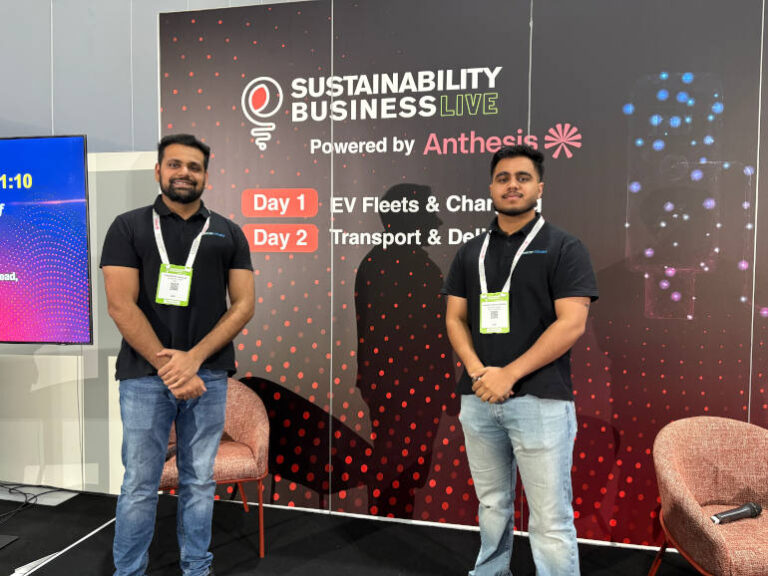
Talking to Fleet News Group at Sustainability Business Live, Jaskirat Singh Ghuman and Lakshay Ahuja, Co-Founders of Country Fleet, explained how they started on the warehouse floor.
Just over two years ago, the pair were working for IKEA, managing deliveries, speaking with drivers, loading trucks, and solving the day-to-day challenges of logistics. Today, they operate a growing transport business with more than 40 vehicles across four states, including almost 30 electric trucks and vans servicing major retailers such as IKEA, JB Hi-Fi, Winnings and Appliances Online.
Their story is a reminder that some of the most innovative businesses in transport aren’t being built in boardrooms—they’re being built by people who understand the job from the ground up.
Spotting an Opportunity
Country Fleet was launched in February 2024 with just two electric vehicles and a simple belief that electric trucks could work in last-mile delivery.
“We started Country Fleet back in 2024, month of February, towards end of February, with two electric vehicles,” said Lakshay Ahuja.
“As of today we have got a fleet of 31 vehicles working in WA, New South Wales, SA, and Victoria. We do IKEA, Winnings, JB Hi-Fi and other retailers as well. We have got about 26 or 27 electric vehicles now, plus another 15 or 16 diesel.”
The idea had been brewing long before the business was launched.
“When we both were working over there, we always used to think, how about someday we have trucks,” said Ahuja.
His business partner had already made up his mind.
“He was very passionate about it, that I want to get those trucks.”
For Jaskirat Singh Ghuman, the opportunity wasn’t simply about owning trucks—it was about recognising that a new technology was creating space for new operators.
“We were in transport. We were working in a warehouse for IKEA. We were pushing the loads out, managing the fleet, taking phone calls of the drivers,” said Ghuman.
“I was driving as well, and doing the warehouse management as well. So with the hands-on experience, and with this new technology coming, we saw an opportunity, and we grabbed it.”
Building an EV Business Before the Market Was Ready
Rather than buying diesel trucks like most new transport operators, Country Fleet took a different approach.
The founders believed electric vehicles would eventually become a key part of last-mile delivery and decided to build their business around that vision.
“We had diesel once. We took the opportunity, we pitched EV instead of diesel, and we started with two,” said Ghuman. “It was very good. With driving EV vehicles and seeing customers every day, they were so surprised that we are driving an EV truck.”
The reaction from customers reinforced their belief they were on the right track.
“It was very new for the customers as well. It was exciting for them.”
That willingness to move early helped Country Fleet become one of the first operators to introduce electric delivery trucks into Western Australia.
Leading the EV Charge in Western Australia
While many operators were still questioning whether electric trucks could work in metropolitan delivery operations, Country Fleet was proving they could.
“We bought two Fotons for IKEA WA, and those Fotons were first electric vehicles for the whole state that worked in WA,” said Ghuman.
“No other client, no other retailer had EVs. IKEA was the first one to get one of them, and we were the first ones to buy those EVs and make it work.”
The company didn’t just deploy the vehicles—they redesigned routes and charging arrangements to maximise utilisation.
“There was a route which was doing over 250 kilometres to 300 kilometres, so we got that route to be done on EV instead of a diesel,” said Ahuja.
Ghuman said the initiative came from Country Fleet rather than the customer.
“Nothing that company forced us or IKEA told us to do. It was our initiative. We made the plan, we supported the charging spots, we made everything that can be covered in a daily fatigue hours, 12 hours of a day.”
The result has been a dramatic increase in electric vehicle utilisation within IKEA’s Perth delivery network.
“Now IKEA is doing 100% EV there,” said Ahuja. “It’s almost 90% in WA,” added Ghuman. “Except when they get busy, everything is covered with EVs now.”
Success Starts With Drivers
Perhaps the most interesting lesson from Country Fleet’s growth is that the founders don’t see trucks or charging technology as the biggest challenge.
They believe success depends on making EVs work for drivers. Having both spent years in operational roles, they understand the frustrations drivers face when charging infrastructure is poorly planned.
“We have started from the ground and we know everything,” said Ghuman. “If you have to work EV, as in for Country Fleet, you have to make it sustainable. It should work for driver number one.”
The company discovered that some drivers were spending more than an hour every day waiting to charge vehicles before they could even begin their deliveries.
Rather than accepting that as part of the transition, they set out to solve it.
“It needs to work for the driver,” Ghuman said. “Driver is happy, he’ll drive and he’ll deliver the stuff. Then it will work for the financials.”
The philosophy is simple – It has to go not top to bottom, but bottom to top.
The Next Stage of Growth
Country Fleet is now preparing to open its own dedicated charging hub in Melbourne, providing overnight charging and parking facilities for electric delivery vehicles.
The facility has been designed around the practical realities faced by drivers and owner-operators, with dedicated charging bays and subscription-based access.
The founders believe solving charging challenges will be the next major step in accelerating fleet electrification.
“We need to make it easy for drivers so that they say yes, that I am okay to drive an EV,” said Ghuman. “There shouldn’t be resistance.”
His solution is straightforward.
“Kill the resistance and build an infrastructure so that it’s easier for the drivers.”
For two founders who started by loading trucks and answering driver phone calls in a warehouse, it’s a philosophy that has already taken Country Fleet from two electric vehicles to one of Australia’s fastest-growing electric delivery fleets.
And if their growth over the past two years is any indication, they’re only getting started.